

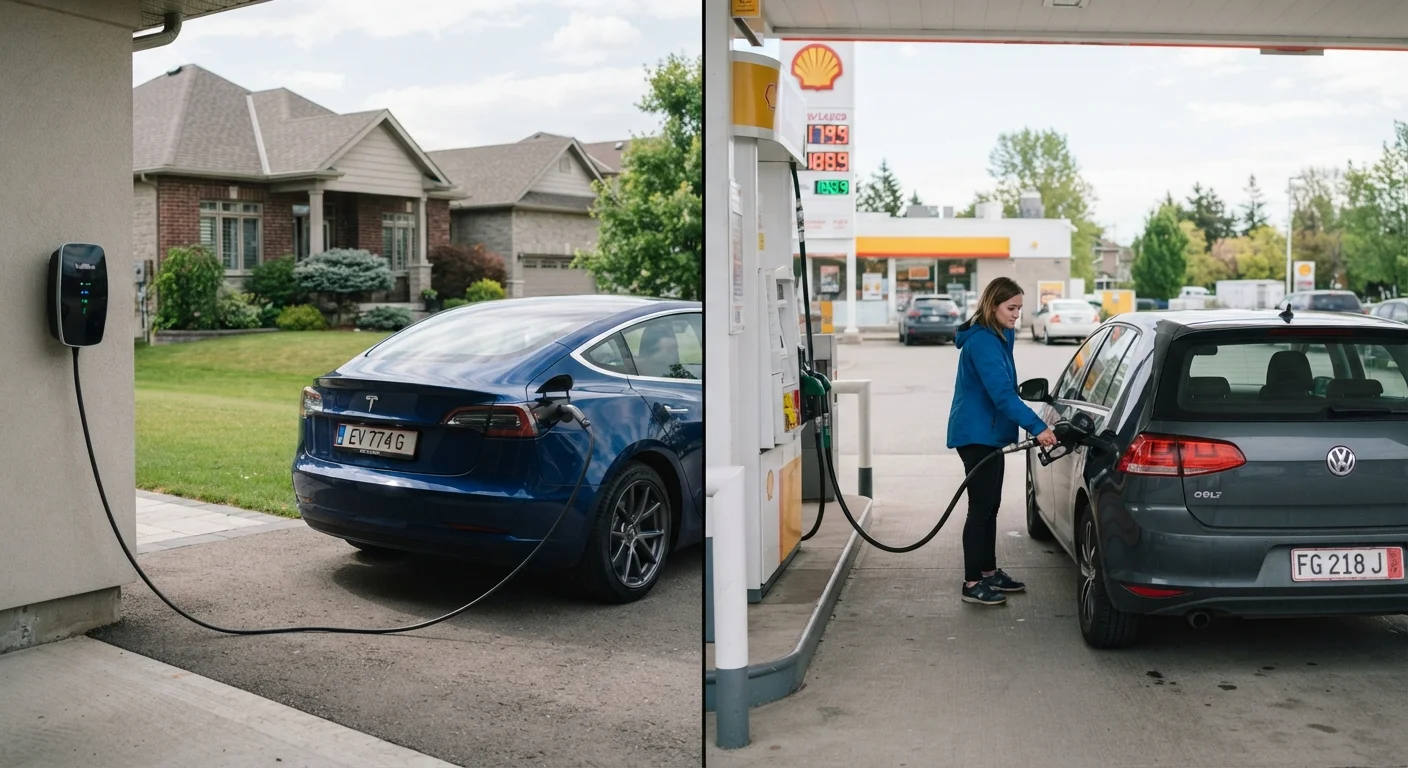
Key Takeaways
Our Verdict
Electric vehicles can deliver meaningful savings over time for drivers who rack up high mileage, have access to home charging, and are comfortable with the upfront cost. Petrol vehicles remain the more practical and financially predictable choice for those with irregular driving habits, limited charging access, or frequent long-distance travel. There is no single correct answer - understanding your own usage patterns is the most important first step.
| Best for | Recommended |
|---|---|
| High-mileage commuters with home charging access | Electric Vehicle |
| Drivers who frequently travel long distances or in rural areas | Petrol Vehicle |
| Those prioritizing lower day-to-day running costs | Electric Vehicle |
| Buyers wanting lower upfront cost and simpler resale | Petrol Vehicle |
The Real Cost of Fueling Up
Fuel cost is usually the first number people reach for in this comparison, and it does tell an important story. Electricity is generally cheaper per mile than gasoline across most of the US, though exact savings depend on local utility rates and how much you drive.
Home charging overnight - particularly on a time-of-use electricity plan - tends to offer the lowest cost per mile. Public fast-charging, however, can narrow or sometimes eliminate that advantage, especially on road trips where DC fast chargers are priced at a premium.
Petrol prices fluctuate, and that unpredictability is a genuine planning challenge. EV running costs are more stable, though electricity rates are not immune to increases either. For a broader look at how fuel fits into the full picture of what you spend annually, see our annual car ownership cost reference guide.
~$700
Estimated annual fuel savings for EV vs petrol
The US Department of Energy has estimated that EV drivers can save several hundred dollars annually on fuel compared to petrol vehicle owners, depending on local electricity and gas prices.
40%
Fewer scheduled maintenance visits for EVs
Studies by the US Department of Energy suggest electric vehicles require roughly 40% fewer scheduled maintenance visits than internal combustion engine vehicles over their lifetime.
Servicing and Maintenance Over Time
This is where electric vehicles have a structural advantage that is easy to underestimate. EVs have significantly fewer moving parts than internal combustion engine (ICE) vehicles - no oil changes, no timing belts, no spark plugs, and simpler transmission systems. Routine maintenance schedules are shorter and less frequent as a result.
Petrol vehicles carry ongoing servicing requirements: oil and filter changes, coolant flushes, air filter replacements, and more. These costs are predictable for experienced owners, but they add up. Our piece on common car servicing assumptions that cost money covers how easily these expenses can be underestimated.
That said, EV brake systems often last longer due to regenerative braking, but tires may wear faster because of the added vehicle weight. And if a high-voltage battery does eventually need replacement, that's a substantial cost - one worth factoring into long-term ownership calculations.
Check Your Home Charging Options First
Before factoring EV savings into your plans, confirm whether your home can support a Level 2 charger (240V outlet). Installation costs vary but are typically a one-time expense that pays off quickly in charging convenience and speed. Renters or those without dedicated parking should research public charging availability in their area before committing.
Depreciation: A More Complex Picture
Depreciation is typically the single largest cost of car ownership, yet it receives far less attention than fuel or insurance. For a detailed breakdown of how this works, our guide on depreciation and the car you drive is worth reading.
Historically, many EVs depreciated faster than comparable petrol models, partly due to rapidly evolving technology making older models feel outdated quickly. That pattern has been shifting as the EV market matures, but it is still a live variable - particularly for models where battery range or software capabilities have improved significantly in newer versions.
Petrol vehicle depreciation is more established and therefore more predictable to model. If you plan to sell within three to five years, this relative certainty can be financially meaningful.
| Electric Vehicle | Petrol Vehicle | |
|---|---|---|
| Upfront purchase cost | Generally higher | Generally lower |
| Fuel / energy cost per mile | Lower (home charging) | Higher, but predictable |
| Routine servicing needs | Minimal - no oil changes | Regular intervals required |
| Depreciation predictability | Variable, market still maturing | More established and predictable |
| Refueling speed | 20-45 min (fast charge) | 3-5 minutes |
| Infrastructure coverage | Growing, uneven in rural areas | Widely available nationwide |
| Long-term battery risk | Replacement cost significant | No equivalent concern |
Day-to-Day Practicality and Range
For most daily commuters, EV range is not a practical barrier - most modern electric vehicles offer 200-300+ miles per charge, far exceeding average daily driving distances. The challenge is not range itself, but charging infrastructure and time.
Filling a petrol tank takes three to five minutes. Even fast-charging an EV to 80% typically takes 20-45 minutes, and that time adds up on longer trips. Public charging networks have expanded considerably, but coverage remains uneven - particularly in rural areas and along less-traveled highway corridors.
Home charging resolves much of this friction for owners with a garage or dedicated parking. Those without that option may find the convenience calculus tilts toward petrol. If your household is weighing whether one or two vehicles makes sense, our guide to owning one car vs two explores how powertrain choice intersects with household logistics.
This article provides general information for educational purposes. Costs, depreciation rates, and infrastructure availability vary by location, vehicle model, and individual usage. Consult a qualified financial adviser for decisions specific to your circumstances.