

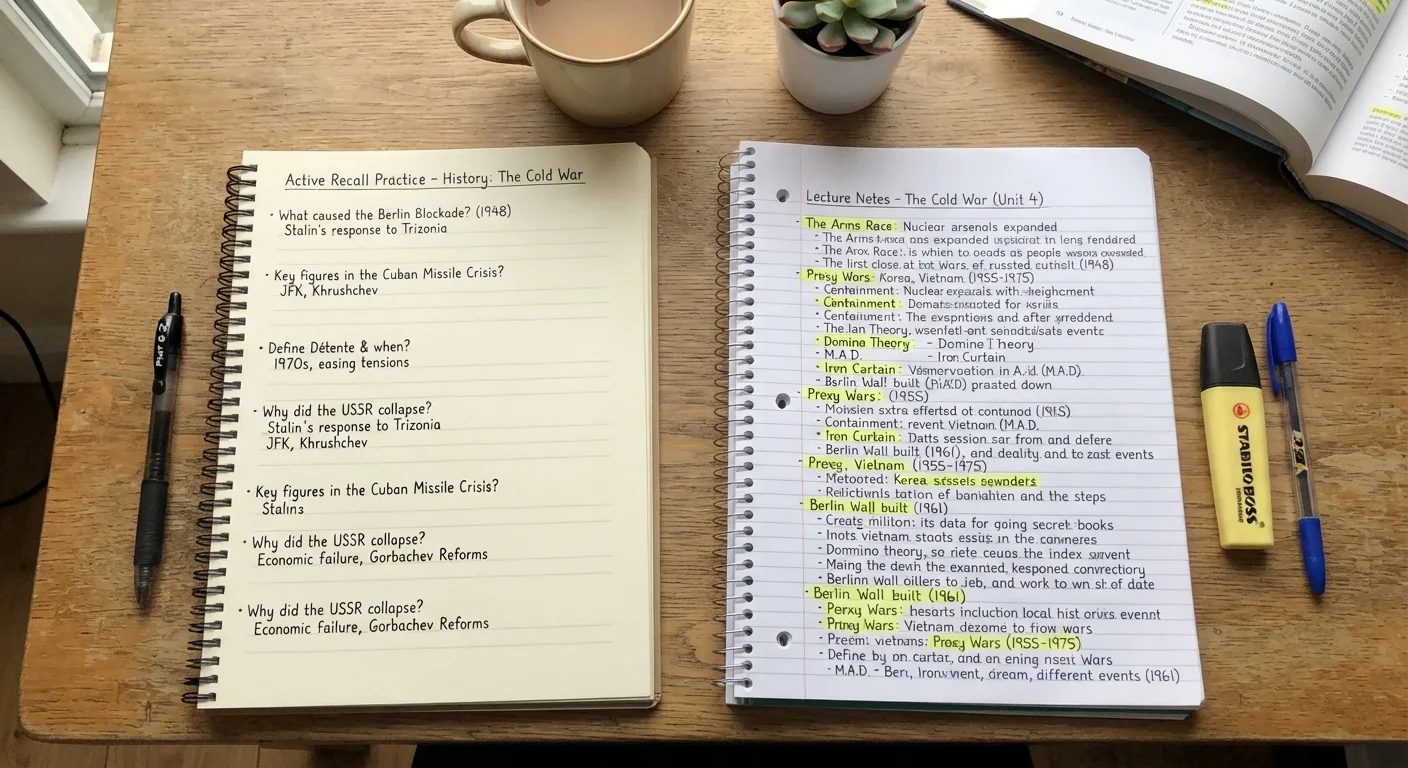
Key Takeaways
Option A
Active Recall
The effortful, retrieval-based approach to learning.
Best for: Learners who want to build durable, long-term memory through self-testing and retrieval practice.
Option B
Passive Review
The familiar, low-effort method of re-reading and reviewing.
Best for: Getting a quick overview of unfamiliar material or orienting yourself before deeper study.
If you want to retain information for an exam or real-world application
Active Recall
Self-testing consistently outperforms re-reading in long-term retention studies. It builds the retrieval pathways your brain needs to access information under pressure.
If you are encountering a topic for the very first time
Passive Review
Passive reading or listening provides the initial schema you need before active practice becomes meaningful. It works best as a starting point, not a finish line.
If your study time is limited and you need maximum efficiency
Active Recall
Research suggests shorter active recall sessions produce better outcomes than longer passive ones, making it the stronger choice when time is a constraint.
If you are reviewing just before a short presentation or meeting
Passive Review
A quick re-read can prime recently learned material for immediate use, though this effect fades faster than retrieval-based review.
What Each Approach Actually Involves
Understanding the difference between these two study methods starts with a simple distinction: active recall asks your brain to produce information, while passive review asks it only to recognize or re-absorb it.
With active recall, you close your notes and attempt to retrieve what you have learned — through flashcards, practice questions, free-recall writing, or self-quizzing. The effort of retrieval is the point. With passive review, you re-read notes, highlight text, re-watch lecture recordings, or skim summaries. Exposure to the material feels engaging, but your brain is doing comparatively little heavy lifting.
For a deeper look at the cognitive mechanics underlying these processes, see how memory works and how it affects retention.
| Criterion | Active Recall | Passive Review |
|---|---|---|
| Core mechanism | Retrieval from memory | Re-exposure to material |
| Cognitive effort | High — deliberately effortful | Low — feels easy and comfortable |
| Long-term retention | Consistently stronger | Weaker without follow-up testing |
| Risk of fluency illusion | Low — gaps become visible | High — familiarity mimics mastery |
| Best stage of study | Consolidation and practice | Initial exposure and orientation |
| Common formats | Flashcards, self-quizzing, free recall | Re-reading, highlighting, rewatching |
| Time efficiency | High — shorter sessions, better results | Lower — longer sessions, faster forgetting |
What the Research Says About Retention
The evidence here is unusually consistent. Studies across cognitive psychology — including landmark work by researchers such as Roediger and Karpicke — have repeatedly demonstrated that testing yourself on material produces significantly better long-term retention than re-reading the same material an equivalent number of times. This is often called the testing effect or retrieval practice effect.
One reason for this advantage is that retrieving a memory actually strengthens the neural pathways associated with it. Each successful retrieval makes future retrieval faster and more reliable. Passive review, by contrast, strengthens recognition — your ability to identify correct information when you see it — but does less to build independent recall.
~50%
More material retained with retrieval practice
Research published in Science (Karpicke & Roediger, 2008) found that students who practiced retrieval recalled roughly 50% more material one week later than those who restudied.
~70%
Average forgetting within 24 hours without review
The 'forgetting curve' concept, associated with Hermann Ebbinghaus's 19th-century memory research, suggests a large proportion of new information is lost within a day without active reinforcement.
3 in 4
Students who overestimate passive study effectiveness
Surveys of undergraduate students consistently find that re-reading and highlighting are among the most commonly used but least effective study strategies, despite students rating them highly.
Passive review also carries a well-documented risk: the fluency illusion. When material feels familiar after re-reading, learners often mistake that sense of ease for genuine mastery. Research suggests this overconfidence can lead to under-studying and poorer test performance. Why you remember so little after reading explores this phenomenon in detail.
How to Put Active Recall Into Practice
Active recall does not require special tools. Some practical methods include:
- Flashcards (physical or digital): Cover the answer and attempt to recall it before flipping.
- Free recall: After reading a section, close the book and write down everything you can remember without prompting.
- Practice questions: Work through past papers, problem sets, or end-of-chapter questions before reviewing answers.
- The Feynman technique: Explain a concept in plain language as if teaching it to someone unfamiliar with the topic — gaps in your explanation reveal gaps in your understanding.
Active recall becomes even more powerful when paired with spaced repetition — revisiting material at increasing intervals over time. The science of spaced repetition explains why timing your review sessions matters as much as the method itself.
Active Recall Works for All Ages
Retrieval practice benefits learners across age groups — from primary school children to adults in professional development. The method does not require advanced prior knowledge; even simple self-quizzing on basic material produces measurable retention gains. The key is generating the answer independently before checking, regardless of subject matter or complexity level.
For study habits that carry these principles across different subjects, strategies that transfer across subjects offers a broader framework.