

Key Takeaways
Spaced Repetition
Spaced repetition is a learning technique in which you review material at gradually increasing intervals over time rather than all at once. Instead of cramming everything into one session, you revisit information just as you're about to forget it — which strengthens the memory trace each time. The result is more durable, long-term retention with less total study time.
Spaced repetition is grounded in the 'spacing effect,' first documented by psychologist Hermann Ebbinghaus in the 1880s, and supported by decades of subsequent cognitive science research on memory consolidation and the forgetting curve.
Why the Forgetting Curve Changes Everything
In the 1880s, German psychologist Hermann Ebbinghaus ran meticulous experiments on his own memory, learning nonsense syllables and tracking how quickly he forgot them. What emerged was the forgetting curve: a steep decline in retention that drops sharply within the first 24 hours after learning and flattens gradually over time. Left unreviewed, most new information fades rapidly.
The counterintuitive insight Ebbinghaus also discovered: each time you successfully retrieve a memory before it disappears, the subsequent forgetting curve flattens. Your brain treats the effort of retrieval as a signal that the information is worth keeping. Spacing your reviews so they occur just before forgetting is complete exploits this mechanism deliberately.
This is why timing outperforms total hours logged. Two students who each spend three hours on new material can have dramatically different long-term retention — depending entirely on how those hours are distributed across days and weeks.
Cramming Isn't Worthless — Just Short-Lived
Massed practice (cramming) can produce solid performance on a test the next day. The limitation is durability: without spaced follow-up, most of that material fades within days or weeks. If your goal is passing a single exam and never needing the information again, cramming can work. If you need knowledge that lasts — for a career, a cumulative course, or a language — spaced repetition is the better investment.
What Happens in the Brain During Spaced Practice
Memory consolidation — the process by which short-term memories become stable, long-term ones — occurs largely during rest and sleep, not during the study session itself. When you space your reviews, you allow consolidation cycles to complete between sessions. Each new review then acts on a memory that has already been partially stabilized, reinforcing the neural pathways more effectively than back-to-back repetition would.
Cognitive scientists describe this as desirable difficulty: the slight struggle to retrieve information that feels just beyond reach produces deeper encoding than effortless re-reading. This is closely related to why retrieval practice — testing yourself rather than passively re-reading — pairs so powerfully with spaced repetition. The two strategies share an underlying mechanism: both require your brain to actively reconstruct knowledge.
~50%
Information forgotten within one hour without review
Ebbinghaus's original forgetting curve research, widely replicated in subsequent memory studies, suggests roughly half of new material is lost within an hour if not reinforced.
~200%
Improvement in long-term retention with spaced vs. massed practice
A meta-analysis by Cepeda and colleagues (2006) found spaced practice consistently produced substantially better long-term retention compared to equivalent massed practice across hundreds of studies.
10–30%
Reduction in study time needed to reach equivalent retention
Research summarized in Dunlosky et al. (2013) in Psychological Science in the Public Interest suggests distributed practice can achieve equivalent or superior retention with meaningfully less total study time.
Putting Spaced Repetition Into Practice
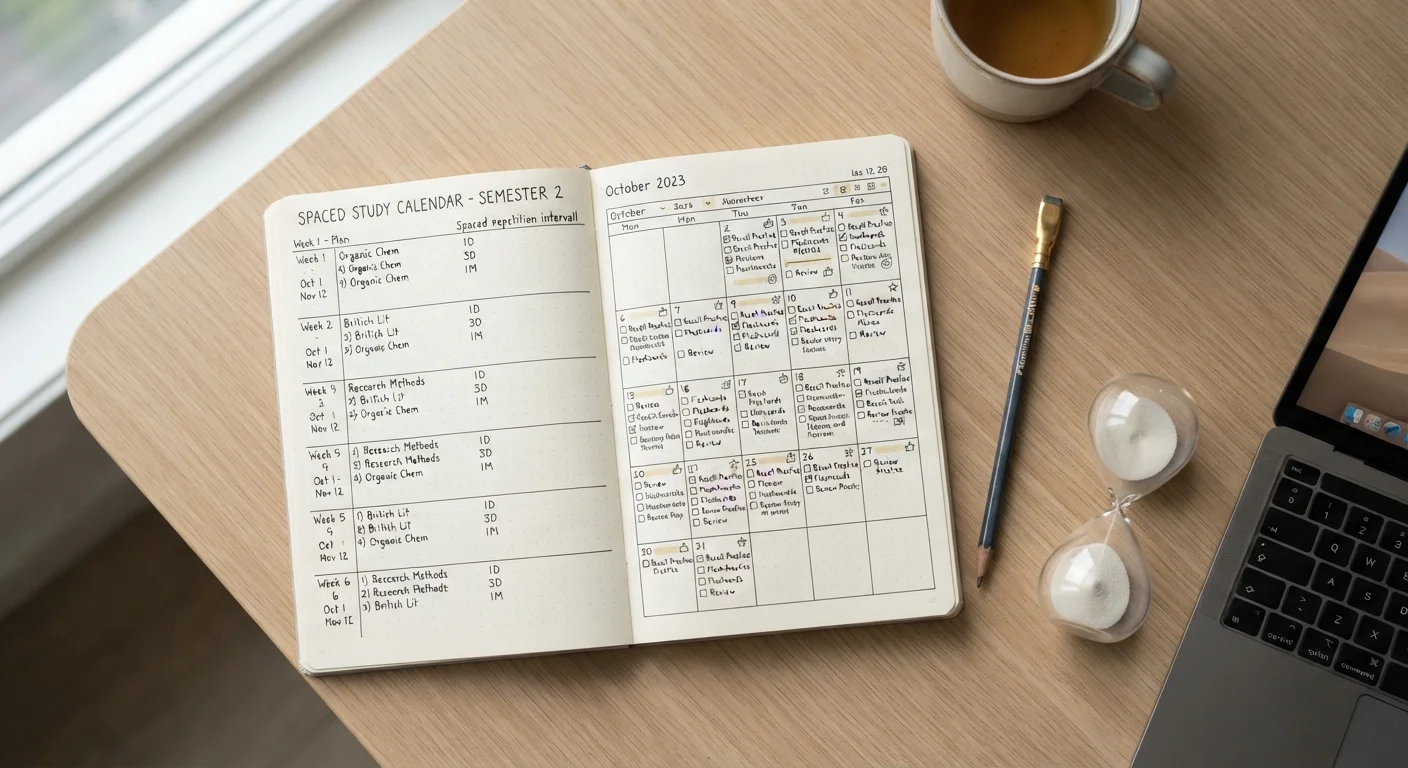
The core rule is straightforward: after first learning something, review it after a short delay. Succeed, and extend the next interval. Struggle, and shorten it. Over time, well-known material moves to very long intervals (weeks or months), while difficult material stays on short cycles.
A simple paper approach works as follows:
- Write each concept or fact on an index card.
- After initial study, review the card the next day.
- If recalled correctly, push the next review to three days out. If not, return it to tomorrow's pile.
- Continue doubling (approximately) successful intervals: 1 day → 3 days → 1 week → 2 weeks → 1 month.
Digital tools automate this calculation using algorithms — but the underlying principle is identical. What matters is the habit, not the format. For guidance on building the scheduling habit into daily life, see building a study routine that actually sticks.
Start Small to Build the Habit
Begin with just 10–15 cards or concepts in your spaced repetition system. A small, manageable daily review — even five minutes — is far more effective than an ambitious system you abandon after a week. Consistency across weeks matters more than the volume of any single session.
Common Misconceptions and How to Avoid Them
The most frequent mistake is treating spaced repetition as a tool for passive re-reading at intervals. Simply glancing at notes on a schedule provides little benefit. The review must involve active retrieval — covering the answer, attempting to recall it, then checking. This connects directly to the difference between active recall and passive review.
A second misconception is that spaced repetition eliminates the need to understand material. Memorizing without comprehension creates brittle knowledge that doesn't transfer to new problems. Build understanding first; use spaced repetition to consolidate what you've genuinely grasped.
Finally, many learners abandon the system because early sessions feel unproductive — they're reviewing things that seem obvious. This is the system working correctly. Those cards are being moved to longer intervals, freeing up future time for genuinely difficult material. Trusting the spacing is part of the method.