

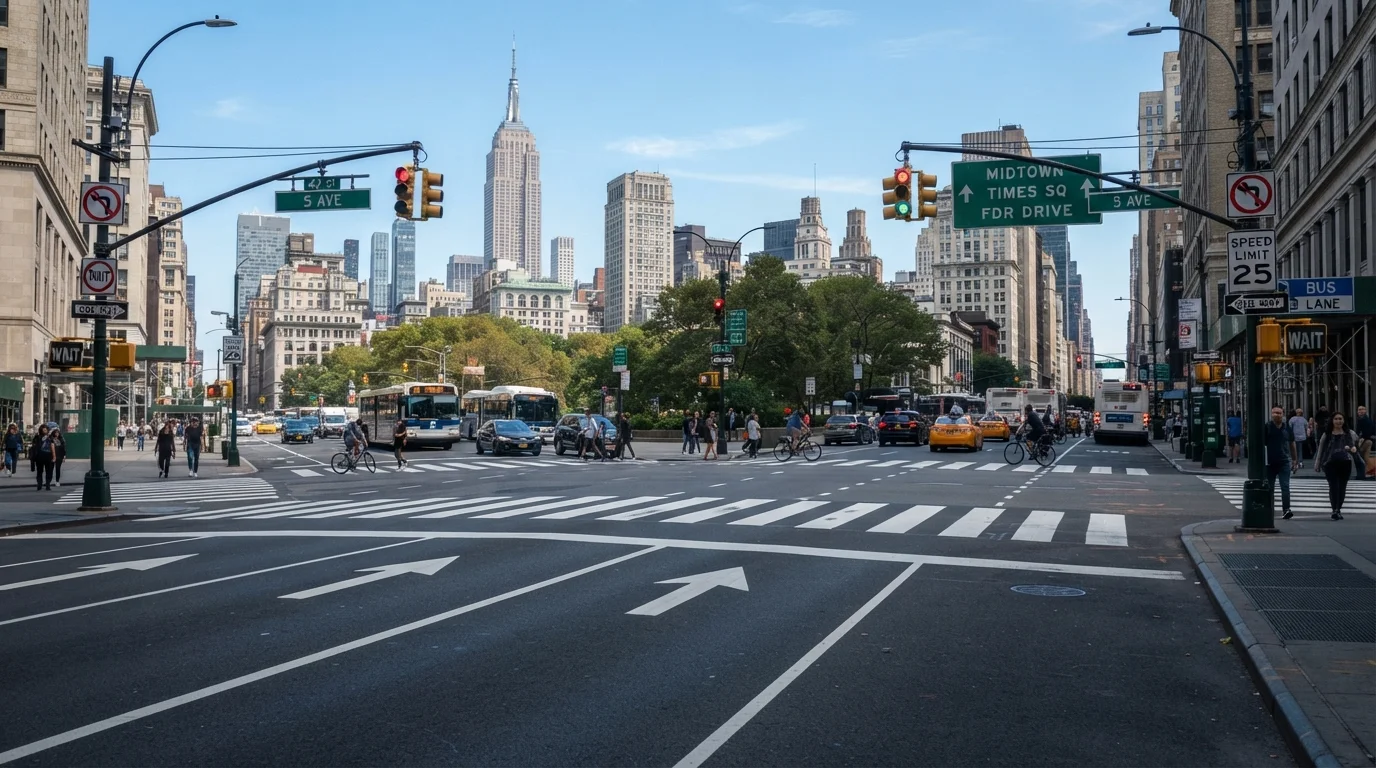
| Total U.S. sign categories | 3 main types: Regulatory, Warning, and Guide (Federal Highway Administration (FHWA) MUTCD) |
| Standard stop sign shape | Octagon (Manual on Uniform Traffic Control Devices (MUTCD)) |
| Yellow line purpose | Separates traffic moving in opposite directions (MUTCD Chapter 3B) |
| Right on red rule | Permitted in most U.S. states after a full stop, unless posted otherwise (State traffic codes; verify locally) |
| Orange signs meaning | Temporary - construction, maintenance, or survey zones (FHWA MUTCD Part 6) |
| Blue highway signs indicate | Motorist services: gas, food, lodging, medical (FHWA sign color standards) |
Road Signs: What Shape and Color Tell You
In the United States, road sign design follows a standardized system where shape and color communicate meaning before you've read a single word - useful when you're moving at speed.
| Total U.S. sign categories | 3 main types: Regulatory, Warning, and Guide (Federal Highway Administration (FHWA) MUTCD) |
| Standard stop sign shape | Octagon (Manual on Uniform Traffic Control Devices (MUTCD)) |
| Yellow line purpose | Separates traffic moving in opposite directions (MUTCD Chapter 3B) |
| Right on red rule | Permitted in most U.S. states after a full stop, unless posted otherwise (State traffic codes; verify locally) |
| Orange signs meaning | Temporary - construction, maintenance, or survey zones (FHWA MUTCD Part 6) |
| Blue highway signs indicate | Motorist services: gas, food, lodging, medical (FHWA sign color standards) |
Sign Shapes at a Glance
- Octagon (red): Stop - complete stop required.
- Triangle pointing down (red/white): Yield - give way to crossing traffic.
- Diamond (yellow or orange): Warning - hazard, change in road conditions, or construction ahead.
- Rectangle (white, vertical): Regulatory - speed limits, turn restrictions, lane rules.
- Rectangle (green, horizontal): Guide - route markers, distances, destinations.
- Pentagon (yellow-green): School zone warning.
- Circle (yellow): Advance warning of a railroad crossing.
Sign Colors Decoded
- Red: Prohibition or danger (stop, do not enter, wrong way).
- Yellow: General warning.
- Orange: Temporary warning - construction or maintenance zones.
- White: Regulatory information.
- Green: Guidance and directional information.
- Blue: Motorist services (fuel, food, lodging, hospitals).
- Brown: Recreational areas and cultural attractions.
Knowing the color-shape system means you can react correctly even when weather or distance makes reading text difficult. For tips on how road features build on this knowledge, see our guide on navigating complex road features.
Lane Markings: Reading the Road Surface
Pavement markings regulate traffic flow, separate lanes, and warn of hazards. Yellow lines separate opposing traffic; white lines separate traffic moving in the same direction.
Regulatory sign
A sign that conveys traffic laws or regulations drivers must obey, such as speed limits, turn restrictions, or lane-use rules. Failure to comply can result in a traffic violation.
Warning sign
A sign that alerts drivers to upcoming hazards, changes in road conditions, or the need to reduce speed. Typically diamond-shaped and yellow.
Center line
A painted line running along the center of a roadway to separate opposing lanes of traffic. May be solid or dashed yellow, each with different passing rules.
Protected turn
A turn made during a dedicated green arrow signal phase, during which oncoming traffic is held by a red light. Drivers in a protected turn have the right of way.
HOV lane
High-Occupancy Vehicle lane - a restricted lane available only to vehicles with a minimum number of occupants, sometimes also open to electric vehicles. Marked with diamond symbols on pavement.
MUTCD
The Manual on Uniform Traffic Control Devices, published by the Federal Highway Administration. It sets the national standards for road signs, markings, and signals across all U.S. jurisdictions.
Common Marking Types
- Solid yellow center line
- No passing permitted on the side with the solid line. If both lines are solid, passing is prohibited in both directions.
- Dashed yellow center line
- Passing allowed when safe and legal. Check for a solid line on the opposing side - if present, only the side with the dashed line may pass.
- Solid white edge line
- Marks the right edge of the travel lane. Crossing it means you're moving onto a shoulder or out of the roadway.
- Dashed white lane lines
- Separate lanes of same-direction traffic. Crossing with care is permitted when safe.
- Double solid white lines
- Lane changes prohibited - often used near toll plazas or designated HOV lanes.
- Crosswalk markings
- White parallel or ladder-style lines across the roadway designating pedestrian priority zones. Stop before the line, not on it.
- Yellow diagonal hatching
- Do not enter or stop in this area - typically used in turn lanes or protected intersections.
If you're driving in another country, markings and their legal meanings can differ significantly. Review our road safety guide for travelers before driving abroad.
Traffic Signals: Beyond Red, Yellow, and Green
Standard three-color signals are familiar to most drivers, but intersections increasingly feature supplemental signals that modify or replace the basic sequence.
~50%
Of fatal crashes occur at or near intersections
According to the Federal Highway Administration, roughly half of all traffic fatalities and injuries involve intersections, underscoring the importance of signal compliance.
4 sec
Typical all-red clearance interval duration
Many traffic engineers program a brief all-red phase between signal changes to help clear the intersection before cross traffic is released.
900+
Standard sign designs in U.S. MUTCD
The Manual on Uniform Traffic Control Devices catalogs over 900 standardized sign designs used across the United States.
Standard Signal Meanings
- Solid red: Stop before the stop line. Remain stopped until the signal changes. Right on red is permitted in most U.S. states unless a sign prohibits it - come to a complete stop first.
- Solid yellow: Prepare to stop. The light is about to turn red. Do not speed up to beat it.
- Solid green: Proceed if the intersection is clear. A green signal does not guarantee it's safe - always scan before entering.
Supplemental Signals
- Green arrow: Protected turn - oncoming traffic is stopped. Proceed in the arrow's direction only.
- Yellow arrow: The protected turn phase is ending. Prepare to stop or yield.
- Flashing red: Treat as a stop sign - come to a full stop, then proceed when safe.
- Flashing yellow: Proceed with caution; slow down and yield as needed.
- Flashing yellow arrow: You may turn in that direction but must yield to oncoming traffic and pedestrians - unprotected turn.
Flashing Yellow Arrow: A Newer Signal Type
The flashing yellow arrow is a relatively recent addition to U.S. intersections, intended to replace the older permissive green ball signal for left turns. It means you may turn left but must yield to oncoming traffic and pedestrians - it is not a protected phase. Some drivers confuse it with a protected green arrow, so pay close attention to whether the arrow is solid or flashing.
Adverse weather can make signals harder to see and stopping distances longer. Our companion article on driving in wet, icy, and foggy conditions covers how to adjust your approach at intersections when conditions deteriorate.