

Key Takeaways
Option A
Solid Hardwood Flooring
The time-tested, refinishable classic.
Best for: Dry, stable living spaces where long-term durability and the ability to sand and refinish are priorities.
Option B
Engineered Wood Flooring
The versatile, moisture-resistant modern option.
Best for: Rooms with fluctuating humidity or temperature, including basements, kitchens, and over radiant heat systems.
If you want a floor that lasts generations and can be refinished repeatedly
Solid Hardwood Flooring
Solid hardwood's full-thickness construction allows multiple sanding and refinishing cycles, making it a strong long-term investment in stable, above-grade rooms.
If you're installing flooring in a basement, kitchen, or over radiant heat
Engineered Wood Flooring
Engineered wood's cross-ply core resists the expansion and contraction caused by moisture and temperature changes, making it far more stable in these environments.
If you're working with a tighter budget but still want a real wood appearance
Engineered Wood Flooring
Engineered wood generally costs less per square foot than solid hardwood and can be floated rather than nailed, potentially reducing installation labor costs.
If you're renovating a historic home and want to match existing floors
Solid Hardwood Flooring
Solid hardwood is available in wider planks, period-appropriate species, and can be sanded flush with existing floors, making it easier to blend with original wood.
What Sets These Two Floors Apart at the Core
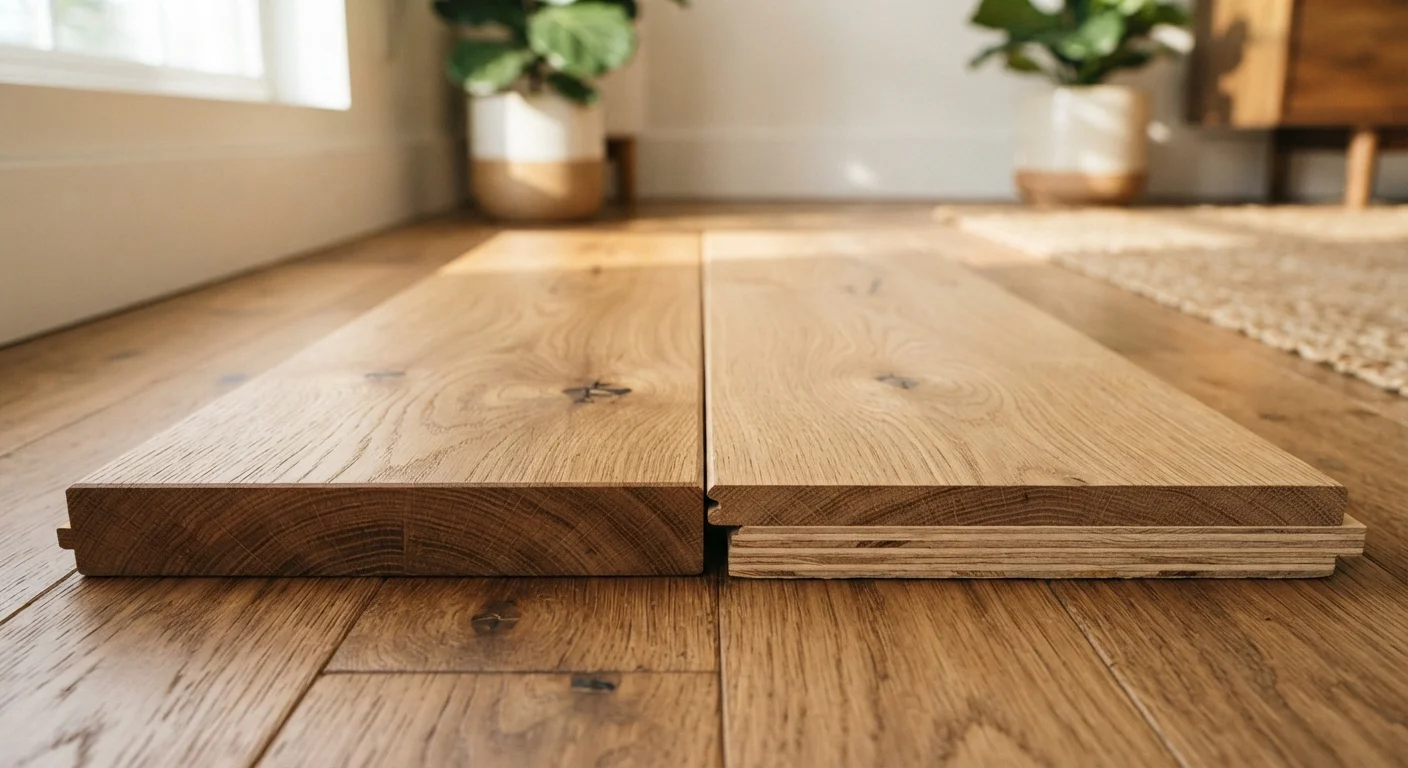
The most important difference between solid hardwood and engineered wood flooring isn't visible once either is installed — it's structural. Solid hardwood is cut from a single piece of timber, giving each plank uniform wood composition from top to bottom. Thicknesses typically run from ¾ inch, and the plank's depth is what allows repeated sanding over its lifetime.
Engineered wood flooring, by contrast, is a layered product. A real wood veneer — often 2 to 6 millimeters thick — sits on top of multiple plies of plywood or a high-density fiberboard (HDF) core. This cross-ply construction is engineered specifically to counteract wood's natural tendency to expand and contract with changes in moisture and temperature.
Neither construction is inherently inferior. The layered core of engineered wood is not a shortcut — it's a deliberate engineering solution to a real performance problem that solid hardwood struggles with in certain environments.
How Each Type Handles Moisture and Temperature
Wood is a hygroscopic material, meaning it absorbs and releases moisture from the surrounding air. In solid hardwood, this movement is uniform throughout the plank — causing noticeable expansion in humid summers and contraction in dry winters. In rooms with significant humidity swings, this can lead to cupping, gapping, or squeaking over time.
Engineered wood's cross-ply core fights this movement at the structural level. The alternating grain directions in each layer resist the natural expansion and contraction forces, keeping the floor significantly more dimensionally stable. This is why engineered wood is generally considered appropriate for below-grade installations (basements), kitchens, and rooms with radiant floor heating — environments where solid hardwood typically is not recommended.
Always Test for Moisture Before Installing
For any flooring installation in rooms with existing moisture concerns — such as a basement with a history of dampness — address the root moisture problem before installing either flooring type. No wood-based floor is designed to handle active water intrusion. Use a calibrated moisture meter on both the subfloor and the wood flooring material before beginning installation, and follow the flooring manufacturer's accepted moisture thresholds.
For any flooring installation in rooms with existing moisture concerns — such as a basement with a history of dampness — address the root moisture problem before installing either flooring type. No wood-based floor is designed to handle active water intrusion.
Refinishing, Lifespan, and Long-Term Value
One of solid hardwood's most practical advantages is refinishability. A ¾-inch solid plank can typically be sanded and refinished anywhere from five to eight times over its lifespan, allowing homeowners to refresh worn surfaces or change stain colors decades later. With proper care, solid hardwood floors can last 80 to 100 years.
Engineered wood's refinishing potential depends entirely on the thickness of its top veneer layer. Thinner veneers (2–3 mm) may allow only one light sanding; thicker veneers (5–6 mm) can handle two or three refinishes. Budget-tier engineered products sometimes cannot be refinished at all without risking damage to the core.
| Criterion | Solid Hardwood | Engineered Wood |
|---|---|---|
| Construction | Single piece of solid timber | Wood veneer over plywood/HDF core |
| Typical thickness | ¾ inch standard | ⅜ to ¾ inch (varies by product) |
| Moisture resistance | Low — expands and contracts | Higher — stable cross-ply core |
| Suitable for basements | Generally not recommended | Yes, with proper moisture control |
| Works over radiant heat | Rarely recommended | Yes, for most engineered products |
| Refinishing potential | 5–8 times over its life | 1–3 times depending on veneer |
| Installation methods | Nail or staple only | Nail, glue, staple, or float |
| Estimated lifespan | 80–100 years with care | 25–50 years (varies by quality) |
When evaluating long-term value, consider how long you plan to stay in your home and whether the room's conditions favor one product over the other. A premium engineered floor in a basement will outperform solid hardwood in that same location regardless of upfront cost.
Installation Differences and Subfloor Compatibility
Solid hardwood is typically nailed or stapled to a wood subfloor and is not recommended for direct installation over concrete slabs or below grade. It requires a dry, structurally sound subfloor and usually needs to acclimate to the room's conditions for several days before installation.
Engineered wood offers more installation flexibility. It can be glued, nailed, stapled, or — in many cases — floated over a variety of subfloor types, including concrete. This makes it a practical choice for slab-on-grade construction common in many US homes, particularly in the South and Southwest.
Both types require proper subfloor preparation. Uneven subfloors cause problems with either material, and moisture testing of the subfloor is an important step before any wood flooring installation. For complex subfloor situations or large installations, consulting a licensed flooring professional is advisable. If you're comparing flooring options for outdoor areas, see our outdoor patio flooring comparison for surface choices suited to exterior conditions.
¾"
Standard solid hardwood plank thickness
This full-depth solid wood construction is what enables multiple sanding cycles over a floor's lifetime.
2–6 mm
Typical engineered wood veneer thickness range
Veneer thickness is the primary factor determining how many times an engineered floor can be refinished.
25–50 yrs
Estimated engineered wood lifespan
Lifespan varies considerably based on veneer thickness, core quality, and how well the floor is maintained.