

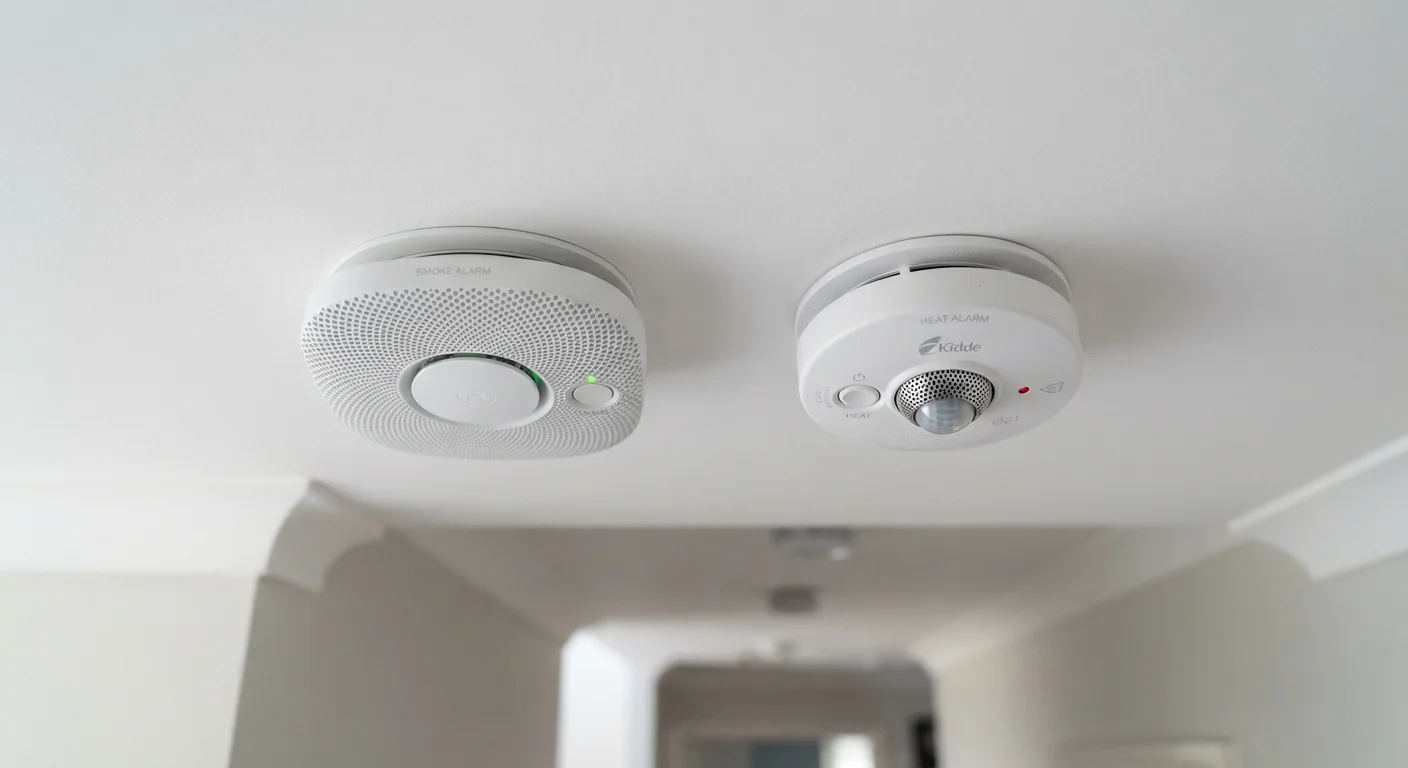
Key Takeaways
Option A
Smoke Alarm
The standard, life-saving early warning device.
Best for: Living areas, hallways, and bedrooms where detecting combustion particles early is the priority.
Option B
Heat Alarm
The reliable alternative for high-dust, high-steam environments.
Best for: Kitchens, garages, and attics where smoke alarms frequently trigger false alerts.
If you want whole-home fire protection in living spaces
Smoke Alarm
Smoke alarms detect the early stages of a fire well before flames develop, giving occupants maximum time to escape from bedrooms, hallways, and living rooms.
If you need an alarm in your kitchen or garage
Heat Alarm
Cooking fumes and vehicle exhaust routinely trigger smoke alarms falsely in these spaces. A heat alarm responds only to significant temperature rise, eliminating nuisance trips.
If you want the most comprehensive home coverage
Both types, interconnected
A combination of smoke alarms in living areas and heat alarms in high-risk utility spaces, all interconnected, provides the broadest and most reliable early-warning coverage.
How Each Alarm Works
Understanding what triggers each device is the foundation for placing them correctly in your home.
Smoke alarms come in two main sensor types. Ionization alarms contain a tiny amount of radioactive material that ionizes the air inside a sensing chamber; smoke particles disrupt the electrical current and trigger the alarm. They tend to respond faster to fast-flaming fires. Photoelectric alarms use a light beam inside the chamber; smoke scatters the light onto a sensor, triggering the alert. These respond more quickly to slow, smoldering fires. Some combination models use both technologies.
Heat alarms do not detect smoke at all. They monitor air temperature and activate when the room reaches a fixed threshold—commonly around 135°F (57°C)—or when temperature rises unusually fast (called a rate-of-rise alarm). Because they ignore particles and only respond to heat, they are immune to steam, cooking vapors, and dust.
| Criterion | Smoke Alarm | Heat Alarm |
|---|---|---|
| Detection method | Airborne combustion particles | Air temperature rise |
| Best locations | Bedrooms, hallways, living rooms | Kitchen, garage, attic |
| False alarm risk from cooking | High | Very low |
| Early fire warning speed | Fast — detects smoke before flames | Slower — waits for heat buildup |
| Typical replacement interval | Every 10 years | Every 10 years |
| Suits dusty environments | No — prone to false alarms | Yes — unaffected by dust |
| Can be interconnected | Yes | Yes |
Where Each Alarm Belongs in Your Home
Placing the right alarm in each location is just as important as having alarms at all. The wrong device in the wrong room creates two equally dangerous problems: missed real fires and ignored false alarms.
Rooms that need smoke alarms
- Every bedroom and sleeping area — most fire deaths occur at night when occupants are asleep
- Hallways outside bedrooms — a critical escape-route warning point
- Living rooms and family rooms — common locations for electrical fires and smoldering upholstery
- Basements — especially near finished living areas or home offices
Rooms that work better with heat alarms
- Kitchen — cooking vapors and steam cause chronic false alarms with smoke detectors
- Attached garage — vehicle exhaust and dust make smoke alarms impractical
- Attic — dust accumulation makes smoke alarms unreliable
- Utility rooms with boilers or furnaces — combustion byproducts can trigger nuisance alerts
A note on bathrooms: most codes do not require alarms inside bathrooms, and steam makes smoke alarms unreliable there. Check your local building code for specific requirements, and consult a licensed electrician or fire safety professional if you are unsure about placement in your home.
Check Your Local Fire Code
Alarm placement requirements vary by state, county, and municipality. Some jurisdictions specify the number of alarms required per floor, exact placement distances from walls, and whether interconnection is mandatory. Before installing or replacing alarms, check with your local fire marshal's office or building department. Licensed electricians and fire safety inspectors can also advise on code-compliant installation.
The Hidden Danger of False Alarms
A nuisance alarm is more than an annoyance — it is a safety hazard. Research on fire alarm behavior consistently shows that people who experience frequent false alarms are more likely to disable their detectors or ignore them when a real fire occurs. Removing the battery or covering an alarm to stop a false alert eliminates protection entirely.
Installing a heat alarm in the kitchen rather than wrestling with a smoke alarm that goes off every time you cook is not a compromise — it is the correct technical choice. The heat alarm will still provide meaningful warning if a real kitchen fire produces enough heat to reach its threshold.
3 in 5
Home fire deaths with missing or disabled alarms
According to the U.S. Fire Administration, roughly three in five home fire deaths occur in properties with no working smoke alarms.
~50%
False alarms caused by cooking
The National Fire Protection Association (NFPA) estimates that cooking is the leading cause of unintentional smoke alarm activations in homes.
If your smoke alarm is going off regularly without a real fire, do not disable it. Instead, evaluate whether the device is in the right location, whether it needs cleaning, or whether a heat alarm would be more appropriate for that space.
Maintenance, Interconnection, and Replacement
Even the best alarm offers no protection if it has dead batteries or has outlived its sensor lifespan. Follow these general maintenance practices:
- Test monthly — press the test button on every alarm and confirm it sounds
- Replace batteries annually (or use 10-year sealed-battery models where available)
- Clean gently — use a vacuum brush attachment to remove dust from vents twice a year
- Replace the unit — most smoke and heat alarms should be replaced every 10 years from the manufacture date printed on the back; check your specific model's documentation
Interconnected systems are strongly recommended. When alarms are interconnected — either by hardwiring or by wireless radio frequency — triggering one alarm sounds all of them throughout the home. This is particularly valuable in larger homes or when occupants are sleeping. Many jurisdictions now require interconnection in new construction; check with your local fire marshal or building department to understand what applies to your home.
If you are installing hardwired alarms, always hire a licensed electrician. This type of work typically requires permits and inspections in most jurisdictions.