

Key Takeaways
Our Verdict
MOOCs are a powerful, low-cost tool for acquiring specific skills or exploring a new field with minimal commitment. Community college online programmes deliver recognized academic credentials, structured learning, and a defined pathway toward degrees or career advancement. Most adult learners benefit from understanding both before committing to either.
| Best for | Recommended |
|---|---|
| Professionals seeking targeted, job-ready skills quickly | MOOCs |
| Learners pursuing transferable academic credit or an Associate degree | Community College Online Programmes |
| Those exploring a subject before making a financial commitment | MOOCs |
| Adult learners who need financial aid eligibility and institutional support | Community College Online Programmes |
What Each Format Actually Offers
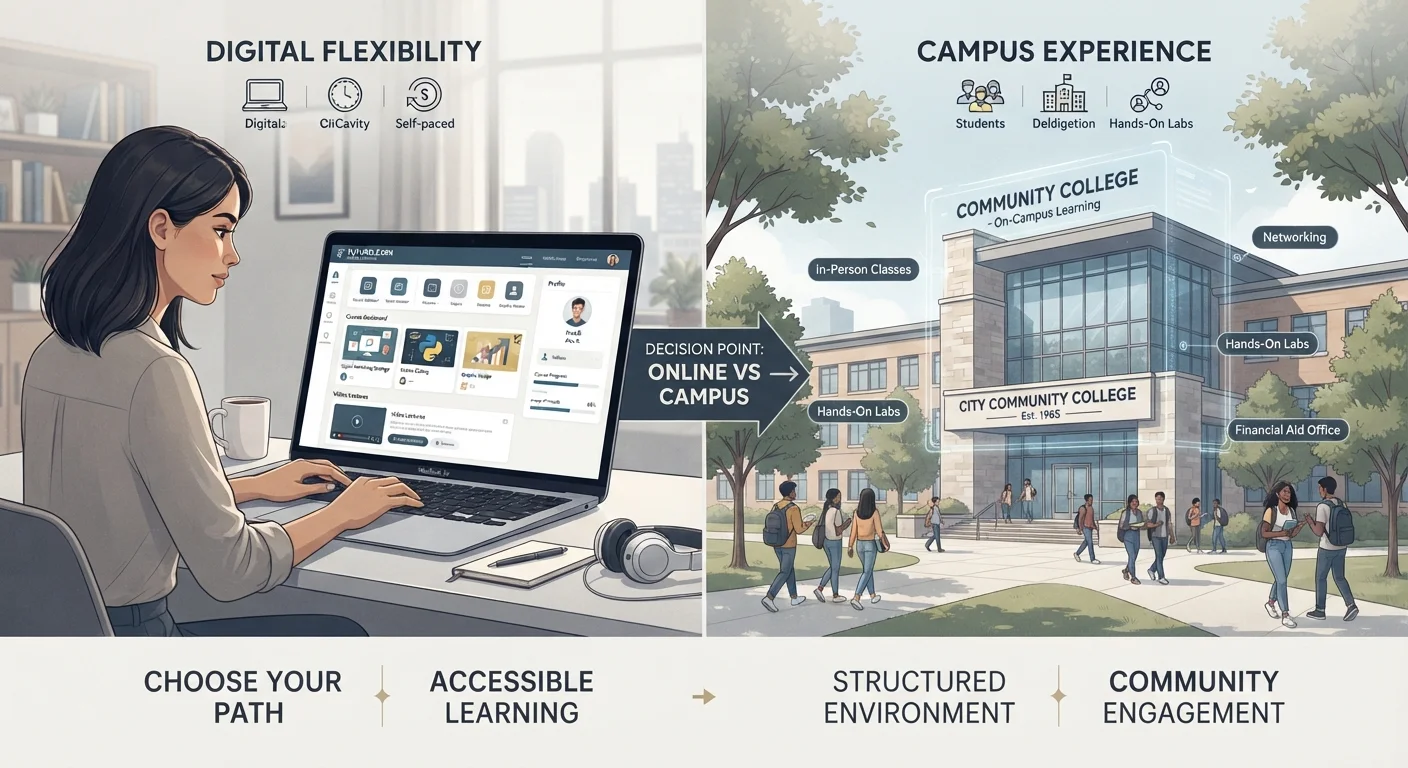
MOOCs — Massive Open Online Courses — are typically offered by universities or ed-tech platforms and made available to anyone with an internet connection, often at no cost or for a modest certificate fee. They cover an enormous range of subjects, from data analysis to philosophy, and are designed for self-directed learners who can set their own pace.
Community college online programmes, by contrast, are courses and credential pathways offered by regionally accredited two-year institutions. They follow semester calendars, require enrollment, and charge tuition — though community colleges remain among the more affordable higher-education options in the United States. Credits earned are generally eligible for financial aid and may transfer toward a bachelor's degree.
Understanding what each format is built for helps you match it to your actual goal. For a broader look at how qualifications differ, see Certificates, Diplomas, and Degrees: Sorting Out Online Qualifications.
| MOOCs | Community College Online | |
|---|---|---|
| Accreditation | Platform-based; not regionally accredited | Regionally accredited institution |
| Cost | Free to low-cost; paid certificates optional | Per-credit tuition; financial aid eligible |
| Academic credit | Rarely transferable | Generally transferable to 4-year colleges |
| Schedule | Self-paced; no fixed deadlines | Semester-based; structured deadlines |
| Instructor access | Limited; often forum-based | Direct instructor support available |
| Completion rates | Typically low due to minimal structure | Higher, supported by accountability |
| Credential recognition | Varies by employer and industry | Broadly recognized by employers and institutions |
Accreditation and the Weight of a Credential
Accreditation is the most consequential difference between these two paths. Community colleges hold regional accreditation — the same standard applied to four-year universities — which means their credits and credentials are broadly recognized by employers and other institutions. A certificate or Associate degree from an accredited community college carries institutional weight that most MOOC certificates do not.
MOOC certificates signal completion and demonstrate initiative, but few are accepted as academic credit by other institutions without a formal credit-recognition agreement. Some employers in technology and creative fields value them as evidence of applied skills, but their standing varies considerably by industry and employer.
Not All Online Credentials Are Equal
A certificate from a MOOC platform and a credential from a regionally accredited institution carry very different weight in academic and professional contexts. Before investing time in any programme, confirm how the credential is regarded by the employers or institutions that matter to your goals. Do not assume that 'online' or 'university-affiliated' automatically means transferable or widely recognized.
Before assuming any credential — MOOC or otherwise — will be recognized, verify directly with employers or institutions you intend to approach. Our guide on recognising fraudulent online credentials can help you distinguish legitimate programmes from those that are not.
Cost, Flexibility, and the Reality of Completion
MOOCs frequently offer free access to course materials, with optional paid certificates. This makes them genuinely low-risk for exploration. Community college courses carry per-credit tuition, though federal financial aid, including Pell Grants, may offset costs for eligible students — an option unavailable through MOOC platforms.
Flexibility cuts both ways. MOOCs allow you to learn on your own schedule with no fixed deadlines, which suits busy adults but also correlates with low completion rates — research consistently shows that fewer than half of MOOC enrollees finish a course. Community college programmes impose deadlines and structure, which many adult learners find supportive rather than restrictive.
Use MOOCs to Test Before You Invest
If you are unsure whether a subject is right for you, a free MOOC in that area lets you explore the material with no financial risk. Once you confirm genuine interest or professional need, you can move into a structured, accredited programme with much greater confidence. This approach saves both time and money in the long run.
If you choose the MOOC route, having a structured approach matters enormously. Getting the Most from Self-Paced Online Courses offers practical strategies for staying on track without an external schedule.
Making the Right Call for Your Situation
The most useful question is not which format is better in general, but which one serves your specific goal. If you want to build a skill for immediate use at work, or you are testing your interest in a field before investing more significantly, a MOOC is a sensible starting point. If you need a recognized credential, plan to transfer credits, or require financial aid, a community college programme is the more practical path.
Some learners use both strategically: MOOCs to explore, community college to formalize. Whatever you decide, evaluate any programme carefully before enrolling. The Before You Enrol checklist provides a structured way to assess accreditation, costs, and outcomes for any online option. For a fuller picture of what online study involves day-to-day, The Real Trade-Offs of Studying Entirely Online offers a candid assessment worth reading first.