

Key Takeaways
Why the Envelope Method Still Makes Sense Without Cash
The original envelope system is straightforward: withdraw your paycheck in cash, stuff labeled envelopes for each spending category, and stop spending when an envelope is empty. It worked because the physical constraint was undeniable — an empty envelope is impossible to argue with.
Most households today rarely carry cash. Card transactions, digital wallets, and automatic bill pay have made physical envelopes impractical. But the logic behind the method is just as powerful as ever. The envelope system forces you to allocate money intentionally at the start of the month rather than looking backward at the damage after the fact. That shift in timing — planning before spending rather than reviewing after — is what makes it effective.
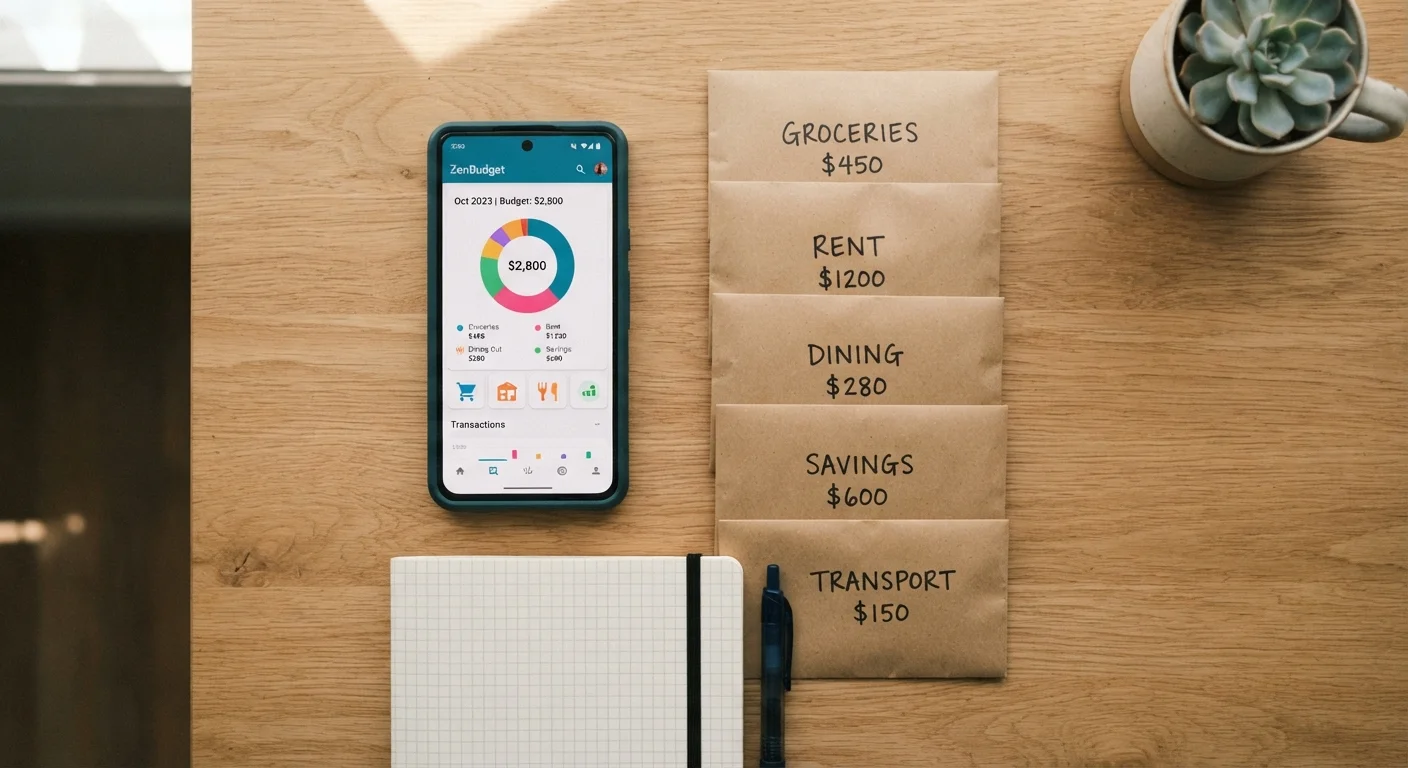
Digital envelope budgeting replaces paper and cash with category-based spending limits tracked in an app or spreadsheet. The friction of a hard-stop envelope is recreated through visibility: when you can see exactly how much remains in your "dining out" category in real time, overspending becomes a deliberate choice, not an accident. For a broader look at how this fits into your overall financial picture, see our complete guide to personal budgeting.
This Is Education, Not Personal Financial Advice
This article explains general budgeting concepts for informational purposes only. It is not personalized financial, tax, or legal advice. For decisions specific to your situation, consult a qualified financial professional.
What You'll Need Before You Start
Getting set up doesn't require special software or financial expertise. What it does require is accurate information about your income and spending, and a tracking tool you'll actually use consistently.
What you will need
Budgeting app with envelope or category features
Provides the digital container structure that replaces physical cash envelopes.
Spreadsheet (e.g., Google Sheets or Excel)
A free alternative for manually tracking envelope balances by category.
One to three months of recent bank and credit card statements
Used to calculate realistic spending amounts for each envelope category.
Dedicated debit card (optional)
Some people assign a single debit card to discretionary envelopes to add friction to overspending.
How to Build Your Digital Envelope Budget
The steps below walk you through setting up a functioning digital envelope system from scratch. Plan to spend 30–45 minutes on the initial setup; ongoing maintenance typically takes five to ten minutes per day and a longer monthly check-in.
Start With Fewer Categories Than You Think You Need
New envelope budgeters often over-segment — creating 20+ categories that become exhausting to track. Start with five to eight broad envelopes and split them only if you repeatedly find a category too vague to manage. Simplicity is what keeps most people consistent month after month.
Calculate your actual monthly take-home income
Add up every reliable after-tax income source arriving this month: wages, freelance payments, side income, or benefits. Use your net figure — what actually lands in your bank account — not your gross salary. If your income varies month to month, use a conservative average based on your three lowest recent months.
List every spending category you genuinely use
Pull up two or three months of bank and credit card statements. Group your transactions into categories: housing, utilities, groceries, transportation, dining out, subscriptions, clothing, medical, entertainment, and so on. Don't guess — let your real history tell you where money actually goes. Also flag any irregular expenses most households overlook, such as annual insurance premiums, car registration, and school supplies, which need their own envelope funded monthly in small increments.
Assign a dollar limit to each envelope
For each category, set the maximum you plan to spend this month — not what you wish you spent, but a realistic target you can actually hit. Fixed costs (rent, loan payments, insurance) get their exact amounts. Variable categories like groceries or dining out should be grounded in your actual statement averages, then nudged toward a goal. The total of all envelopes must not exceed your take-home income from Step 1. This zero-sum constraint is the heart of the system — every dollar gets a job before it's spent. For more context on how this compares to other frameworks, see zero-based budgeting vs. the 50/30/20 rule.
Set up your digital envelopes
Choose your tracking method: a budgeting app that supports category-based spending limits, or a simple spreadsheet with one column per envelope. For each category, create a named bucket and enter the dollar limit you assigned in Step 3. If you use a debit card for variable spending, some people find it helpful to designate one card exclusively for discretionary envelopes — this adds a natural pause before spending. For a comparison of tracking tools, see manual ledgers, spreadsheets, and apps compared.
Log every transaction as it happens
Each time you spend, record the amount against the right envelope immediately — or at least daily. This is the discipline that separates envelope budgeting from passive expense tracking. When a category's balance hits zero, you have two choices: stop spending in that category for the rest of the month, or consciously move money from another envelope to cover it. That trade-off decision is exactly what the method is designed to surface.
Review and reset at the end of each month
Before the new month starts, sit down with your envelope balances. Note which categories you consistently underspend or overspend, then adjust the limits accordingly. Leftover balances can roll into savings, be applied to debt, or carry forward into next month's envelope at your discretion. This monthly reset is what separates a one-time setup from a habit that keeps a budget working long-term.
Don't Let Your Emergency Fund Become an Envelope
Keep your emergency fund in a separate savings account — not as a digital envelope inside your spending budget. Mixing the two makes it too easy to raid long-term reserves for short-term overspending. Treat them as entirely distinct buckets.
This article is for general informational and educational purposes only and does not constitute personalized financial, tax, or legal advice. Consult a qualified financial professional for guidance specific to your situation.