

Key Takeaways
Expert feedback corrects errors in real time
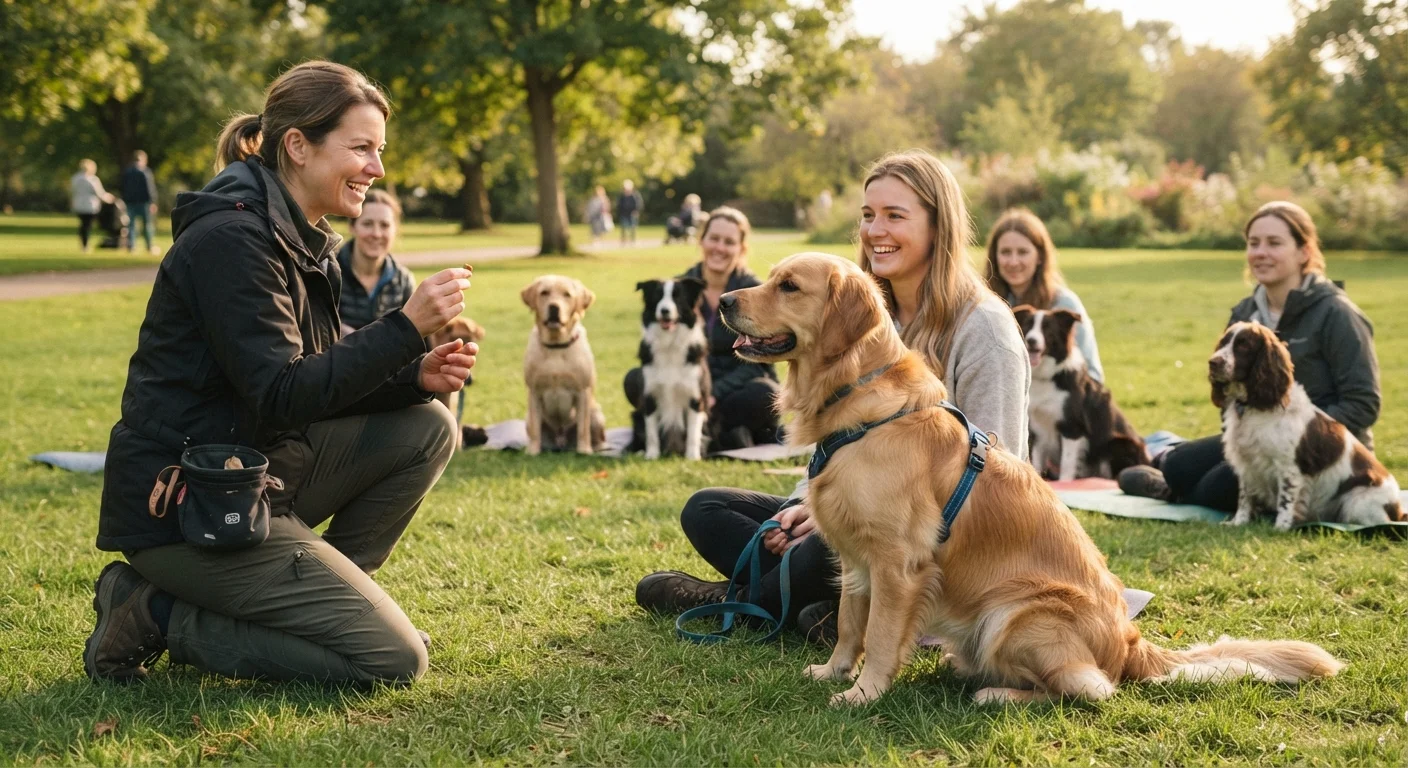
A certified trainer can identify and fix small handling mistakes — like inconsistent timing when rewarding — before they become ingrained habits that undermine progress.
Structured socialization with dogs and people
Controlled exposure to unfamiliar dogs and humans builds confidence and reduces reactivity, benefits that are hard to engineer consistently at home.
Accountability keeps training on schedule
Scheduled class times create a commitment that motivates owners to practice regularly, reducing the drift that often stalls home-only programs.
Access to specialized knowledge for complex issues
Trainers certified through organizations such as the Certification Council for Professional Dog Trainers (CCPDT) are trained to assess and address behavioral problems that go beyond basic commands.
Home environment is familiar and low-stress
Anxious or fearful dogs often learn more readily when trained in a space they already associate with safety, reducing the cognitive load that a new location adds.
Training integrates naturally into daily life
Practicing sit, stay, and loose-leash walking during everyday moments — meals, walks, arrivals — reinforces skills far more frequently than a weekly class session can.
Flexible scheduling suits busy households
Short, frequent sessions of five to ten minutes can be slotted into existing routines without the time and travel commitment of attending a class.
Cost can be significantly lower
Group class fees and private sessions add up quickly; a solid at-home program using reputable books, video guides, or a single consultation can achieve comparable results for motivated owners.
Our Verdict
Neither professional classes nor at-home training is universally superior — both can produce well-behaved, confident pets when applied thoughtfully. Professional instruction provides accountability, expert feedback, and vital socialization, while home training offers flexibility and a stress-free environment for sensitive animals. For most owners, a blended approach — starting with a class and reinforcing skills at home — delivers the strongest long-term results.
Professional classes are best for first-time owners or dogs that need socialization; at-home training suits busy schedules, anxious pets, or owners reinforcing already-learned skills.
Why the Training Setting Matters More Than You Might Think
Where and how you train your dog shapes not just what they learn, but how reliably they apply it in real life. A pet that sits perfectly in the kitchen may ignore the same command at the dog park — a phenomenon trainers call the generalization gap. Understanding this helps explain why the choice between a professional class and at-home training is more than a matter of convenience.
Both formats rest on the same behavioral science. Positive reinforcement methods, which reward desired behaviors rather than punishing unwanted ones, are supported by a strong body of animal behavior research and form the foundation of most reputable training programs — whether delivered by a certified instructor or an owner working independently at home.
What differs is the environment, the feedback loop, and how well each suits your dog's temperament and your own lifestyle.
The Case for Professional Training Classes
Group classes and one-on-one sessions with a certified trainer bring advantages that are difficult to replicate at home.
Expert feedback corrects errors in real time
A certified trainer can identify and fix small handling mistakes — like inconsistent timing when rewarding — before they become ingrained habits that undermine progress.
Structured socialization with dogs and people
Controlled exposure to unfamiliar dogs and humans builds confidence and reduces reactivity, benefits that are hard to engineer consistently at home.
Accountability keeps training on schedule
Scheduled class times create a commitment that motivates owners to practice regularly, reducing the drift that often stalls home-only programs.
Access to specialized knowledge for complex issues
Trainers certified through organizations such as the Certification Council for Professional Dog Trainers (CCPDT) are trained to assess and address behavioral problems that go beyond basic commands.
Socialization is perhaps the most underappreciated benefit. Dogs that train around other animals and people in a controlled setting develop the confidence and impulse control needed to behave well in the real world. This matters especially for puppies during the critical developmental window, typically between 3 and 14 weeks of age, when positive exposures have the greatest impact.
Professional trainers are also equipped to spot subtle miscommunications between owner and pet — a timing error when delivering a treat, an inconsistent hand signal — that owners rarely notice themselves. For complex behavioral concerns such as leash reactivity or resource guarding, working with a certified professional is strongly advisable. Responsible pet care includes recognizing when a problem exceeds a DIY approach.
The Case for At-Home Training
Home training has genuine strengths that make it the right fit for many dogs and owners.
Home environment is familiar and low-stress
Anxious or fearful dogs often learn more readily when trained in a space they already associate with safety, reducing the cognitive load that a new location adds.
Training integrates naturally into daily life
Practicing sit, stay, and loose-leash walking during everyday moments — meals, walks, arrivals — reinforces skills far more frequently than a weekly class session can.
Flexible scheduling suits busy households
Short, frequent sessions of five to ten minutes can be slotted into existing routines without the time and travel commitment of attending a class.
Cost can be significantly lower
Group class fees and private sessions add up quickly; a solid at-home program using reputable books, video guides, or a single consultation can achieve comparable results for motivated owners.
For pets with anxiety or fearfulness, the familiar home environment removes a major stressor, allowing them to focus and learn without being overwhelmed. A dog that shuts down in a noisy class may thrive with calm, one-on-one sessions at the kitchen table.
At-home training also integrates naturally into daily life. Asking your dog to sit before meals, wait at the door, or stay calm during a knock are real-world moments that reinforce habits far more frequently than a once-a-week class can. Building a consistent daily routine is one of the most reliable ways to reinforce training gains and support stable behavior over time.
Online video resources and virtual trainer consultations have also improved dramatically, making it easier than ever to get credible, science-based guidance without leaving home.
When to Involve a Veterinarian First
Before beginning any training program, it is worth ruling out medical causes for behavioral changes. Pain, thyroid imbalances, and neurological conditions can all manifest as aggression, anxiety, or sudden disobedience. If your pet's behavior has changed abruptly, a veterinary checkup is a sensible first step. Your vet can also refer you to a board-certified veterinary behaviorist if a clinical approach is warranted.
How to Choose — or Combine Both
The decision rarely has to be binary. Consider the following factors:
- Your dog's age: Puppies benefit enormously from structured socialization in group classes early on. Adult dogs with existing skills may do well with primarily home-based reinforcement.
- Behavioral concerns: Aggression, severe anxiety, or reactivity toward other dogs or strangers warrants professional evaluation before any training approach is chosen.
- Your experience level: First-time dog owners often gain confidence and avoid common mistakes by starting with at least a basic group class.
- Your schedule: If attending weekly classes is genuinely not sustainable, a quality at-home routine maintained consistently every day will outperform sporadic class attendance.
3–14 weeks
Critical socialization window for puppies
Veterinary behaviorists broadly recognize this early developmental period as the most influential for shaping a dog's long-term confidence and social behavior.
5–10 min
Optimal length for a home training session
Animal behavior researchers recommend keeping sessions short to maintain focus, with multiple brief sessions per day outperforming longer, infrequent ones.
A practical middle path for many families: enroll in a foundational class to learn correct technique and give your dog socialization opportunities, then reinforce and expand those skills through daily home practice. This mirrors how adults often learn best — a structured starting point followed by self-directed application, much like the balance between live and self-paced learning that works for many students.
This article is for general informational purposes only and does not constitute professional veterinary or animal behavior advice. If your pet displays aggression or severe behavioral issues, consult a certified applied animal behaviorist or veterinary behaviorist.