

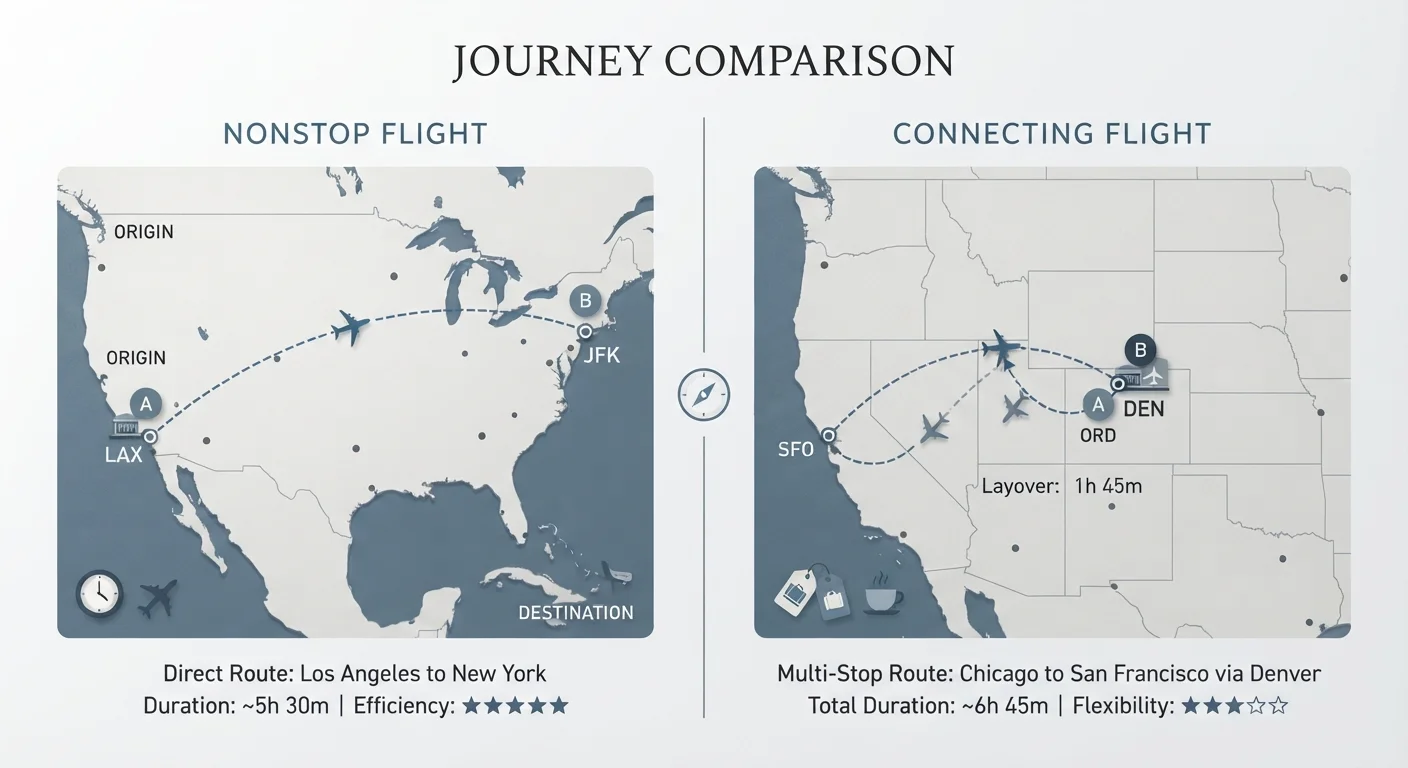
Key Takeaways
Option A
Direct (Nonstop) Flights
The time-efficient, stress-reduced option.
Best for: Travelers prioritizing schedule reliability, minimal transit stress, and preserved time at their destination.
Option B
Connecting Flights
The budget-friendlier, flexibility-demanding alternative.
Best for: Cost-conscious travelers with schedule flexibility, patience for layovers, and routes where nonstop service doesn't exist.
If your time is your most limited resource
Direct (Nonstop) Flights
Nonstop removes every variable a connection introduces. You land, collect bags, and go — no waiting on a second departure or scrambling between gates.
If you're traveling on a tight budget with a flexible schedule
Connecting Flights
The fare gap between connecting and nonstop can be substantial. If you can absorb a few extra hours and a layover, connecting itineraries regularly offer genuine savings.
If you're traveling with young children or elderly companions
Direct (Nonstop) Flights
Connections multiply physical demands — more gates, more waiting, more chances for a missed flight. Nonstop keeps the journey manageable for passengers with lower endurance.
If your destination has limited or no nonstop service
Connecting Flights
For many smaller cities and international destinations, a connection isn't a trade-off — it's the only option. Choosing the right hub and layover duration becomes the key decision.
If you want to explore two destinations for the price of one ticket
Connecting Flights
A deliberate long layover (sometimes called a 'stopover') in a well-located hub can serve as a second destination. Some airlines offer programs that facilitate this at no extra fare cost.
Understanding What You're Actually Comparing
Before weighing costs, it helps to clarify the terminology. A nonstop flight goes from origin to destination without any intermediate stops. A direct flight — despite the name — can include a stop where passengers remain on board but the plane briefly lands. What most travelers mean when they say "direct" is nonstop, and that's the usage this article follows. A connecting flight requires you to deplane, wait in an intermediate airport, and board a second (or third) aircraft.
This distinction matters because the risks and trade-offs are meaningfully different. A nonstop trip has one departure, one arrival, one luggage transfer. A connecting trip multiplies every one of those variables — and with them, the potential for things to go wrong.
See our breakdown of common flight booking myths to make sure your assumptions about airfare savings are grounded in fact before you start comparing fares.
The Real Price Difference — and Its Hidden Costs
Connecting flights are often cheaper in headline fare, and for straightforward routes the gap can be $50 to $200 or more each way. But the true cost calculation is rarely that simple.
| Criterion | Direct (Nonstop) Flights | Connecting Flights |
|---|---|---|
| Typical fare | Higher on most routes | Often lower; gap varies by route |
| Total travel time | Shortest possible | Longer; layover adds hours |
| Delay/disruption risk | Single point of failure | Multiple compounding failure points |
| Baggage handling | Checked once, retrieved once | Risk of misrouting at transfer |
| Rebooking protection | Standard airline policy applies | Protected only if booked as one ticket |
| Route availability | Limited to well-served city pairs | Available to virtually any destination |
| Suitable for families/elderly | More manageable | More demanding; higher endurance required |
Factor in what a long layover actually requires: meals, possibly a lounge fee or airport hotel, and ground transport if you choose to leave the terminal. A missed connection caused by a delay on your first leg — even a short one — can mean a same-day rebooking fee or an unplanned overnight stay. Airline policies on compensation for missed connections vary considerably, and a same-day rebooking on a busy route may cost more than the original fare differential.
On the flip side, strategic connecting itineraries can reduce costs substantially when flexibility exists. Midweek layovers through less-congested hub airports, itineraries booked as a single ticket (which provides more legal protection for rebooking), and routes where connecting through a hub reflects how airlines actually price capacity can all deliver genuine value.
~20%
Average fare gap on domestic connecting vs. nonstop routes
Industry analyses of US domestic airfare have generally found connecting itineraries average around 15–25% less than nonstop fares on comparable routes, though this varies considerably by carrier and market.
1 in 5
US flights arrive with a reportable delay
US Department of Transportation data consistently shows that roughly 20% of domestic flights experience some form of reportable delay, a baseline risk that compounds with each added connection.
For a full view of how individual booking decisions interact — including whether to lock in flights or accommodation first — the flights-first framework offers a structured approach to sequencing your travel purchases.
Delay Risk: Where Connecting Flights Are Most Vulnerable
The most underappreciated cost of a connecting itinerary is delay exposure. Each leg of a connecting journey adds independent sources of delay — weather, crew availability, air traffic control — that can cascade into missed connections.
The critical variable is minimum connection time (MCT): the shortest layover an airline considers sufficient to transfer between two flights at a given airport. Booking a 45-minute connection at a major international hub might technically be allowed by the booking system, but it leaves virtually no buffer for a late arrival on your first leg.
- Domestic connections: Industry guidance generally suggests at least 60–90 minutes at major US airports.
- International connections: Allow 90–120 minutes minimum, longer if you'll clear customs and re-check bags.
- Booked on a single ticket: If you miss the connection, the airline is obligated to rebook you at no extra charge. If booked as separate tickets, you bear the full cost.
Single Ticket vs. Two Separate Tickets
Booking a connecting itinerary as one reservation — even across multiple airlines via a codeshare — gives you meaningful legal protection. If your first leg delays and you miss the second, the operating carrier must rebook you on the next available flight at no additional cost. Booking two separate tickets to save a few dollars removes that protection entirely: missing the second flight because of a delay on the first is treated as a no-show, not a disruption. The financial risk of separate-ticket bookings is rarely worth the marginal savings.
Nonstop flights are not immune to delays, of course. But a delayed nonstop typically lands late — it rarely results in stranded passengers, unplanned hotels, or forfeited onward transportation. The risk profile is simply more contained.
When a Layover Actually Works in Your Favor
Not every connection is a burden to minimize. A well-planned layover can shift from inconvenience to genuine opportunity — particularly for flexible or curious travelers.
Some hub airports are cities worth exploring in their own right. A deliberate 8–12 hour layover in a well-connected hub can become a structured day trip, especially when visa-on-arrival or transit visa programs permit it. Before assuming this is feasible, verify entry requirements for your nationality with the relevant embassy or official government source — transit rules change and vary widely by passport.
From a pure savings angle, connecting itineraries also open up a wider range of airlines and routing options. On routes where a single carrier holds near-monopoly nonstop service, connecting through a competing hub can break that pricing power. This is one of the more durable money-saving mechanics in airfare — and one that the flight booking myths article addresses in detail alongside tactics that don't actually work.
Once you've settled your flight approach, the same cost-versus-convenience logic applies to where you stay — explored in our accommodation options comparison.