

Key Takeaways
Carry-On-Only Travel
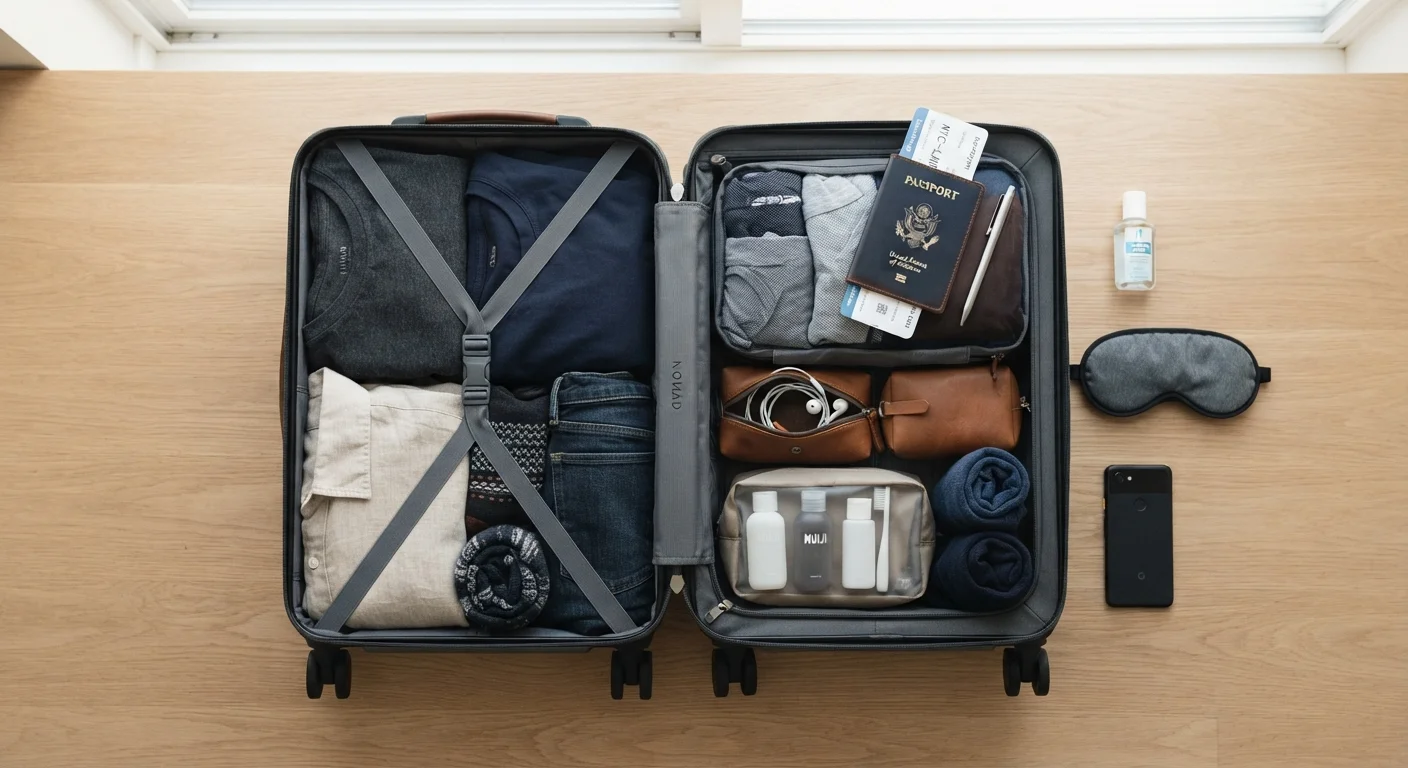
Carry-on-only travel means taking a single bag small enough to fit in an aircraft's overhead bin or under the seat in front of you — with no checked luggage at all. This approach eliminates checked-bag fees and speeds up airport transit. It requires intentional packing but pays off financially and logistically on many trip types.
Carry-on size limits vary by airline and even by fare class; always check the specific dimensions and weight allowances of each carrier before packing, as some budget airlines impose stricter limits than full-service carriers.
The Real Cost of Checked Baggage
Most travellers think of checked-bag fees as a minor inconvenience — a small line item on a trip that costs far more overall. In practice, those fees add up quickly. Major U.S. carriers charge between $30 and $40 for a first checked bag each way on domestic flights. A couple taking a round-trip vacation with one checked bag each can pay $120–$160 before a single hotel night is booked.
International itineraries can be more complex. Some long-haul carriers include a checked bag in their standard fare, but many budget transatlantic or transpacific airlines do not. Reading the fine print matters — which is exactly why understanding what cheap fares actually include can prevent sticker shock at check-in.
$30–$40
Typical first checked bag fee, each way
Major U.S. domestic carriers commonly charge this range per bag per direction, based on publicly listed fee schedules.
$120–$160
Round-trip baggage cost for two passengers
One checked bag each for two travellers on a domestic round trip at standard fee rates.
45–90 min
Extra airport time added by checked luggage
Estimated additional time at check-in and baggage claim compared to carry-on-only passengers, based on typical airport workflows.
Beyond airline fees, checked luggage creates secondary costs that rarely appear in travel budgets: longer wait times for ground transport, higher odds of needing a taxi rather than a shared shuttle, and the real (if uncommon) expense of replacing items in a lost or delayed bag. The U.S. Department of Transportation tracks mishandled baggage reports, and while the rate has improved over the years, delayed bags still affect millions of passengers annually — each incident carrying potential out-of-pocket costs.
How Carry-On Travel Changes Your Airport Economics
Time is money, and nowhere is that clearer than in an airport. Travellers checking bags typically need to arrive earlier, wait at a check-in counter or kiosk, and then stand at baggage claim on arrival — a process that routinely adds 45 to 90 minutes to each end of a trip. That extra time translates into real expenses: longer parking fees, additional meals or snacks purchased in the terminal, and in some cases, missing cheaper ground transport options that run less frequently.
Carry-on travellers can check in online, proceed directly through security, and walk straight off the plane to their ground transport. On a weekend trip, the time saved is a convenience. On a business trip or a tight connection, it can be the difference between making a flight and buying a new one.
Keep Essentials in Your Personal Item
Always pack medications, travel documents, a phone charger, and one change of clothes in your personal item (the smaller under-seat bag), not your overhead carry-on. If your carry-on is gate-checked or delayed, these essentials remain with you. This habit protects against the small but real risk of an unexpected separation from your bag.
This efficiency also opens up cheaper transport options at the destination. Travellers burdened with large suitcases often default to taxis or rideshares. Those with a single compact bag can navigate public transit, airport buses, or shared shuttles with far less friction — modes that typically cost a fraction of a private car.
Practical Packing Strategies That Make It Work
The financial case for carry-on travel is compelling, but it only holds if you can actually fit what you need. The most effective approach is building a capsule wardrobe: a small set of versatile, neutral-toned pieces that can be mixed and matched across multiple days. Quick-dry fabrics — common in travel-focused clothing lines — allow items to be washed in a hotel sink and dried overnight, cutting the number of garments you need to carry.
Toiletries are the other major space challenge. TSA's 3-1-1 rule (containers of 3.4 oz or less, in one quart-sized bag) applies to carry-ons through U.S. airport security. Purchasing full-size toiletries at the destination — or using hotel-provided products for shorter stays — removes this constraint entirely and saves packing space. For trips longer than a week, planning one laundry stop mid-trip is often more economical than checking a second bag.
Packing cubes, compression bags, and roll-folding techniques are widely used by experienced carry-on travellers to maximize usable space without adding weight. These are organizational tools, not magic — they work best when combined with deliberate item selection. For a broader framework on planning smart trips, the habits experienced travellers rely on offer useful complementary guidance.
When the Numbers Make Sense — and When They Don't
Carry-on-only travel is a financial strategy, not a lifestyle mandate. It makes the strongest case for trips of one to fourteen days with access to laundry, in moderate or warm climates, and without specialized gear requirements. Weekend city breaks, beach vacations, and standard business travel all fit this profile well.
The calculus changes for ski trips, destination weddings requiring formal wear, travel with young children, or extended expeditions into remote areas without laundry access. For those situations, checking a bag may be the genuinely practical choice — and acknowledging that is part of travelling smartly. The goal is informed decision-making, not rigid rule-following.
Airline Policies Vary Significantly
Carry-on allowances differ not just between airlines but sometimes between fare classes on the same airline. A basic economy ticket on some U.S. carriers restricts overhead bin access entirely, limiting passengers to a personal item under the seat. Always verify your specific fare's baggage rules before assuming a carry-on is included at no charge.
If you're new to budgeting a trip from the ground up, the comprehensive guide to stretching a travel budget covers carry-on strategy alongside dozens of other cost-control approaches across every phase of a trip. Carry-on travel is one lever — pulled alongside smart booking, flexible dates, and thoughtful spending on the ground, it contributes to a meaningfully lighter travel budget overall.