

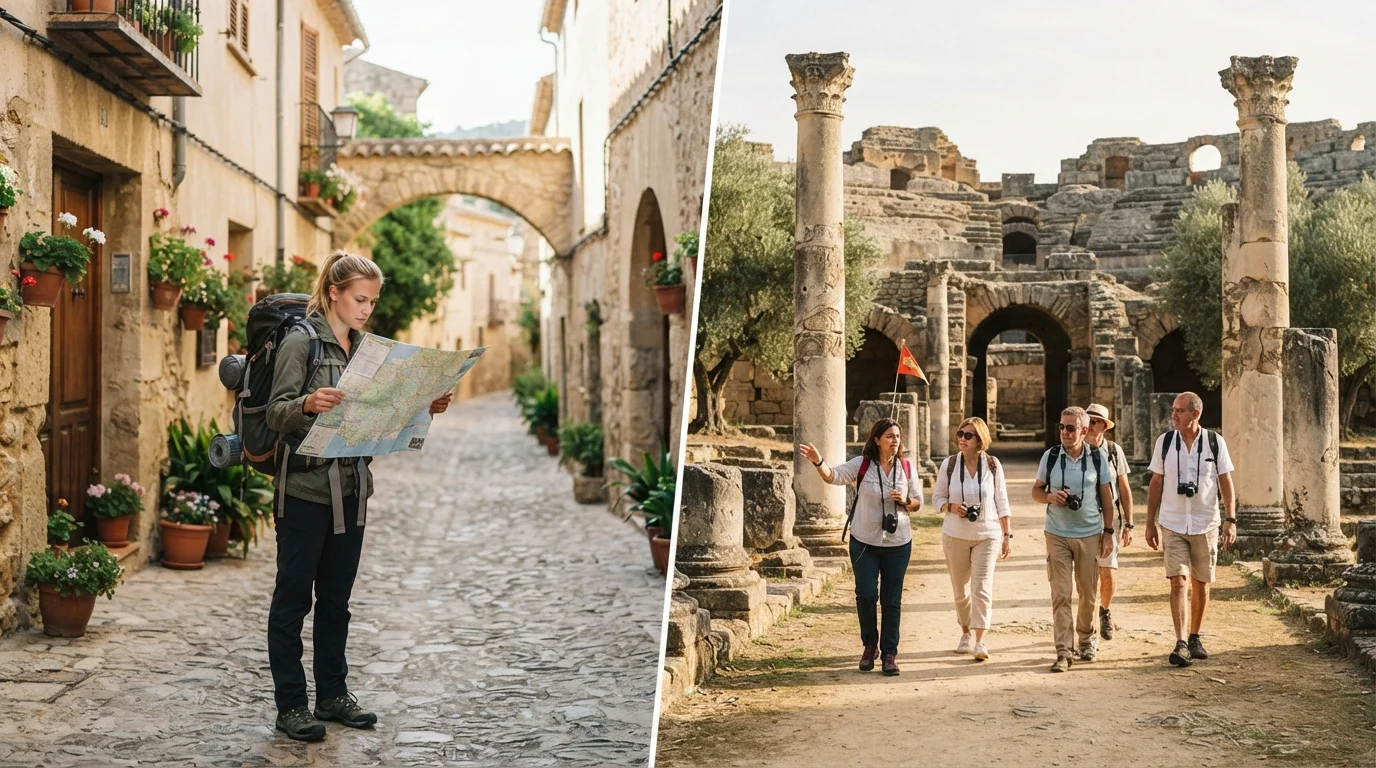
Key Takeaways
Option A
Solo / Independent Travel
The flexible, self-directed approach to seeing the world.
Best for: Travelers who want full control over their pace, itinerary, and budget allocation.
Option B
Guided Tours
The structured, logistics-handled way to explore new destinations.
Best for: Travelers who value convenience, local expertise, and built-in social connection.
If you want full control over your daily schedule
Solo / Independent Travel
Independent travel lets you linger where you're captivated and skip what doesn't interest you, without being tied to a group pace.
If you're visiting a destination with significant language or navigation barriers
Guided Tours
A knowledgeable guide handles translation, local protocols, and logistics — dramatically reducing stress in unfamiliar environments.
If you want deep cultural and historical context
Guided Tours
Expert guides routinely provide layers of context that self-guided visitors miss, especially at historical or archaeological sites.
If budget flexibility and cost control matter most
Solo / Independent Travel
Independent travelers can tailor every spending decision — from accommodation type to meal choices — to their own priorities.
If you're a first-time international traveler feeling uncertain
Guided Tours
A structured tour removes the guesswork from logistics and provides a safety net of support while you build travel confidence.
What Each Approach Actually Involves
Before comparing the two, it helps to be precise about what each option entails. Independent travel means you research, book, and navigate your trip yourself — accommodation, transport, activities, and meals all fall to you. You set the pace, choose the route, and adapt on the fly. For a solid foundation on what that planning process looks like in practice, see The Anatomy of a Well-Planned Trip.
Guided tours range from large group packages covering multiple countries to small-group or private day tours at a single site. The common thread is that someone else handles the logistics framework — transport between stops, accommodation on multi-day trips, and a human expert to contextualize what you're seeing.
Neither approach is monolithic. Many experienced travelers use a hybrid: they book flights and accommodation independently, then layer in a guided half-day at a complex archaeological site or a cooking class led by a local. This middle path is often overlooked but frequently delivers the best of both worlds.
| Criterion | Solo / Independent Travel | Guided Tours |
|---|---|---|
| Itinerary control | Full — change plans at will | Fixed — set by operator |
| Planning effort required | High — all research falls to you | Low — logistics handled for you |
| Cost structure | Variable; each element priced separately | Bundled; may include transport and lodging |
| Local expertise access | Depends on your own research | Built in via licensed guides |
| Social dynamic | Solitary by default; connections organic | Built-in group; structured social contact |
| Pace | Entirely your own | Group-determined |
| Best for complex destinations | Possible with thorough preparation | Generally easier and less stressful |
Flexibility vs. Convenience: The Core Trade-Off
The sharpest difference between independent travel and guided tours is where the burden of decision-making falls. Solo travelers carry it entirely — which is empowering when you're confident, and exhausting when you're not. A guided tour redistributes that burden to the operator, freeing your mental bandwidth to simply experience the destination.
Flexibility has a real cost in time. Independent travelers typically spend hours researching transport options, reading reviews, cross-checking visa requirements, and building itineraries. Done well, this work produces a highly personalized trip. Done poorly, it produces expensive last-minute fixes. Building your itinerary without over-scheduling it is a skill worth developing before you commit to a fully independent trip in an unfamiliar region.
Guided tours sacrifice spontaneity for reliability. You'll know departure times, included meals, and entry tickets in advance. The trade-off is that when the group wants to move on, you move on — even if you'd happily spend another hour at a particular museum.
~70%
Solo travelers who are repeat independent travelers
Surveys by travel industry bodies consistently find most solo travelers have taken multiple independent trips, suggesting experience builds comfort with the format.
3–5 hrs
Average daily planning time for first-time independent travelers
Traveler self-reports suggest first-time independent travelers spend significantly more time on daily logistics than those on guided itineraries.
Cost: A More Nuanced Picture Than You Might Expect
Independent travel is often assumed to be cheaper — and it can be, but the comparison is less straightforward than it looks. When you book a guided multi-day tour, the per-person cost typically bundles accommodation, ground transport, guides, and sometimes meals. Compare that bundled figure against what you'd actually spend booking each element yourself before concluding which is cheaper for your specific destination and travel style.
Where independent travel clearly saves money is in daily choices: you can eat at local markets instead of tourist restaurants, stay in a wider variety of accommodation types, and move at a pace that avoids rushed, expensive decisions. For ideas on trimming accommodation costs specifically, Accommodation Options Beyond Hotels lays out a practical set of alternatives.
Guided tours, meanwhile, often negotiate group rates for entry tickets and transport that individual travelers cannot access. On high-demand routes or in destinations where advance booking is essential, that can offset a portion of the tour premium.
Safety, Comfort, and Destination Complexity
Your destination's profile should heavily influence your choice of structure. In regions where English is rarely spoken, road infrastructure is inconsistent, or entry logistics are complicated, the value of a guided tour rises sharply. The same applies in destinations where local knowledge is the difference between a meaningful experience and a missed one.
Solo travel carries distinct safety considerations that are worth thinking through honestly — not to discourage independent travel, but to prepare for it properly. Solo Travel Safety: Risks, Realities, and Reasonable Precautions covers what the risks actually are and how experienced independent travelers manage them.
Comfort is a personal variable. Some travelers find the social structure of a guided tour reassuring — built-in companions, a guide to defer to, and a clear daily plan. Others find it constraining. Knowing which camp you fall into is one of the most useful things you can establish before booking anything.
The Hybrid Approach Worth Considering
Many travelers find the most satisfying trips combine independent booking with selective guided experiences. You might arrange your own flights and accommodation, then join a guided day tour at a historically dense site where context genuinely enriches the visit. This approach preserves flexibility while accessing expertise where it matters most. It also lets you test guided travel before committing to a fully packaged trip — or vice versa.
All travel decisions should be verified against current government travel advisories, entry requirements, and provider terms before booking. Conditions at any destination can change; always consult official sources.