

Key Takeaways
Tailgating
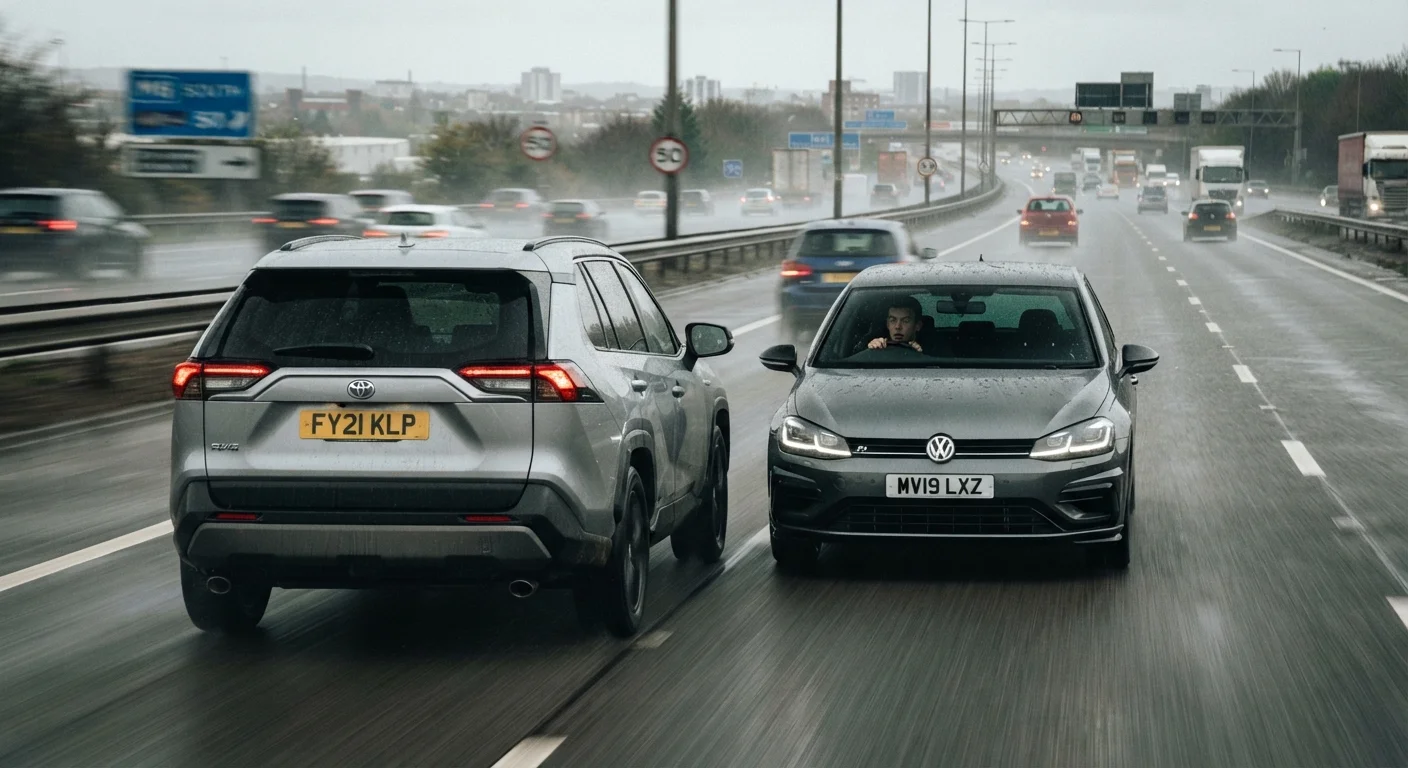
Tailgating means following the vehicle in front of you too closely, leaving insufficient space to brake safely if that driver slows or stops suddenly. It is one of the most common - and most underestimated - contributors to rear-end collisions on US roads. Most drivers who tailgate do not realise they are doing it, or underestimate how much stopping distance their vehicle actually needs.
At 60 mph, a typical passenger vehicle travels roughly 88 feet per second. Add reaction time of 1.5 seconds and standard braking distance, and the total stopping distance can exceed 240 feet - far more than most drivers leave between themselves and the car ahead.
The Physics Behind the Risk
At highway speeds, the distance between safe and catastrophic can be measured in fractions of a second. Before your foot even reaches the brake pedal, your vehicle has already covered significant ground - that gap is your reaction distance, and it is entirely lost to physics before any braking begins.
At 60 mph, reaction distance alone - assuming a typical 1.5-second response - amounts to roughly 132 feet. Add the braking distance for a well-maintained vehicle on dry pavement, and the total stopping distance climbs past 240 feet. Most tailgating drivers are leaving a fraction of that.
For a deeper breakdown of how thinking and braking distances combine, see our guide to stopping distances.
~29%
Share of US crashes that are rear-end collisions
According to the National Highway Traffic Safety Administration (NHTSA), rear-end crashes represent a substantial portion of all traffic collisions reported annually.
132 ft
Reaction distance at 60 mph before braking begins
Based on a standard 1.5-second reaction time, a vehicle travelling 60 mph covers approximately 132 feet before the driver's foot reaches the brake.
3 sec
Minimum recommended following distance gap
Traffic safety educators widely recommend the three-second rule as a practical baseline for maintaining safe following distance under normal driving conditions.
Why Drivers Consistently Underestimate the Danger
One reason tailgating persists is that it rarely results in a crash - until it does. Drivers who follow closely and avoid collision hundreds of times develop false confidence, a phenomenon psychologists call outcome bias: because nothing went wrong, the behaviour feels safe.
There is also a speed perception problem. At higher speeds, the vehicle ahead appears to be moving slowly relative to you, which makes the gap look larger than it is. In reality, closing speed - the rate at which you are approaching the car ahead during a sudden stop - can be extreme even when both vehicles appear to be travelling similarly.
Fatigue compounds this further. Tired drivers have measurably slower reaction times and poorer distance judgement. Driving while tired amplifies the danger of every unsafe following distance you hold.
“The single most important thing a driver can do to prevent rear-end collisions is to create and maintain adequate following distance. Most drivers simply do not appreciate how much distance a vehicle actually needs to stop.”
— NHTSA Traffic Safety Research Division, Federal agency responsible for US road safety research and standards
The Three-Second Rule - and When to Extend It
The three-second rule is a practical, field-tested method for maintaining safe following distance. Choose a stationary reference point - a road sign, overpass, or tree - and when the vehicle ahead passes it, count slowly: one-thousand-one, one-thousand-two, one-thousand-three. If you pass that same point before you finish counting, you are too close.
This rule works across a range of highway speeds because the gap it creates scales with speed - faster travel means a larger absolute gap at the same three-second count. However, three seconds is a minimum for good conditions.
Apply the Three-Second Rule Starting Today
You do not need special equipment or training - just a fixed landmark and the habit of counting. Practice it deliberately on your next few drives until it becomes automatic. Over time, maintaining a proper gap will feel natural rather than effortful.
Increase your following distance to at least four to six seconds when driving in:
- Rain, snow, or ice
- Fog or low-visibility conditions
- Heavy traffic where stops can happen rapidly
- When towing a trailer or carrying a heavy load
- Behind large trucks or motorcycles, which stop differently from standard passenger cars
Smooth, anticipatory driving also happens to be more fuel-efficient. Fuel-efficient driving habits and safe following distance reinforce each other in practice.
Tailgating as a Defensive Driving Failure
Defensive driving is fundamentally about managing space and time around your vehicle. Tailgating eliminates both. When you follow closely, you surrender your ability to anticipate hazards, absorb mistakes by the driver ahead, or respond to sudden changes in road conditions.
A key principle of defensive driving is maintaining an escape route - a gap in traffic you can move into if something goes wrong. A tailgating driver has no escape route in the most critical direction: forward.
Defensive driving encompasses far more than simply leaving space, but following distance is one of its most immediately actionable components. Every driver can apply it on the very next trip.
Some Driving Myths Reinforce Tailgating
A number of widely held beliefs - such as the idea that staying close to the car ahead improves your view of hazards, or that following closely is only dangerous at very high speeds - are simply incorrect. Common driving myths like these can quietly make roads more dangerous for everyone.