

Key Takeaways
Why Low-Impact Exercise Deserves More Credit
When most people picture a serious workout, they imagine high-intensity intervals, heavy lifting, or long runs. Low-impact exercise rarely gets the same cultural enthusiasm - but the evidence for its effectiveness is solid. Research consistently shows that gentler movement modalities can improve cardiovascular fitness, support healthy weight, build strength, reduce stress, and lower the risk of chronic disease, all without placing excessive stress on joints, connective tissue, or the nervous system.
That matters enormously for a wide range of people: those managing joint pain or arthritis, adults returning to exercise after a long break, older adults prioritising longevity over performance, and busy homeowners who need movement that fits into a real day rather than an idealised training plan. If you've been putting off physical activity because high-impact workouts feel out of reach, this list is worth your attention.
Before ramping back up, it's worth thinking through where your body currently is - especially if you've had a long stretch away from regular movement.
Low-Impact Is Not the Same as Easy
Low-impact refers to the mechanical forces placed on joints - not the effort level or cardiovascular demand. Swimming hard, cycling uphill, or holding a challenging yoga pose can all be physically demanding. The distinction is that these activities achieve that demand without the repetitive ground-impact stress associated with running or jumping. This makes them gentler on structural tissues while still producing genuine fitness adaptations.
Six Low-Impact Options Worth Considering
Swimming and Water-Based Exercise
Water supports roughly 90% of body weight when submerged to the chest, making swimming one of the most joint-friendly cardiovascular options available. It works the entire body - upper body, lower body, and core - with virtually no impact on the hips, knees, or spine. Resistance from the water also provides a mild strength stimulus that complements aerobic conditioning.
Who it suits best: People with arthritis, chronic joint pain, or recent orthopedic injuries often find water-based exercise accessible when nothing else is. It's also well-suited to older adults, those carrying extra weight, and anyone for whom ground-based impact is a limiting factor. Aqua aerobics classes offer an additional social element that many find motivating.
Water supports up to 90% of body weight, making swimming uniquely gentle on joints while still delivering a full-body workout.
Cycling (Stationary and Outdoor)
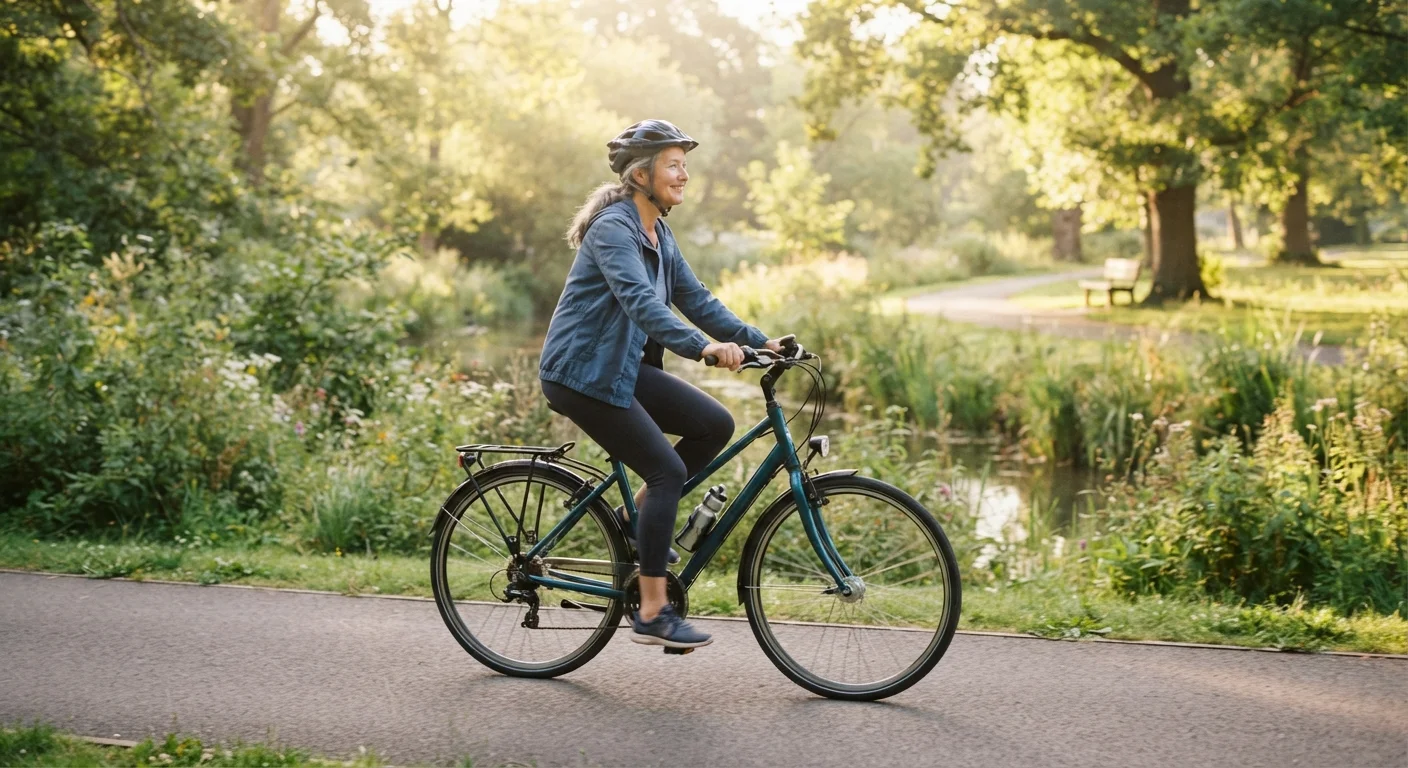
Cycling generates very little joint impact because the pedals support your feet rather than the ground absorbing force through your legs. It can be adjusted across a wide intensity range - from a gentle recovery spin to a sustained cardiovascular challenge - making it adaptable as fitness improves. Stationary bikes remove weather and traffic variables, which is meaningful for consistency.
Who it suits best: Cycling works especially well for people with knee or hip issues who find walking painful, those building baseline cardiovascular fitness, and homeowners who want an at-home option with reliable year-round access. It's also a natural entry point for Zone 2 training, which keeps heart rate in a sustainable, aerobic range.
Cycling's pedal-supported motion means knees and hips get a genuine cardiovascular workout without repetitive ground-impact stress.
Walking
Walking is the most accessible form of structured movement for most adults - it requires no equipment, no facility, and no prior fitness level. While it does involve ground impact, the forces involved are significantly lower than running, and the body adapts readily. Brisk walking (fast enough to raise your heart rate noticeably) qualifies as moderate-intensity aerobic activity under standard public health guidelines.
Who it suits best: Nearly everyone can start here, including those who are completely sedentary. It's an ideal foundation for a realistic first month of exercise. Older adults, people managing mild joint discomfort, and anyone under significant time pressure can benefit from even short, consistent walks built into their day.
Brisk walking counts as moderate-intensity aerobic activity - and consistency with walking outperforms sporadic high-intensity sessions.
Yoga
Yoga combines controlled breathing, deliberate body positioning, and progressive range-of-motion work. Depending on the style - restorative, Hatha, Vinyasa - the demands range from deeply calming to moderately challenging. Regular yoga practice is associated with improvements in flexibility, balance, core strength, and stress regulation, all of which contribute to functional health over time.
Who it suits best: Yoga is particularly well-matched to people dealing with stress or sleep disruption alongside physical deconditioning, as well as those who want to improve mobility and flexibility alongside general fitness. It works well at home with minimal space, which suits homeowners who prefer not to travel for exercise.
Yoga's combination of breathwork and controlled movement addresses physical and stress-related health concerns simultaneously.
Elliptical Training
The elliptical machine mimics a walking or running stride but keeps feet in continuous contact with the pedals, eliminating the impact phase entirely. Studies comparing treadmill running with elliptical training generally find similar cardiovascular and caloric responses at equivalent perceived effort, making it a genuine high-efficiency option for those who cannot tolerate running.
Who it suits best: People who want a running-adjacent workout without the joint load - particularly those with shin splints, stress fracture history, or knee pain - tend to find elliptical training a practical middle ground. It's also useful for maintaining fitness during recovery from lower-limb injuries when cleared by a healthcare provider. Access typically requires a gym or a home machine investment.
Elliptical training delivers running-equivalent cardiovascular output while keeping impact on joints close to zero.
Tai Chi
Tai chi is a Chinese movement practice built around slow, deliberate sequences of postures connected through weight shifts and breath. It builds body awareness, balance, and lower-body strength in a way that is accessible even at low fitness levels. A substantial body of research - including guidance from the U.S. Centers for Disease Control and Prevention - supports tai chi as an evidence-based approach for fall prevention in older adults.
Who it suits best: Older adults are the most studied population, but tai chi benefits anyone who wants to improve balance and coordination without high physical demand. It's also well-suited to people managing anxiety, as the meditative rhythm of the practice tends to support calm focus. Classes are widely available at community centres, and many instructional resources exist for home practice.
Tai chi's slow, deliberate sequences build balance and lower-body strength - qualities that protect independence as we age.
Start Narrow, Then Broaden
Rather than sampling several activities at once, pick one low-impact modality and commit to it for four to six weeks. This gives your body time to adapt and gives you an honest read on whether the activity fits your schedule and preferences. Once a consistent habit is established, adding variety becomes much easier.
Finding the Right Fit for Your Life
The most effective exercise is one you'll actually do. That sounds obvious, but it's frequently overlooked in favour of what seems most rigorous or efficient on paper. Low-impact modalities have an underappreciated advantage: they tend to feel good during and after, which makes it easier to build the consistency that actually produces results over time.
For those juggling full schedules, fitting movement into a packed day is a real challenge worth addressing strategically. And if you're weighing whether to exercise at home or at a facility, the trade-offs between home and gym sessions depend heavily on which activity you're pursuing. Swimming, for instance, requires a pool; yoga and cycling can both work at home.
Whatever you choose, start at an honest level, progress gradually, and pay attention to how your body responds. Low-impact does not mean zero adaptation - you will still get tired, you will still improve, and your body will still need recovery time.
This article is for general informational and educational purposes only and is not a substitute for professional medical advice. Consult a qualified healthcare provider before beginning any new exercise program, particularly if you have an existing health condition, are recovering from injury, or are pregnant.