

Key Takeaways
Why the Nutrition Facts Panel Exists — and What It Can Actually Tell You
The Nutrition Facts panel is a standardized format mandated by the US Food and Drug Administration (FDA). Its current design, updated in 2020, reflects decades of nutritional science and public health research. Every compliant packaged food in the US must display the same categories in the same order — which means once you know how to read one label, you can read all of them.
What the panel can tell you: the calorie density of a food, its macronutrient breakdown (fat, carbohydrate, protein), the presence of key micronutrients, and how a single serving fits against general daily reference values. What it cannot tell you: whether a food is right for your specific health situation, dietary goals, or medical history. Think of it as a map, not a verdict.
This Is General Information, Not Medical Advice
This article explains how to read nutrition labels for general educational purposes. It is not a substitute for personalized guidance from a registered dietitian or healthcare provider. If you have a specific health condition, food allergy, or dietary restriction, consult a qualified professional before making significant changes to your diet.
The panel also doesn't capture everything nutritionally relevant — phytonutrients, antioxidants, and food processing level (often discussed as 'ultra-processed') don't appear on the label. That's why reading labels well is one skill among several, not a complete nutrition strategy on its own.
Nutrition Facts Panel
The standardized FDA label found on most packaged foods that lists calories, macronutrients, micronutrients, and %DV per serving.
Ingredient List
Found below or beside the nutrition panel; lists all ingredients in descending order by weight.
Smartphone Calculator
Useful for multiplying nutrient values when you consume more or less than the listed serving size.
How to Read a Nutrition Label Step by Step
Follow these steps the next time you pick up a packaged food. With practice, the whole process takes under a minute.
Start with the Serving Size
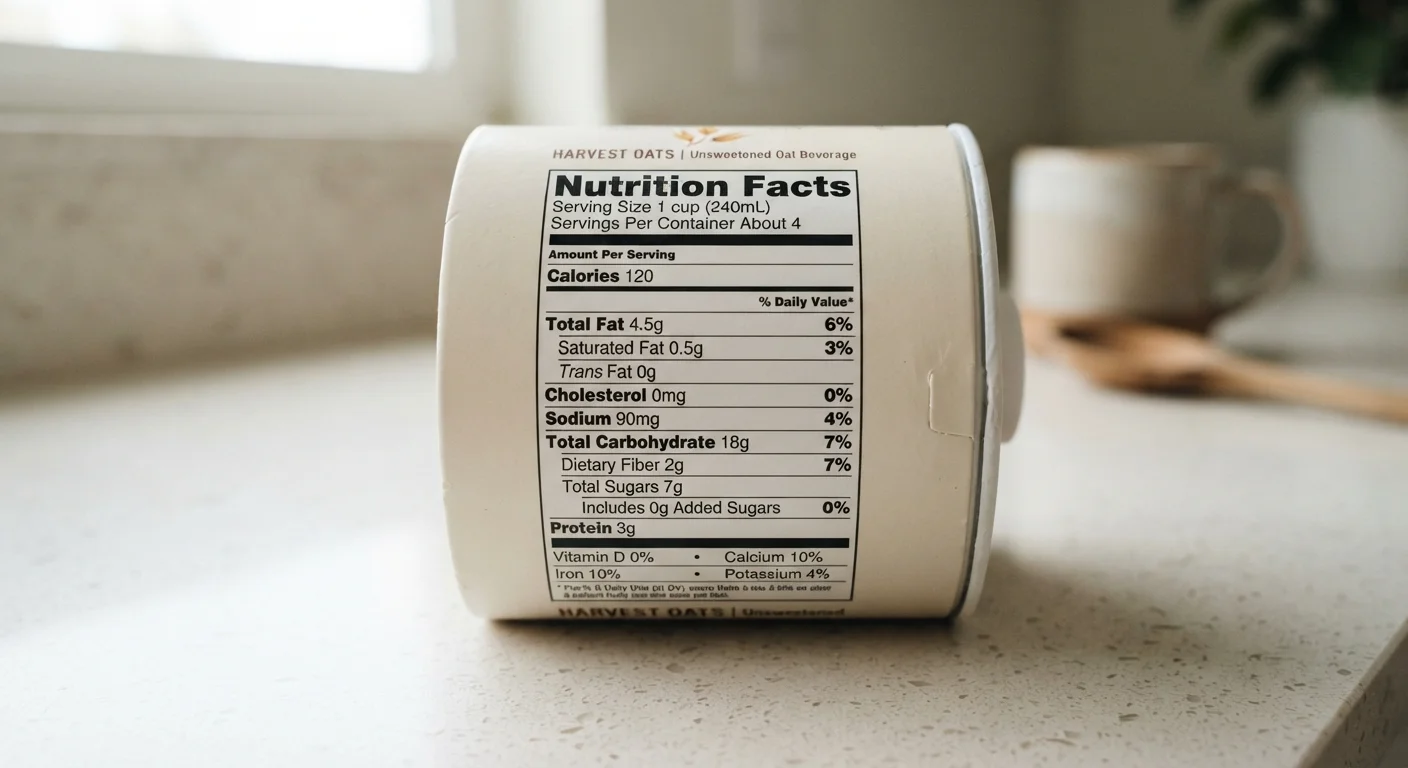
Every figure on the label — calories, fat, sodium, everything — is calculated for one serving. Find Serving Size and Servings Per Container at the very top of the panel. If a container lists 2.5 servings and you eat the whole thing, multiply all values by 2.5. This single step prevents the most common misreading of nutrition labels.
Check the Calories
Calories measure total energy per serving. This number appears prominently in large type. Neither high nor low calories automatically makes a food 'good' or 'bad' — context matters. A handful of nuts is calorie-dense but also nutrient-rich; a low-calorie candy offers little nutritional value. Use calories as one data point, not a verdict.
Scan the Nutrients to Limit
The FDA groups certain nutrients under a 'limit these' category because most Americans already consume them in excess. Look for:
- Saturated Fat — linked in research to cardiovascular risk when eaten in excess; aim for a lower %DV.
- Sodium — most adults consume well above recommended levels; high intake is associated with elevated blood pressure in some individuals.
- Added Sugars — distinct from naturally occurring sugars (like those in fruit or dairy), added sugars appear on their own line since a 2020 FDA rule update.
For context on how different fats compare, see our guide to saturated, unsaturated, and trans fats.
Look for Nutrients to Encourage
These are nutrients many people under-consume. Prioritize higher %DV values here:
- Dietary Fiber — supports digestive health and is associated with heart health and blood sugar regulation.
- Potassium — helps maintain healthy blood pressure; often lacking in processed-food-heavy diets.
- Calcium, Iron, Vitamin D — listed because deficiencies are common in the US population.
For a broader look at what vitamins and minerals do, our micronutrients reference guide covers each one in plain language.
Understand Percent Daily Value (%DV)
%DV tells you how much of a nutrient one serving contributes toward a standard daily intake, based on a 2,000-calorie reference diet set by the FDA. It's not a personal prescription — your actual needs may differ based on age, sex, activity level, and health status. But it's a reliable, fast compass for comparison shopping and spotting outliers.
Read the Ingredient List
Ingredients are listed in descending order by weight. The first two or three ingredients make up the bulk of the product. If refined flour or added sugar appears first, that's the primary component. Look for whole, recognizable ingredients near the top. A long list isn't automatically bad — spice blends add many items — but unfamiliar additives or multiple forms of sugar (cane syrup, dextrose, maltose) scattered throughout the list are worth noting.
Put It in Context of Your Whole Diet
No single label — and no single food — defines the quality of your overall eating pattern. A snack high in sodium isn't a health crisis if the rest of your day is sodium-moderate. Use labels as navigational tools, not scorecards. Pair this skill with a realistic sense of portions by exploring practical portion awareness strategies that don't require calorie counting or food scales.
Serving Sizes Can Be Misleading
Manufacturers are required to list realistic serving sizes, but they can still be smaller than what most people actually eat. A bag of chips listed as 'about 2.5 servings' means every calorie and nutrient figure must be multiplied accordingly. Always do this math before comparing products or estimating your intake.
Use %DV as a Quick Compass
The FDA's general rule: 5% DV or less is considered low for a nutrient, while 20% DV or more is considered high. This shortcut helps you evaluate a product in seconds without needing to memorize specific gram targets. Apply it to both nutrients you want more of (fiber, calcium) and those you want to limit (sodium, saturated fat).
Common Misreads and How to Avoid Them
Even label-savvy shoppers run into a few consistent traps:
- '0 g trans fat' doesn't always mean zero. FDA rounding rules allow products with less than 0.5 g per serving to list 0 g. Check the ingredient list for 'partially hydrogenated oils' as a more reliable indicator.
- 'Natural' and 'organic' are not nutrition claims. Neither word on the front of a package tells you anything about calorie, sugar, or sodium content. Always flip to the panel.
- Low-fat can mean high-sugar. When fat is removed from processed foods, manufacturers often add sugar or salt to compensate for lost flavor. The label reveals this; front-of-package claims don't.
- Protein grams don't indicate protein quality. The label lists total protein by weight but doesn't distinguish between complete proteins (containing all essential amino acids) and incomplete ones. Food source context matters here.
Developing label literacy pairs naturally with understanding portion sizes in real-world contexts. For practical, non-obsessive approaches, see portion awareness without obsession.
This article is for general informational and educational purposes only and does not constitute medical, dietary, or nutritional advice. Consult a registered dietitian or qualified healthcare provider for guidance tailored to your individual health needs.