

Key Takeaways
Why Portion Awareness Matters (And Why Obsession Backfires)
Most adults have a distorted sense of how much food a standard serving actually contains — and that's largely not their fault. Restaurant plates have expanded, packaged snacks are engineered for mindless eating, and nutrition guidance has historically leaned on scales and calorie math that few people find sustainable. Research consistently shows that chronic over-restriction and obsessive tracking can heighten anxiety around food and, paradoxically, lead to less balanced eating over time.
Portion awareness takes a different approach. Rather than treating every meal as a measurement exercise, it asks you to build a flexible, internalized sense of what reasonable amounts look like — so the knowledge travels with you to restaurants, dinner parties, and rushed weekday lunches alike. If you've been working on understanding food labels, our guide to reading nutrition labels pairs naturally with this skill set.
What you will need
Practical Steps to Calibrate Your Portions
The techniques below require no equipment beyond what you already have. Work through them gradually — picking one or two to try this week — rather than attempting to overhaul every meal at once. For broader strategies on fitting healthy eating into a full schedule, see our article on building eating habits that stick.
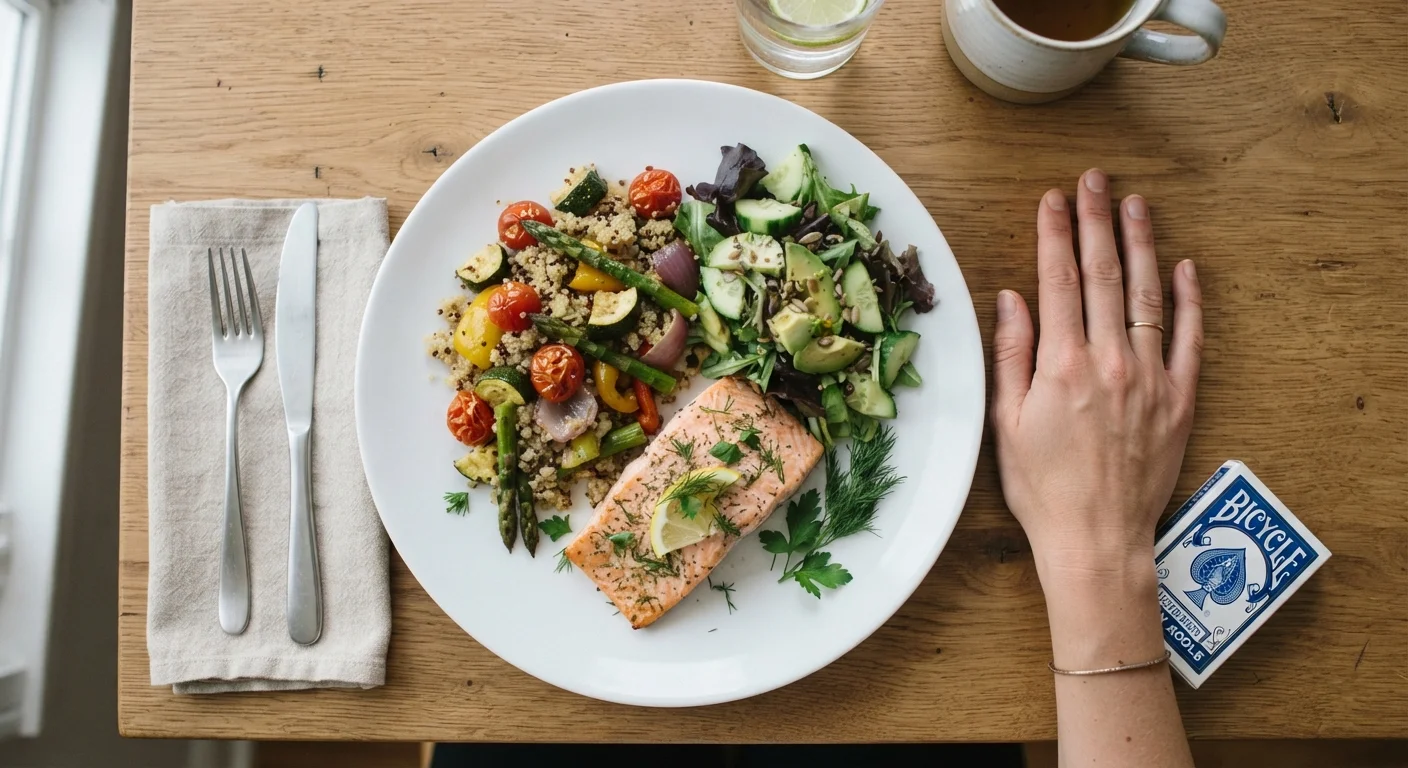
Use your hand as a built-in measuring guide
Your hand scales proportionally with your body, making it a surprisingly consistent reference. As a general guide used by many nutrition educators:
- Palm (no fingers): roughly one serving of protein (meat, fish, tofu) — about 3–4 oz
- Closed fist: approximately one cup — useful for grains, pasta, or raw leafy greens
- Cupped hand: about half a cup — good for cooked grains or legumes
- Thumb: roughly one tablespoon — helpful for nut butters, oils, or dressings
- Thumb tip to first knuckle: approximately one teaspoon — for butter or concentrated condiments
These are approximations, not precise measurements, but they give you a fast, portable framework that travels everywhere you do.
Anchor portions to everyday objects
When hand comparisons feel awkward — especially in social settings — familiar objects offer a discreet mental anchor:
- A deck of cards ≈ 3 oz of cooked meat or fish
- A tennis ball ≈ one medium piece of fruit or about half a cup of food
- A standard hockey puck ≈ one serving of a bagel or muffin (often much smaller than what's served)
- A golf ball ≈ two tablespoons — useful for nut butter or hummus
- A CD or DVD disc ≈ one serving of pancake or waffle
Anchoring to objects you already know makes estimation feel natural rather than clinical. Over time, these comparisons become second nature.
Plate your food before eating, rather than eating from containers
Serving food onto a plate or bowl — even for a snack — creates a visual starting point and a clear stopping point. Research in behavioral nutrition suggests that people consistently eat more when portion size is undefined, as with a large bag or serving dish at the table. Portioning food before sitting down removes that ambiguity without requiring any counting.
A useful plate structure many nutrition professionals reference: aim for roughly half the plate to be non-starchy vegetables, one quarter protein, and one quarter grains or starchy carbohydrates. This isn't a rigid rule, but it provides a useful visual framework for building balanced meals.
Eat slowly and pause mid-meal
Your stomach takes roughly 15–20 minutes to signal fullness to your brain. Eating quickly means you can overshoot comfortable fullness before your body has had a chance to register where you are. Deliberately slowing your pace — putting your fork down between bites, chewing fully, or simply removing distractions — gives those signals time to catch up.
A practical mid-meal check: halfway through your plate, pause for 30 seconds and assess whether you're still genuinely hungry or eating from habit or momentum. You don't have to stop eating — the point is simply to make the decision consciously.
Recalibrate periodically, not constantly
Portion awareness works best as an occasional recalibration rather than a constant mental overlay. Consider spending one or two meals a month actually measuring common foods — cooked rice, cereal, salad dressing — alongside your estimates. Most people find that portions drift over time, especially with high-calorie foods where small differences accumulate. A brief recalibration session resets your mental baseline without turning every meal into a measurement exercise.
Progress Over Perfection
Portion awareness is a skill that develops gradually. If one meal feels off, treat it as data rather than failure and move on to the next. Consistent attention over weeks and months produces far better results than stressful perfection at any single sitting. Small, sustained habits outperform intense short-term efforts in virtually every area of nutrition science.
Common Pitfalls to Watch For
Even with the best intentions, a few habits quietly undermine portion awareness. Eating directly from a bag or box removes visual feedback — you lose track of how much you've consumed because there's no clear end point on the plate. Distracted eating (scrolling, watching TV) has a similar effect; your attention isn't registering satisfaction cues. Our article on eating patterns that undermine good nutrition explores these subtle traps in depth.
Watch for Signs of an Unhealthy Relationship with Food
If thoughts about food portions or body size feel intrusive, distressing, or difficult to control, that's worth taking seriously. Portion awareness should feel grounding and practical — not anxiety-producing. If tracking or estimating food amounts triggers guilt, fear, or obsessive thinking, please speak with a qualified healthcare professional or registered dietitian who can offer personalized support.
It's also worth doing periodic honest check-ins on your habits. A structured self-audit — like the one outlined in our weekly nutrition self-check — can surface patterns you might not notice meal to meal.
This article is for general informational purposes only and is not a substitute for personalized dietary advice. If you have specific health conditions or concerns about your eating habits, please consult a registered dietitian or qualified healthcare professional.