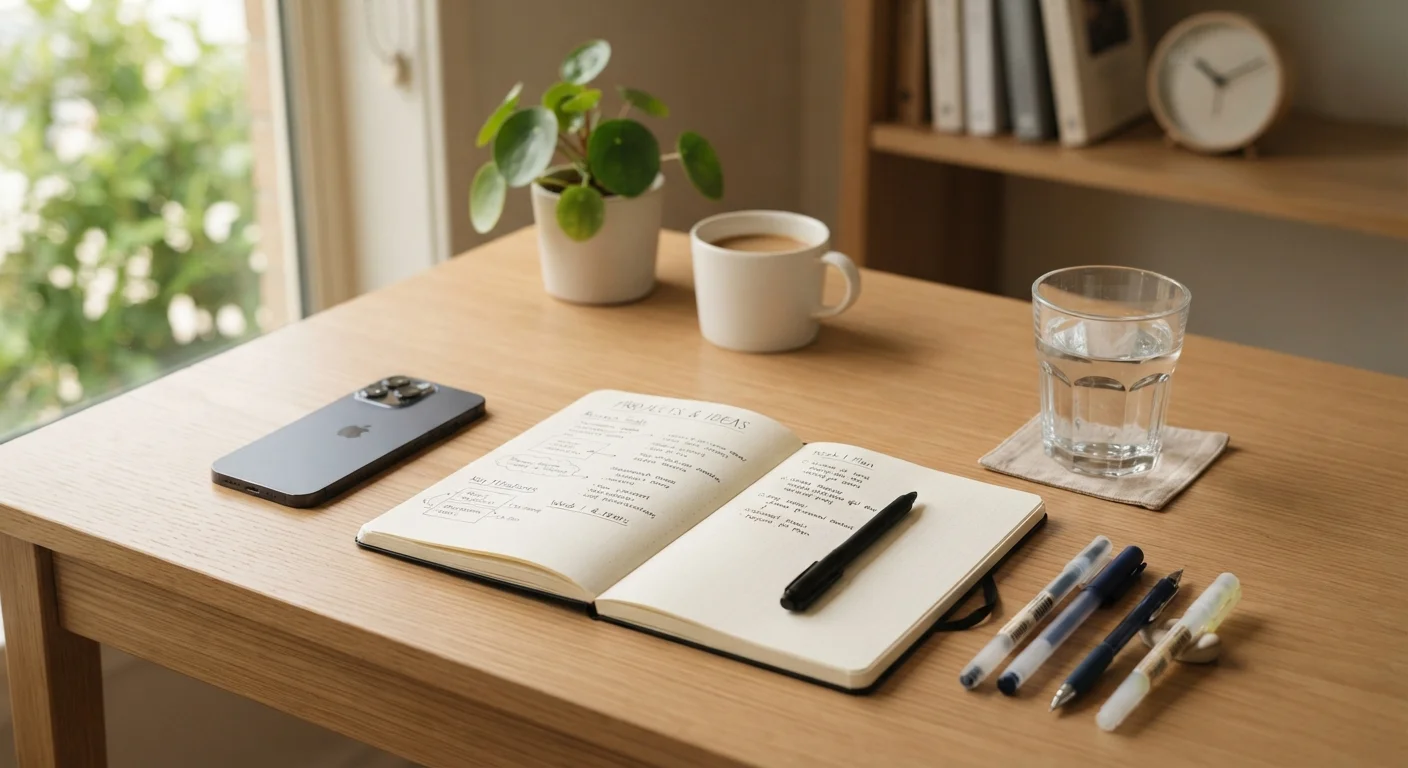
Your physical environment has a measurable effect on your ability to concentrate and retain information.
A brief mental transition ritual helps your brain shift from distraction mode into learning mode.
Defining a specific goal before each session keeps studying purposeful rather than passive.
Reducing digital interruptions before you start is one of the highest-leverage preparation steps.
Gathering all materials in advance prevents attention-breaking micro-interruptions mid-session.
20–40 min
Summary
22 items · 20–40 minutes
Why Preparation Matters Before You Open a Single Book
Most study sessions fail before they begin. A distracted environment, an unclear goal, and a restless mind combine to turn 90 minutes of intended study into 90 minutes of unfocused drifting. Cognitive science gives us a clear explanation: the brain requires both environmental cues and internal readiness to shift into a deep learning state — what researchers sometimes call effortful retrieval mode.
This checklist works as a brief pre-study ritual that removes friction, primes attention, and gives every session a defined purpose. It is designed for learners of all ages and situations — whether you are a high schooler cramming for exams, an adult juggling study alongside work (see our guide on building a study routine around a full-time job), or someone returning to learning after years away.
Work through each group in order. The full routine takes between 20 and 40 minutes the first few times; once it becomes habitual, many steps take seconds.
Required
Timer (physical or app-based)
Marks study blocks and break intervals, helping you maintain a sustainable rhythm without clock-watching.
Required
Blank notepad or journal
Used for the brain-dump exercise, session goals, and capturing notes without switching between digital windows.
Optional
Website blocker (e.g., browser extension)
Temporarily restricts access to distracting sites so willpower isn't required to resist them mid-session.
Optional
Noise-canceling headphones or white-noise app
Masks unpredictable ambient sounds that can spike the brain's alertness response and interrupt deep focus.
The Pre-Study Checklist
The items below are grouped into four logical phases: setting up your space, managing your technology, priming your mind, and clarifying your plan. Complete them in sequence for the most benefit.
Environment Setup
Choose a dedicated study location you use consistently — the brain associates recurring environments with specific behaviors, reinforcing focus over time.Must
Clear your desk or workspace of anything unrelated to today's study goal, leaving only what you need within arm's reach.Must
Set the lighting so it is bright enough to read comfortably without glare — natural light is preferable when available.Should
Adjust the room temperature to a comfortable level; research suggests mild coolness (around 68–72°F) tends to support alertness.Nice to have
Prepare a drink — water is the simplest choice — and place it within reach so thirst doesn't interrupt you mid-session.Should
If noise is a concern, decide on your sound strategy: silence, white noise, or instrumental music without lyrics before you start.Should
Digital and Distraction Management
Put your phone on Do Not Disturb mode and place it face-down or in a drawer — even its visible presence reduces available working memory.Must
Close all browser tabs and applications on your computer that are unrelated to your study material before the session begins.Must
Enable a website or app blocker for the duration of your session if you find social media or news particularly distracting.Should
Inform household members or roommates of your intended study window so interruptions are minimized.Should
Mental Preparation
Spend two to three minutes doing slow, deliberate breathing to lower your baseline stress level before picking up any material.Should
Do a brief brain-dump: write down any unrelated worries or to-dos on a separate notepad to clear mental clutter before focusing.Should
Briefly recall what you covered in your previous session — spending 60 seconds retrieving prior material activates relevant memory networks.Must
Set a positive, specific intention for the session (e.g., "I will understand the three causes of World War I") rather than a vague one like "study history."Must
Materials and Planning
Gather all textbooks, notes, flashcards, or digital resources you need before sitting down — mid-session searching breaks concentration.Must
Open your notes or study guide to the correct section so you can start immediately without navigating or searching.Must
Set a timer for your planned study block — use a method such as the Pomodoro Technique (25 minutes on, 5 minutes off) if you are prone to losing track of time.Should
Write down your session goal in one sentence at the top of a blank notebook page — this anchors your purpose visually throughout the session.Should
Decide in advance what note-taking method you will use for this session based on the type of material you are covering.Should
Plan your break schedule before you begin so rest periods feel earned rather than impulsive.Nice to have
Identify the single most important concept or skill you want to master by the end of this session.Must
Review any practice questions or prompts you plan to work through so your mind is already framing the upcoming challenge.Nice to have
Passive Review Is Not the Same as Active Study
Re-reading notes or highlighting text feels productive but is one of the weakest study strategies identified by learning researchers. Before your session starts, commit to at least one active technique — self-testing, practice problems, or summarizing from memory. Structuring your session around retrieval practice, rather than passive review, is the single biggest lever for long-term retention.
Once your space is ready and your goal is set, think carefully about how you will structure the session itself. Research on practice methods — including the difference between working on one topic at a stretch versus mixing subjects — can shape how productively you use your time. Our article on interleaved practice vs. blocked practice explores that choice in depth.
Effective note-taking during your session also starts with a decision made before you sit down. If you haven't settled on a system yet, note-taking methods compared walks through Cornell, mind mapping, outlining, and more so you can choose what fits your subject.
Don't Let Preparation Become Procrastination
Pre-study routines are valuable only when they remain brief and purposeful. If you find yourself reorganizing your desk for 20 minutes or researching productivity tools instead of studying, the checklist has become avoidance. Set a hard limit of 10–15 minutes for your entire pre-session routine and start your timer as soon as it's up.
Learning & Education Editorial Team is the collective byline for our editorial team and contributor network. Articles published under this byline or an editorial pen name are researched, written, and reviewed according to our editorial standards for clarity, consistency, and independence before publication.
Disclaimer: The content provided on our blog site traverses numerous categories, offering readers valuable and practical information. Readers can use the editorial team’s research and data to gain more insights into their topics of interest. However, they are requested not to treat the articles as conclusive. The website team cannot be held responsible for differences in data or inaccuracies found across other platforms. Please also note that the site might also miss out on various schemes and offers available that the readers may find more beneficial than the ones we cover.