

Key Takeaways
Our Verdict
Each note-taking method has genuine strengths tied to specific learning contexts. The Cornell Method excels for dense lecture content that requires review; mind mapping opens up creative and conceptual subjects; outlining keeps structured material organized and scannable. Most effective learners don't commit to just one — they match the method to the material.
| Best for | Recommended |
|---|---|
| Lecture-heavy courses requiring frequent review | Cornell Method |
| Conceptual or creatively interconnected subjects | Mind Mapping |
| Structured content with clear hierarchies | Outlining |
| Capturing ideas quickly during fast-paced reading | Sentence Method |
Why the Method You Choose Actually Matters
Note-taking is not just transcription — it is an act of processing information. Research in cognitive science consistently shows that how you organize information as you record it influences how well you encode and later retrieve it. Yet most students default to one method — usually informal bullet points — without considering whether it fits the content or their learning goals.
Understanding the trade-offs between structured systems can make a measurable difference in comprehension and retention. This comparison covers four widely used methods: the Cornell Method, mind mapping, outlining, and the sentence method — explaining how each works, what it suits, and when to consider switching. For broader study habits that complement strong note-taking, see what effective learners do differently.
The Four Methods at a Glance
Before diving into detail, here is a side-by-side view of how the four methods compare across the criteria that matter most to learners.
| Cornell Method | Mind Mapping | Outlining | Sentence Method | |
|---|---|---|---|---|
| Structure | Divided page zones | Radial, branching | Hierarchical indentation | Sequential lines |
| Best for subject type | Lectures, dense factual content | Conceptual, visual subjects | Structured readings, presentations | Fast-paced or unpredictable content |
| Review/self-testing built in | Yes — cue column | Partial — visual recall | No — requires extra step | No — requires reorganizing |
| Learning style fit | Analytical, sequential | Visual, associative | Logical, organized | Any — minimal setup |
| Effort to set up | Low — template-based | Low to moderate | Low | Minimal |
| Ease of later review | High | Moderate | High | Low without reorganizing |
Cornell Method: Built-In Review Structure
Developed at Cornell University in the 1950s, this system divides a page into three zones: a narrow left column for cue words or questions, a wide right column for main notes, and a bottom summary section. During a lecture or reading, you fill the right column. Afterward, you add questions to the left column that the notes answer — then cover the right side and use those cues to quiz yourself.
This built-in retrieval practice is the method's key advantage. It transforms notes into a self-testing tool, aligning with the testing effect — a well-established finding in memory research showing that actively recalling information strengthens long-term retention more than passive re-reading.
Best suited for: College lectures, textbook chapters, sciences, history — any content that is dense, fact-rich, and benefits from regular review sessions.
Make Cornell Notes Work Harder
Fill in the cue column within 24 hours of taking notes — the sooner, the better for retention. Use questions rather than just keywords; phrasing cues as questions primes your brain for retrieval practice. Cover the right column and try to answer each question before checking your notes.
Mind Mapping: Thinking in Networks
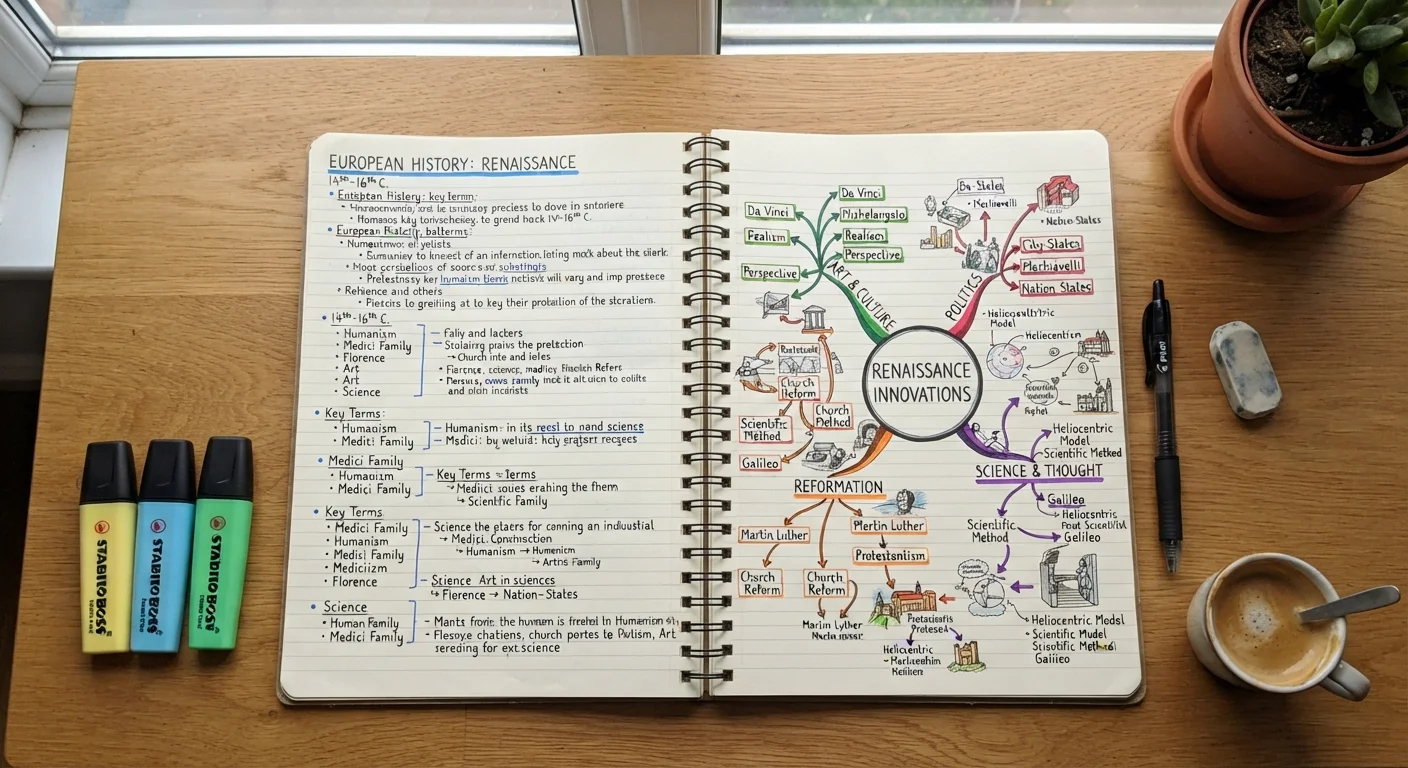
Mind mapping places a central concept at the page's center and branches outward into related subtopics, details, and connections. The format is nonlinear by design, mirroring how associative memory works. Nodes can be color-coded, illustrated, or linked with arrows to show relationships that linear notes would obscure.
This approach particularly benefits learners who think visually or are working with subjects where ideas overlap and branch — literature themes, biological systems, historical causation, or brainstorming for writing projects. Its weakness is that it can become unwieldy for content with strict sequential logic, such as mathematical proofs or procedural instructions.
Best suited for: Subjects with interconnected concepts, creative planning, studying relationships between ideas, and initial brainstorming.
Outlining and the Sentence Method
Outlining uses a hierarchical structure of headings, subheadings, and indented bullet points to reflect the logical organization of material. It works best when the source itself is already structured — a textbook chapter, a presentation with clear sections, or a well-organized lecture. The result is highly scannable and easy to add to over time. Its limitation is that it imposes a rigid hierarchy that can distort content where ideas are more fluid or interconnected.
The sentence method is the most accessible: each new thought or piece of information gets its own line, written as a complete sentence. It is fast and requires no pre-planning, making it useful for rapid information capture. The downside is that it produces a dense block of text that requires significant organizing work later to become a useful study resource.
Pairing any of these methods with a reliable study routine amplifies their effectiveness — the study routine guide offers a practical framework for doing exactly that. You may also find value in setting up your environment before you begin — see this pre-study checklist for a focused start.
Choosing and Switching Methods Strategically
Effective learners treat note-taking methods as tools, not identities. A practical approach is to default to one method per subject type — Cornell for lecture-based courses, mind mapping for conceptual or discussion-heavy classes, outlining for structured readings — while staying flexible when the content demands it.
When you notice your notes feel disconnected or hard to review, that is a signal to evaluate the method, not just work harder. Experiment during a low-stakes session and compare how well you can recall material afterward. The method that supports active engagement and makes review efficient for you in that subject is the right one.
~50%
Retention boost from active recall
Studies on the testing effect suggest active retrieval during study can significantly outperform passive re-reading for long-term retention.
1 in 3
Students who regularly switch methods
Research on self-regulated learning suggests most students use a single default strategy regardless of subject, missing opportunities to optimize for content type.