

Key Takeaways
Credit Score
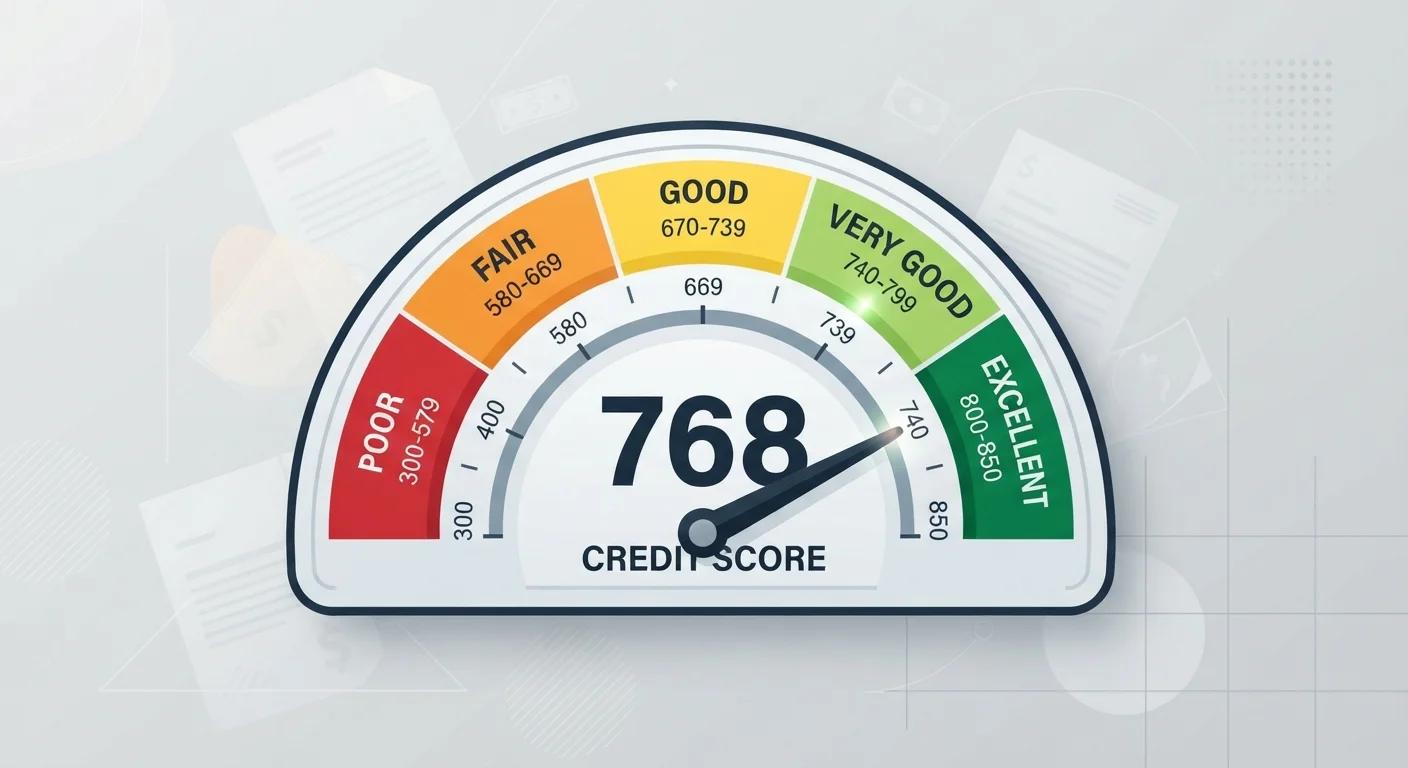
A credit score is a three-digit number, typically ranging from 300 to 850, that summarizes how reliably you've managed borrowed money. Lenders use it to quickly assess how likely you are to repay a new loan or credit card. The higher your score, the lower the perceived risk — and usually the better the terms you'll be offered.
The most widely used scoring model in the U.S. is the FICO Score, though VantageScore is also common. Both use the same 300–850 range but may weight factors slightly differently.
The Score Range and What Each Tier Means
Both the FICO Score and VantageScore use a 300–850 scale. While lenders set their own thresholds, the following tiers are widely used as benchmarks:
- Exceptional (800–850): Borrowers in this range are seen as very low risk and typically qualify for the most favorable rates.
- Very Good (740–799): You'll generally qualify for competitive rates and terms with most lenders.
- Good (670–739): Considered near or above average; most mainstream credit products are accessible.
- Fair (580–669): You may qualify for credit, but often at higher interest rates.
- Poor (300–579): Access to credit is limited, and approval often requires secured products or a co-signer.
These tiers matter because even a modest score improvement — say, moving from fair to good — can translate to a meaningfully lower interest rate on a mortgage or auto loan, saving hundreds or thousands of dollars over the life of the loan.
716
Average U.S. FICO Score
According to FICO's publicly released data, the average American FICO Score has hovered around 716 in recent years, placing the typical consumer in the 'good' range.
~49M
Credit-invisible Americans
The Consumer Financial Protection Bureau has estimated that tens of millions of Americans lack enough credit history to generate a score, limiting their access to mainstream financial products.
35%
Weight of payment history in FICO Score
FICO's published scoring breakdown identifies payment history as the largest single factor, making on-time payments the most impactful habit a borrower can build.
The Five Factors That Build Your Score
Credit scores aren't arbitrary — they're calculated from specific pieces of data in your credit report. Understanding the five main factors helps you see where you have the most leverage.
- Payment history (~35%): Whether you pay on time is the single biggest driver. Even one missed payment can cause a noticeable drop.
- Amounts owed / credit utilization (~30%): This measures how much of your available credit you're using. High balances relative to your limits signal risk. Credit utilization deserves its own close look — it's one of the fastest levers you can pull.
- Length of credit history (~15%): Older accounts generally help your score. This is why closing an old card can sometimes backfire.
- Credit mix (~10%): A mix of account types — credit cards, installment loans — can benefit your score, though it's a minor factor.
- New credit (~10%): Opening several accounts in a short window can temporarily lower your score. Learn more about what lenders assess when you apply.
Focus on the Biggest Levers First
Since payment history and credit utilization together account for roughly 65% of a FICO Score, those two factors deserve your attention before anything else. Set up autopay to avoid missed payments, and aim to keep your balances well below your credit limits — ideally under 30% of each card's limit. Small, consistent actions in these two areas produce the most reliable score improvements over time.
Why Lenders Look Beyond Just the Number
Your credit score is a starting point — not the whole conversation. Lenders typically pull your full credit report alongside your score to understand the story behind the number. A score of 680 held by someone who had one rough year but a decade of clean history looks different from one held by someone with recent missed payments across multiple accounts.
That's why it pays to understand what's actually on your report. Walking through your credit report section by section gives you the context your score alone can't provide. And if you spot something that doesn't look right, it's worth knowing that errors can be formally challenged.
“A credit score is not a measure of your worth as a person — it's a narrow, backward-looking snapshot of how you've used credit. Understanding what goes into it is the first step to using it as a tool rather than fearing it as a judgment.”
— Personal Finance Editorial Team, Editorial analysis based on widely published FICO and CFPB scoring documentation
Finally, be cautious about widely repeated assumptions. Many common credit beliefs turn out to be myths — and acting on bad information can slow your progress significantly.
This article is for general informational purposes only and does not constitute personalized financial or legal advice. Consult a licensed financial professional for guidance specific to your situation.