

Key Takeaways
Start here
What a Credit Report Actually Is
Core knowledge
The Five Main Sections Explained
Watch out for
Red Flags to Look For
Put it into practice
How to Get Your Report and Review It Regularly
What a Credit Report Actually Is
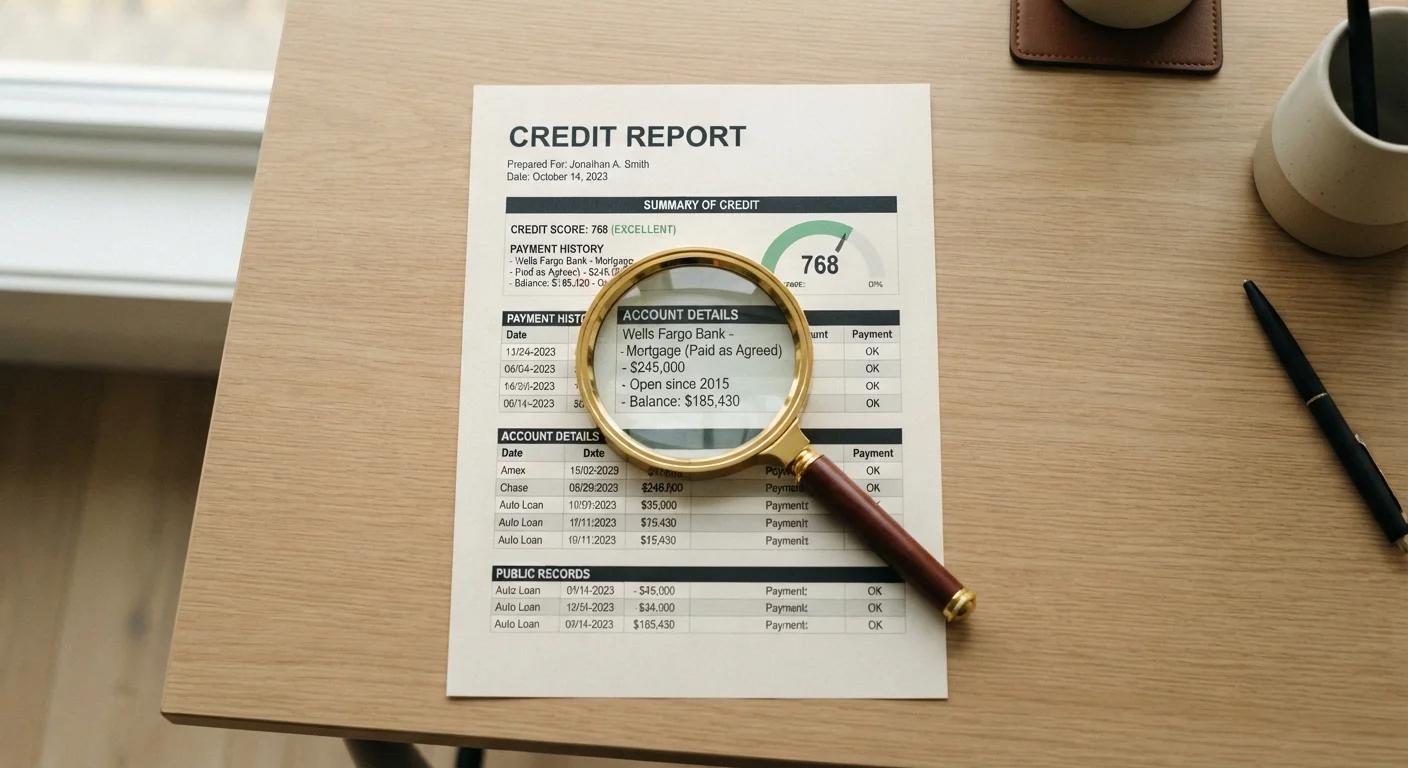
A credit report is essentially a financial biography assembled by a third party. Three national credit bureaus — Equifax, Experian, and TransUnion — collect data from lenders, card issuers, and public records, then organize it into a structured file on you. Lenders pull this file when you apply for a mortgage, car loan, or credit card to decide whether to approve you and at what interest rate.
Critically, a credit report is not the same as a credit score. The report contains the raw facts; the score is a number calculated from those facts by a separate scoring model. To understand your credit score and what it means, you first need to understand what feeds into it — which starts with your report.
Credit bureau
A company that collects and maintains credit information on consumers and provides that data to lenders in the form of credit reports. The three major U.S. bureaus are Equifax, Experian, and TransUnion.
Trade line
Industry shorthand for any individual credit account on your report, such as a credit card, mortgage, or auto loan, including its full payment history.
Hard inquiry
A credit check triggered when you apply for new credit. It is visible to lenders and can temporarily lower your credit score by a small amount.
Credit utilization ratio
The percentage of your available revolving credit (like credit card limits) that you are currently using. Lower utilization is generally viewed more favorably by scoring models.
Charge-off
When a lender writes off a debt as a loss after an extended period of non-payment, typically around 180 days. The debt still exists and can be sold to a collection agency.
The Five Main Sections Explained
Most credit reports follow a consistent structure across all three bureaus. Here's what each section contains and why it matters.
1. Personal Information
This section lists your name, current and previous addresses, date of birth, Social Security number (partially masked), and employer history as reported by lenders. It does not factor into your credit score — but review it for accuracy, since mismatched identifiers can signal a data mix-up or identity theft.
2. Account History (Trade Lines)
This is the heart of your report. Every credit card, mortgage, auto loan, student loan, and line of credit you've opened should appear here. For each account, look for: the creditor's name, account type, date opened, credit limit or original loan amount, current balance, and — most importantly — your payment history. A record of on-time payments is the single most influential factor in most credit scoring models.
3. Public Records
Bankruptcies filed in federal court appear in this section. A Chapter 7 bankruptcy can remain for up to ten years; Chapter 13 for seven. Not all public records appear — civil judgments and tax liens are treated differently across bureaus and have seen reporting rule changes over time, so what you see here may vary.
4. Collections
If a debt was charged off and sold to a collection agency, it typically generates a separate entry here in addition to (or instead of) the original account entry. Collections can significantly affect your score and remain for seven years from the original delinquency date — not from when the debt was sold.
5. Inquiries
There are two types. Hard inquiries are triggered by credit applications and are visible to lenders; they can cause a minor, short-term dip in your score. Soft inquiries — such as checking your own report or pre-approval screenings — don't affect your score and aren't visible to lenders. Hard inquiries generally fall off after two years.
Space Out Your Bureau Reviews
Rather than pulling all three credit reports at once, consider requesting one bureau's report every few months. This way, you're effectively monitoring your credit throughout the year rather than in one annual snapshot. It costs nothing and takes only a few minutes each time.
Red Flags to Look For
Reviewing your report isn't just about understanding it — it's about catching problems. Here are the most common issues to watch for:
- Accounts you don't recognize: An unfamiliar account could indicate identity theft or a bureau data mix-up. Don't ignore it.
- Late payments you disagree with: A payment marked 30, 60, or 90 days late when you paid on time is a reportable error.
- Incorrect balances or credit limits: These can affect your credit utilization ratio — a key scoring factor — even if the account itself is legitimate.
- Duplicate accounts: The same debt appearing twice inflates what you appear to owe.
- Outdated negative items: Items that should have aged off after seven (or ten) years but haven't should be disputed.
If you find an error, you have the right to dispute it. Our guide to disputing errors covers the general process step by step. Inaccurate negative information can unfairly drag your score down and cost you money in the form of higher interest rates.
Don't Confuse Age-Off With Forgiveness
A negative item aging off your credit report doesn't erase the underlying debt if it's still legally owed. Collectors may still attempt to collect. What changes is that the item no longer appears on your report and can no longer affect your credit score. Verify your state's statute of limitations on debt collection separately.
How to Get Your Report and Review It Regularly
Under the Fair Credit Reporting Act (FCRA), you are entitled to free credit reports from each of the three major bureaus. The official, federally mandated source is AnnualCreditReport.com. Be cautious of lookalike sites — the official site does not require a credit card to access your reports.
Because each bureau maintains an independent file, reviewing all three is worthwhile. Accounts or errors that appear on one report may not appear on others. A common approach is to stagger reviews across the year rather than pulling all three at once, so you have more frequent touchpoints.
If you're just starting to build a credit history, understanding your report is part of the foundation. Our guide to building credit from scratch covers the steps commonly used to establish a profile responsibly. And for a broader picture of how credit and borrowing fit into your overall finances, the Credit & Borrowing complete foundation is a useful companion resource.
This article is for general informational and educational purposes only. It is not financial, legal, or credit advice tailored to your individual situation. Consult a qualified financial professional for guidance specific to your circumstances.