

Key Takeaways
Why Accommodation Safety Deserves More Attention
Most travelers invest considerable effort comparing room prices, amenity lists, and star ratings — but safety factors often get a fraction of that scrutiny. This is a meaningful gap. The property you sleep in is where you're most vulnerable: tired, unfamiliar with the layout, and potentially unaware of local emergency procedures.
Safety considerations fall into two phases: what you can assess before you book, and what you should verify the moment you arrive. Both matter. A five-star review score won't tell you whether the smoke detector battery has been replaced, or whether the ground-floor window in your room can be locked from the inside.
The checklist below covers the factors most commonly overlooked by travelers — not the obvious ones, but the details that distinguish a genuinely safe stay from one that only looks safe on paper. For a broader pre-departure safety framework, see our pre-trip safety checklist for travelers.
Locate fire exits before you unpack
On arrival, walk the floor of your accommodation and identify at least two exit routes from your room. Count the number of doors between your room and the nearest stairwell — this helps you navigate in low-visibility or smoke-filled conditions. Note whether fire doors are propped open (a common violation that negates their function) and whether exit signage is illuminated.
In many international destinations, fire safety standards differ significantly from those in the US. Don't assume compliance — observe directly.
Count doors to the nearest exit so you can navigate without visibility if needed.
Test smoke and carbon monoxide detectors
Smoke detectors and carbon monoxide (CO) alarms should be present in every guest room. Press the test button on any detector you can reach. A functioning unit will emit a loud tone. If a detector is missing, has been painted over, or appears tampered with, notify the front desk and request a different room or a replacement device.
Carbon monoxide is colorless and odorless — CO poisoning while sleeping is a documented cause of travel-related injury and death, particularly in properties that use gas heating or have inadequate ventilation. This check takes 30 seconds and is non-negotiable.
CO alarms are as important as smoke detectors — test both immediately after entering your room.
Assess room-door and window security
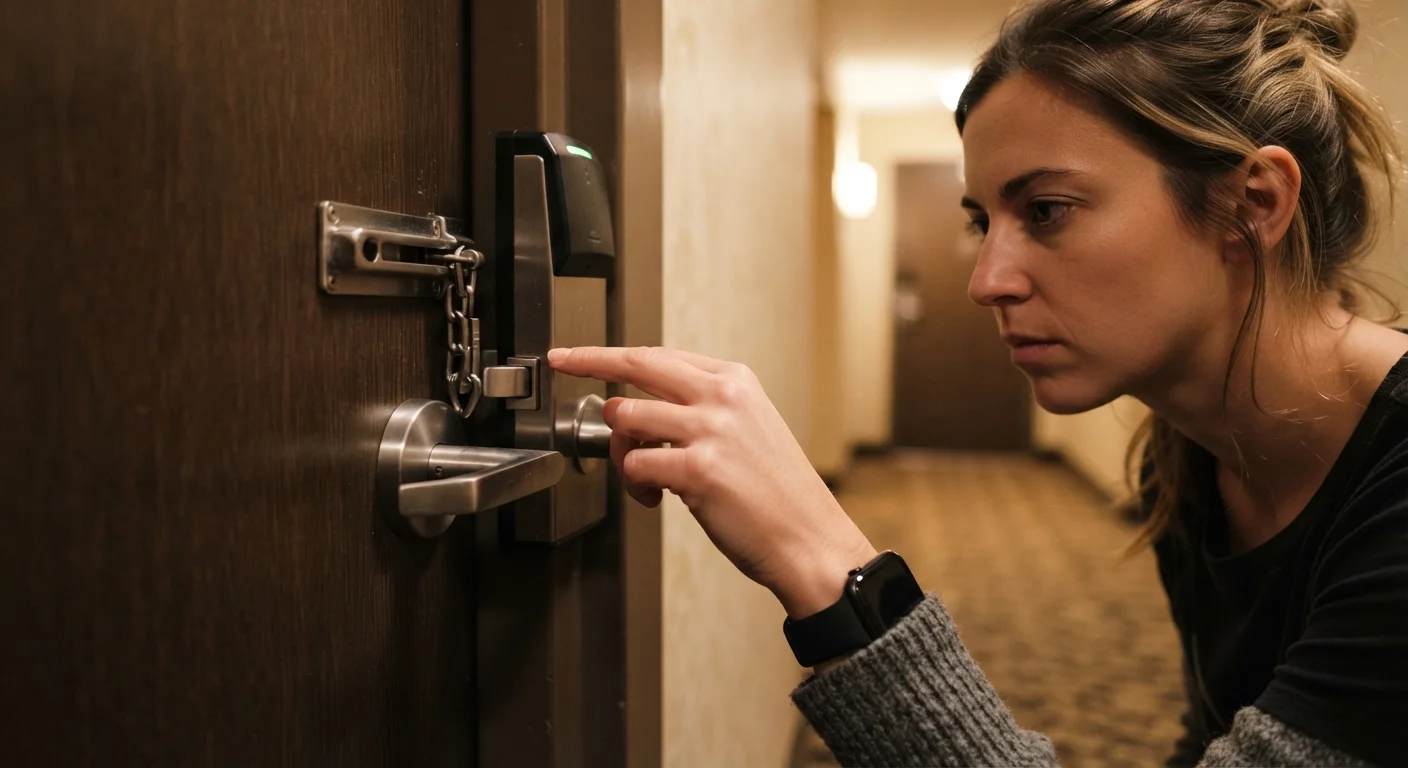
Your room's key card or key is the baseline — not the ceiling. Check whether your door has a secondary deadbolt and a chain or swing bar latch that can be engaged from inside. If it doesn't, a portable door alarm or rubber door stop wedge adds meaningful resistance against unauthorized entry.
Examine windows, particularly on lower floors. Can they be opened from outside? Do they lock securely? Ground-floor and easy-access rooms carry a higher forced-entry risk, especially in properties with limited overnight staffing. Request a higher floor if security is a concern.
A key card alone is a baseline — always engage the deadbolt and secondary latch before sleeping.
Research neighborhood safety before you book
The building itself exists within a neighborhood context. Before booking, use mapping tools to understand what surrounds the property at night — not just during the day when listing photos are taken. Look at walking routes between the accommodation and transit stops, restaurants, or attractions you plan to use after dark.
Travel forum discussions, recent guest reviews, and your government's travel advisory pages can surface patterns that photographs don't show. For deeper guidance on reading unfamiliar environments, our article on situational awareness on the road is worth reviewing before arrival.
Neighborhood conditions at night often differ significantly from what daytime listing photos convey.
Check reviews specifically for safety mentions
When reading guest reviews, filter or search for terms like "safe," "security," "noise," "break-in," or "lock." Patterns in reviews — even indirect mentions — often reveal operational issues that inspection certificates miss. A single incident can appear in a review; a recurring one will appear in several.
Be cautious of properties with no negative reviews or a review gap: an absence of critical feedback is not the same as a clean safety record. Also note whether management responds to safety-related complaints constructively. This signals whether concerns are taken seriously. For a broader look at how common assumptions can lead travelers astray, see our piece on travel safety myths.
Search reviews for safety-specific terms — patterns across multiple guests carry more weight than a single rating.
Confirm in-room safe and valuables storage
In-room safes are common in hotels but not universal in rentals, hostels, or budget properties. If a safe is present, test it before storing anything. Set your own code rather than using any default code that may be documented online. If no safe is available, ask the front desk whether a secure storage option exists at reception.
Avoid leaving passports, cash, or electronics visible in an unattended room. This applies equally whether you're out for an hour or overnight. Housekeeping schedules and maintenance visits mean your room may be accessed while you're away — keep valuables secured regardless of how trustworthy a property appears.
Always set your own safe code — default codes for common hotel safe models are widely documented online.
Making These Checks a Travel Habit
None of these checks require specialist knowledge or extra equipment. Most take under five minutes at check-in. The goal isn't to approach every stay with anxiety — it's to build a reliable routine so that safety assessment becomes automatic, the way experienced travelers naturally note exit locations when they board a plane.
Pack a small personal safety kit
A portable door alarm, a rubber door-stop wedge, and a compact flashlight weigh almost nothing but meaningfully extend your security options in any accommodation type. The flashlight is especially useful for navigating exits during a power outage or fire, where emergency lighting may be insufficient or absent.
If you're staying in a short-term rental or a non-traditional property type, some of these checks become even more important. Unlike hotels, private rentals aren't always subject to the same fire-safety inspections or alarm requirements. Our guide to accommodation options beyond hotels outlines the trade-offs worth weighing. And if you're traveling alone, the solo travel safety guide covers additional precautions relevant to staying independently.
This article provides general travel safety information for educational purposes. Conditions vary widely by destination, property type, and local regulation. Always verify safety details directly with your accommodation provider and consult official government travel advisories before your trip.