

Key Takeaways
Our Verdict
Neither approach wins outright - the right call depends on the task, your skill level, and the tools available to you. DIY is genuinely worthwhile for routine, low-risk maintenance, but professional service is the safer choice whenever safety systems, specialist diagnostics, or major mechanical work are involved. Building a clear sense of where your limits are is the most valuable skill any car owner can develop.
| Best for | Recommended |
|---|---|
| Drivers comfortable with basic tools who want to reduce routine maintenance costs | DIY maintenance |
| Safety-critical repairs, complex diagnostics, or work requiring specialist equipment | Professional garage |
| New owners building confidence and foundational knowledge | Hybrid approach - DIY simple tasks, garage for everything else |
Why the DIY vs. Garage Question Matters
Every car owner eventually faces the same dilemma: is this something I can handle myself, or do I need to book it in? The answer genuinely depends on the job. Getting it wrong in either direction costs you - either unnecessary labor fees for a five-minute task, or a botched repair that creates a bigger problem than the one you started with.
If you're newer to ownership, our introductory guide to understanding your car is a useful starting point before deciding what to tackle. For experienced drivers, this comparison focuses on where the line actually sits - and why it moves depending on the task.
| DIY Maintenance | Professional Garage | |
|---|---|---|
| Cost | Parts cost only; tools may be needed | Labor + parts; can include markups |
| Skill requirement | Low to moderate for routine tasks | Trained for all task types |
| Equipment needed | Basic tools for simple jobs | Specialist tools and diagnostics available |
| Time investment | Variable; learning curve applies | Efficient; familiar with the work |
| Risk level | Low for simple tasks; high if overreached | Low when using a qualified mechanic |
| Warranty implications | May affect warranty if done incorrectly | Documented service history maintained |
| Best suited for | Filters, fluids, wipers, tyre pressure | Brakes, suspension, electrics, timing |
Tasks That Are Genuinely DIY-Friendly
Several routine maintenance jobs require minimal tools, carry low risk, and are well-documented in most owner's manuals. These include:
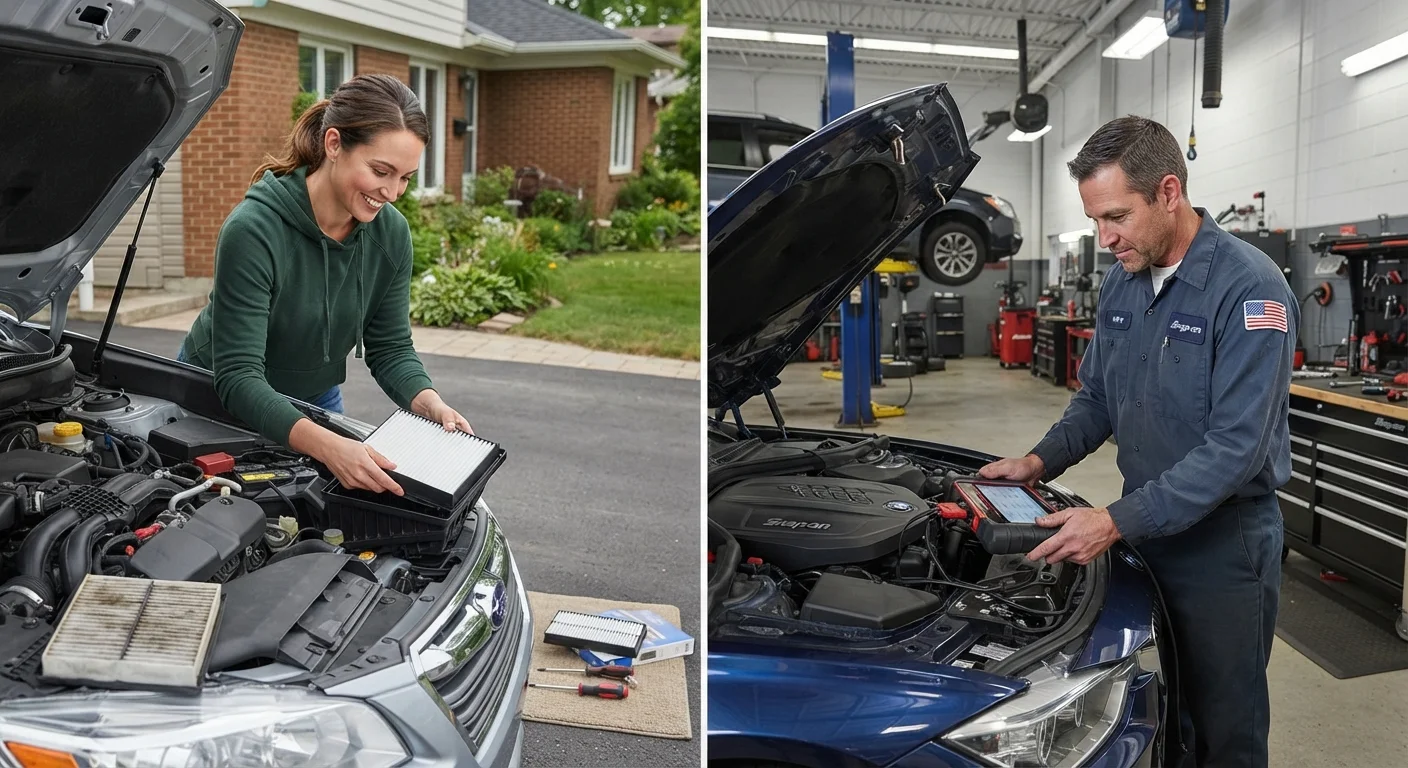
- Engine air filter replacement - typically a clip or screw, no specialist tools needed
- Cabin air filter swap - usually behind the glove box, takes under 15 minutes
- Wiper blade replacement - straightforward clip mechanism, clear instructions on packaging
- Topping up fluids - windshield washer fluid and coolant reservoir top-ups (not full flushes) are safe with basic care
- Tyre pressure checks and inflation - a quality gauge and access to an air line is all you need
These are also the tasks most likely to be missed entirely - see our piece on maintenance tasks new car owners often overlook for a fuller list. Doing these yourself builds familiarity with your vehicle and keeps small problems from escalating.
Check Your Owner's Manual First
Before attempting any maintenance task, consult your vehicle's owner's manual. It specifies the correct fluid types, filter part numbers, service intervals, and torque settings for your exact model. Using the wrong specification - even on a simple job - can cause problems that aren't immediately obvious. Most manuals are also available as free PDFs from the manufacturer's website.
When You Should Always Use a Professional
Some jobs aren't just complex - they're genuinely dangerous to attempt without training, proper equipment, or both. Attempting them without the right background can put you, your passengers, and other road users at risk.
- Brake system work - pad replacement can be a grey area, but anything involving calipers, brake lines, or ABS components needs a qualified mechanic
- Suspension and steering repairs - incorrect reassembly directly affects vehicle handling
- Airbag-related work - airbag systems can deploy without warning and cause serious injury if disturbed improperly
- Emissions and catalytic converter systems - regulated components with legal compliance implications
- Electrical fault diagnosis - modern vehicles use complex, interconnected control modules; guesswork here is expensive
- Timing belts and chains - a mistake can cause engine failure, often without any warning
Don't Let Confidence Outpace Your Knowledge
Watching a video tutorial is useful preparation, but it doesn't account for your specific vehicle, worn or corroded components, or the subtleties a trained mechanic would recognize immediately. If a job involves your braking system, steering, or any safety-critical component, please have it assessed by a qualified professional. Getting it wrong isn't just expensive - it can be dangerous.
For a broader framework on keeping your vehicle safe and reliable over time, the long-term maintenance framework covers servicing intervals and what to prioritise.
The Hidden Costs on Both Sides
DIY isn't always cheaper when you account for the full picture. Tools, replacement parts bought incorrectly (wrong spec, wrong fitment), and time spent diagnosing a problem you ultimately can't fix all add up. Garage costs, on the other hand, can include markups on parts and labor time for straightforward jobs a confident driver could manage in 20 minutes.
The common assumptions that cost owners money piece covers several of the ways drivers quietly spend more than they need to - on both sides of this equation. The most expensive outcome is usually a confident DIY attempt on a job that requires diagnostic equipment or specialist knowledge, turning a £60 garage visit into a £400 repair.
~35%
Of basic maintenance tasks drivers could do at home
Industry estimates suggest a significant share of routine upkeep - filters, fluids, wipers - falls within a capable DIYer's reach with the right guidance.
2-3x
Cost multiplier when a DIY mistake requires professional correction
Mechanics commonly report that incorrect amateur repairs can cost significantly more to undo than the original job would have cost at a garage.
Honest self-assessment is the most important tool in your kit. If you're unsure, a quick consultation with a trusted garage - even just asking whether something is DIY-appropriate - is always worth it.