

Key Takeaways
Why Tyres Deserve More Attention Than They Get
Tyres are the only part of your vehicle actually touching the road. Every steering input, every brake application, every cornering force - all of it passes through four palm-sized patches of rubber. Yet tyre care is one of the most consistently neglected aspects of everyday car ownership.
The good news: most tyre maintenance is simple, inexpensive, and requires no special tools beyond a basic pressure gauge. Understanding the fundamentals puts you in control before something goes wrong, rather than scrambling after it does.
This guide covers the five pillars of tyre maintenance - pressure, tread depth, rotation, alignment, and balancing - in plain language, so you can manage them with confidence. For broader upkeep context, see our long-term maintenance framework for a structured approach to keeping your whole vehicle reliable.
TPMS Is a Warning System, Not a Maintenance Tool
Most vehicles built after 2008 include a Tyre Pressure Monitoring System (TPMS) that illuminates a dashboard warning light when a tyre drops significantly below the recommended pressure. However, TPMS typically triggers only when pressure has already dropped 25% or more below spec. Relying solely on this light means your tyres may have been underinflated for some time before the warning appears. Monthly manual checks catch problems the TPMS will not.
Tyre Pressure: The Most Important Check You're Probably Skipping
Tyre pressure is measured in PSI (pounds per square inch). The correct pressure for your vehicle is printed on a sticker inside the driver's door jamb - not on the tyre sidewall, which shows the maximum pressure the tyre can hold, not the recommended operating pressure.
Underinflation is the more common problem. A tyre that's 8 PSI below spec can run hotter, wear faster on its outer edges, and reduce fuel efficiency. Overinflation causes the centre of the tread to wear prematurely and reduces the tyre's ability to absorb road imperfections.
1-2 PSI
Pressure drop per 10°F temperature fall
The US Department of Energy notes that tyre pressure typically changes by about 1 PSI for every 10°F shift in ambient temperature.
25%
Vehicles with at least one significantly under-inflated tyre
NHTSA vehicle safety surveys have consistently found that a substantial proportion of passenger vehicles on US roads have at least one tyre significantly under-inflated.
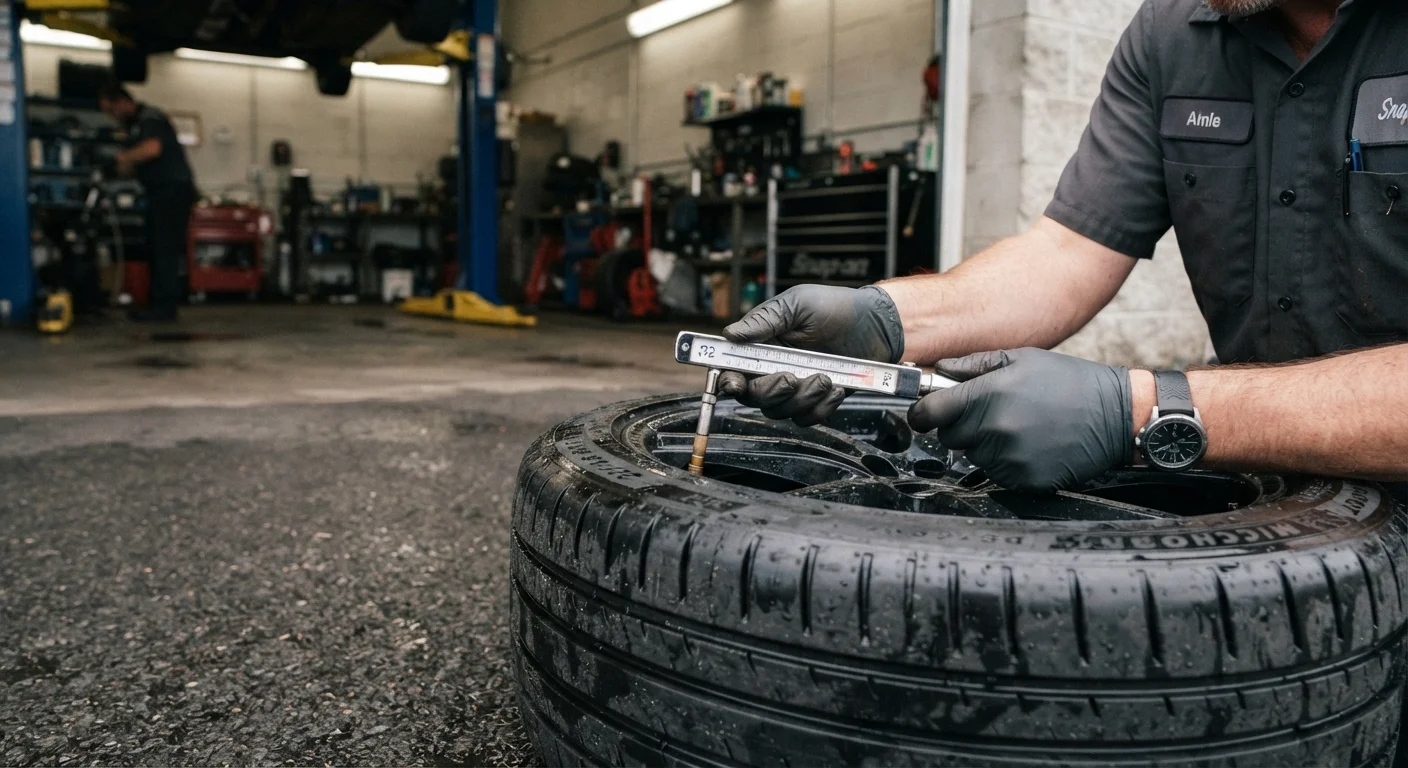
Check pressure when tyres are cold - meaning the car has been parked for at least three hours or driven fewer than one mile. Heat from driving temporarily increases pressure readings. Use a quality gauge (digital or dial-type), unscrew the valve cap, press the gauge firmly onto the valve stem, and read the result.
Buy a dedicated tyre pressure gauge and keep it in the glovebox. Petrol station gauges are notoriously inaccurate from heavy use and exposure to the elements.
Accurate pressure readings depend on a calibrated tool. A personal gauge costs only a few dollars and pays for itself in one corrected tyre check.
Check pressure first thing in the morning before moving the car - this gives you the most accurate cold-tyre reading, especially in seasonal temperature extremes.
Even a short drive heats the tyres enough to raise pressure by several PSI, masking under-inflation that could affect handling and wear.
Don't forget the spare. A flat spare at the roadside is a scenario easily avoided with a 30-second check every few months.
Tread Depth: Reading the Wear on Your Tyres
Tread channels water away from the contact patch, maintaining grip on wet roads. As tread wears down, that ability diminishes - stopping distances increase, and the risk of hydroplaning (where a film of water lifts the tyre off the road surface) rises significantly.
In most US states, the legal minimum tread depth is 2/32 of an inch. Many safety organizations recommend considering replacement at 4/32 - particularly if you drive in wet or winter conditions. A quick check: insert a quarter into the tread groove with Washington's head pointing down. If you can see the top of his head, you're at or below 4/32 and should start planning for replacement.
Don't Wait for the Legal Minimum
While 2/32 inch is the legal threshold in most US states, wet-weather braking performance degrades measurably before tyres reach that point. Studies by tyre safety organizations have shown that tyres at 4/32 inch can require significantly longer stopping distances on wet roads compared to new tyres. If your driving regularly involves rain or light snow, factor this into your replacement timing rather than waiting until the tyre is technically illegal.
Also inspect for uneven wear patterns. Excessive wear on both outer edges suggests chronic underinflation. Centre-only wear points to overinflation. Wear on one edge alone often indicates an alignment issue. These patterns are your tyres communicating a problem - pay attention to them. Our article on common car maintenance myths addresses some widespread misconceptions about how and when tyres actually need attention.
Rotation: Making Your Tyres Last Longer
Front and rear tyres wear at different rates. On front-wheel-drive vehicles, the front tyres handle acceleration, steering, and a larger share of braking - meaning they typically wear faster. Rear-wheel-drive vehicles distribute wear differently, but asymmetry still develops over time.
Rotation moves tyres to different positions on the vehicle according to a pattern recommended in your owner's manual. This distributes wear more evenly, extending overall tyre life. A common guideline is to rotate every 5,000-7,500 miles, though your manual may specify a different interval based on your drivetrain type.
Many drivers pair rotation with oil changes to simplify scheduling. If your tyres are directional (designed to rotate in only one direction, usually marked with an arrow on the sidewall), they can only be swapped front-to-rear on the same side. Your technician will know this, but it's useful to understand the constraint.
Alignment and Balancing: What's the Difference?
These two services are frequently confused because they're often recommended together - but they address different problems.
Wheel Alignment
Alignment refers to the angle at which your tyres make contact with the road. Over time, hitting potholes, curbs, or rough roads can knock your suspension geometry out of spec. Misaligned wheels cause uneven tread wear (often one-sided), can make the steering wheel sit at an angle when driving straight, and may cause the car to pull to one side.
Alignment is adjusted using specialized equipment and is typically recommended annually, or whenever you notice the symptoms above or after a significant impact. It's not a DIY task - it requires a shop with an alignment rack.
Wheel Balancing
Balancing addresses weight distribution around each wheel and tyre assembly. A tiny imbalance - sometimes as little as half an ounce - can cause vibration, particularly noticeable at highway speeds. Technicians use a balancing machine and small counterweights attached to the rim to correct this.
Balancing is usually done during rotation or when a new tyre is mounted. It's a quick and inexpensive step that protects wheel bearings and reduces driver fatigue on longer journeys. For more on overlooked maintenance like this, see maintenance tasks new car owners often overlook.
“Tyre maintenance is the simplest, most cost-effective safety investment a driver can make. Pressure alone accounts for more premature tyre failures than most drivers ever realize.”
— Roger Marble, Retired tyre engineer and widely cited independent tyre safety educator
When to Call a Professional
The checks described above - pressure, visual tread inspection, and general observation - are well within reach of any driver. But some tyre-related situations call for professional assessment:
- Sidewall damage or bulges: A bulge in the sidewall indicates internal structural failure. The tyre should be replaced promptly - do not continue driving on it.
- Persistent pressure loss: If a tyre repeatedly loses pressure, it may have a slow puncture, a faulty valve stem, or a bead leak. A technician can identify the source.
- Vibration that appears suddenly: A new vibration at speed can indicate a lost wheel weight, a separated tread, or a bent rim - all of which require professional inspection.
- Mounting and demounting: Never attempt to seat or remove a tyre from a rim yourself. The forces involved can cause serious injury.
Developing a working knowledge of your tyres makes it easier to spot changes and describe symptoms accurately when you do visit a shop. That's a practical skill that saves time and helps technicians diagnose problems faster. For a broader foundation on understanding your vehicle, our guide on understanding your car from the ground up is a useful companion read.
Your tyres are one of the few vehicle systems you interact with every single drive. A few minutes of attention each month keeps them performing as designed - and keeps you and your passengers safer on the road.
This article provides general informational guidance only. Always consult a qualified automotive technician for assessment, diagnosis, or repair of tyre or vehicle safety issues.