

Key Takeaways
Option A
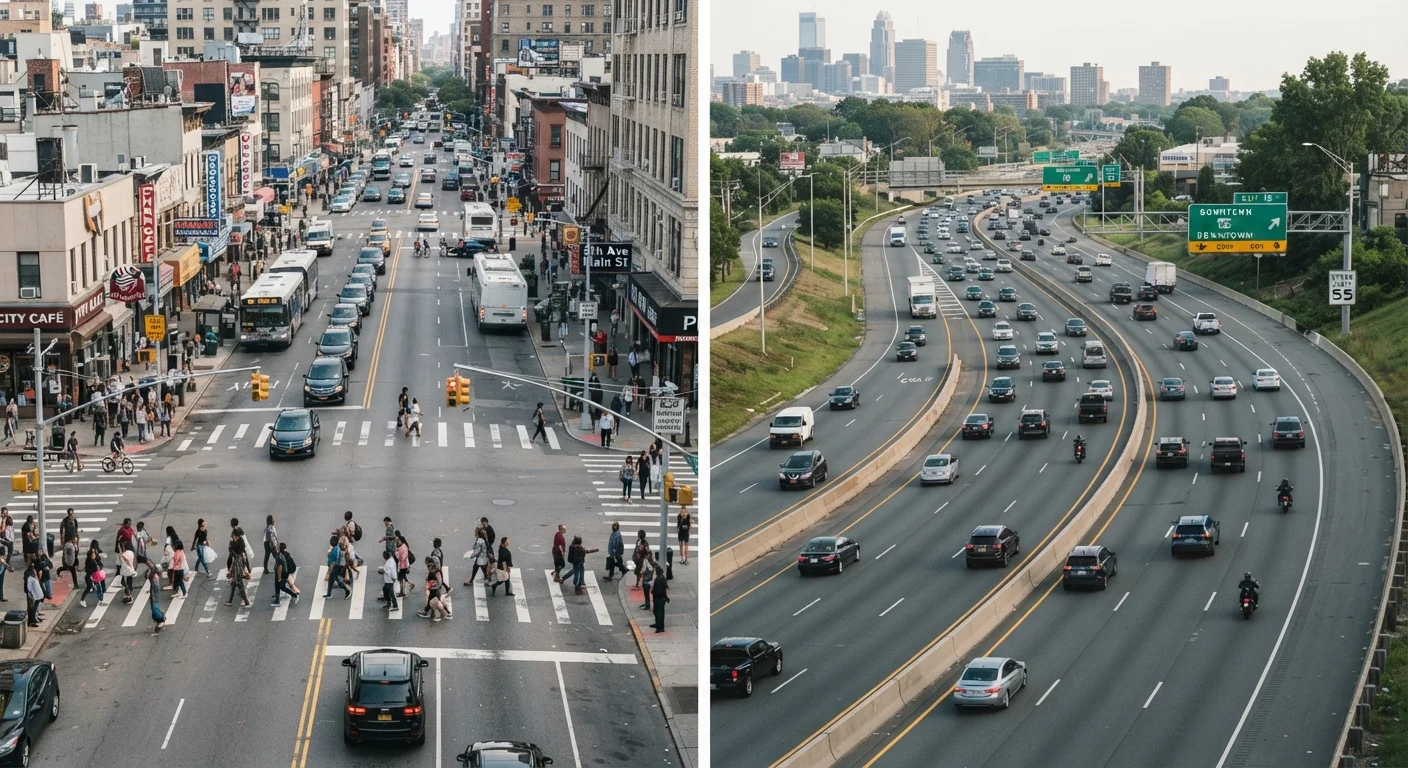
Urban Street Driving
The high-attention, low-speed environment.
Best for: Drivers navigating dense traffic, intersections, pedestrians, cyclists, and unpredictable stop-start conditions.
Option B
Motorway Driving
The high-speed, sustained-focus environment.
Best for: Drivers covering longer distances at consistent speeds with fewer interactions but greater consequences for errors.
If you mostly drive in cities and want to reduce stress and errors
Urban Street Driving
Focusing on urban-specific skills - intersection awareness, pedestrian scanning, and smooth stop-start technique - will have the greatest impact on your daily safety.
If you're a new driver preparing for your first solo motorway run
Motorway Driving
Understanding joining, lane discipline, and safe following distance before you get on the motorway builds the confidence that prevents panic decisions.
If you regularly switch between both environments on a single journey
Urban Street Driving
Transitioning from motorway speeds back to urban roads is where drivers are most likely to underestimate their speed - sharpening your urban awareness first addresses the higher-risk moment.
Why the Same Driver Needs Two Different Mindsets
Most drivers treat driving as a single, unified skill. In reality, urban streets and motorways are distinct operating environments that reward very different habits. A driver who excels in city traffic may feel genuinely unsettled on a fast-moving motorway - and vice versa. Understanding why helps you adapt deliberately rather than relying on instinct alone.
The core difference comes down to decision frequency vs. decision consequence. Urban driving involves dozens of micro-decisions per minute: a pedestrian stepping toward the curb, a parked car with an open door, a cyclist filtering to the front at a light. Motorway driving involves fewer decisions, but each one - a lane change at 70 mph, a merge onto a busy carriageway - carries far greater physical consequences if misjudged.
For a deeper look at how road features like roundabouts and filter lanes fit into the urban picture, see our guide to navigating complex road features.
| Criterion | Urban Streets | Motorways |
|---|---|---|
| Typical speed range | 25-45 mph | 55-75 mph |
| Recommended following distance | 2-second minimum | 4-second minimum (dry) |
| Primary hazard type | Pedestrians, cyclists, intersections | Speed differentials, fatigue, debris |
| Decision frequency | Very high - constant | Lower - but higher stakes |
| Main fatigue cause | Sensory overload | Monotony and speed-induced drowsiness |
| Lane discipline focus | Positioning and junction choice | Travel-lane usage and overtaking rules |
| Mirror check frequency | Every 5-8 seconds | Every 8-12 seconds, plus before all changes |
Speed, Space, and Following Distance
In urban environments, speed limits typically range from 25 to 45 mph, but your actual safe speed is often lower. Parked cars, school zones, bus stops, and crossing pedestrians all compress the space you need to react. A useful habit is scanning roughly 12 seconds ahead - at 30 mph, that's about 175 feet of road - giving you time to identify hazards before they become emergencies.
On the motorway, the same 12-second scan now covers much greater distance. At 65 mph, you're traveling roughly 95 feet per second. The standard two-second following distance used in urban settings is wholly inadequate here. Most driver safety guidelines recommend a minimum four-second gap in dry conditions, extending further in rain or low visibility.
4 sec+
Recommended motorway following gap (dry conditions)
The Highway Code and most driver safety bodies recommend at least a four-second gap at highway speeds, increasing in poor weather.
95 ft/sec
Distance covered per second at 65 mph
At this speed, a one-second reaction delay means you travel nearly the length of a standard semi-truck before braking begins.
Speed limits are also frequently misunderstood. They represent the legal maximum for ideal conditions - not a default target. In heavy rain on a motorway, 55 mph may be far more appropriate than 70 mph. Our article on driving in adverse conditions covers how to adjust your speed and spacing in detail.
Hazard Types and Where to Look
Urban hazards are dense and often unpredictable. Children, cyclists, delivery vehicles double-parking, and drivers reversing out of driveways all require near-constant peripheral awareness. Your eyes should be moving continuously - checking mirrors every five to eight seconds, glancing toward gaps between parked cars, and watching for body language cues from pedestrians about to cross.
Motorway hazards are less frequent but harder to recover from. Debris in the road, a sudden reduction in traffic speed ahead, or a vehicle that has stopped on the hard shoulder all require you to spot them early enough to respond without sharp braking. Avoid fixating on the vehicle immediately ahead - instead, look through it to the vehicles two or three cars forward.
Fatigue is a specific motorway hazard with no urban equivalent. The monotony of sustained highway speeds dulls alertness in ways that stop-start city driving simply does not. If you notice yourself missing exits, losing track of your speed, or feeling heavy-eyed, treat it as a serious warning. Pull off at the next services - do not push through.
If you're driving in an unfamiliar city, the situational awareness habits in our travel safety guide apply directly to your driving decisions.
Lane Discipline and Transitions Between Environments
Urban lane discipline is primarily about positioning - staying clear of the door zone alongside parked cars, choosing the correct lane early at junctions, and not straddling lanes during turns. Mistakes here tend to create friction and minor conflicts rather than high-speed incidents.
On motorways, lane discipline is a safety fundamental. The right lane (in the US context, the left lane on divided highways) is the travel lane; passing lanes are for overtaking only. Sitting in a passing lane when not actively overtaking is a common source of motorway frustration and, in some states, a traffic violation. After overtaking, return to the travel lane promptly.
The transition moment - coming off a motorway back onto urban roads - is where many drivers underestimate their speed. After sustained high-speed travel, 40 mph can feel deceptively slow. Your speedometer, not your perception, should set your pace during this adjustment window. For new drivers facing their first motorway experience, our dedicated motorway guide for new drivers offers practical, confidence-building steps.
Speed Perception After Motorway Travel
Research in driver behavior consistently shows that speed perception becomes distorted after extended motorway driving. What feels like a safe urban speed may actually be well above the posted limit. A practical habit: check your speedometer actively every 30 seconds for the first few minutes after leaving a motorway, rather than relying on how fast the environment feels.