

Key Takeaways
What Situational Awareness Actually Means for Travelers
Situational awareness — knowing what is happening around you and anticipating how it might affect you — is often associated with military or law-enforcement training. In practice, it is a transferable skill that any traveler can develop with deliberate effort.
For everyday travel, it means three things: understanding your environment before you enter it, staying attentive once you're in it, and recognizing early when something feels off. It does not mean being paranoid or treating every stranger as a threat. The goal is informed calm, not anxiety.
Unfamiliar cities amplify risk in subtle ways. You don't know which streets dead-end, where the well-lit routes are, or which areas locals avoid after dark. That information gap is what preparation and attentiveness are designed to close. For a broader foundation on safety knowledge before any trip, see our first-time international travel safety guide.
Awareness Is Not the Same as Suspicion
Situational awareness is sometimes misunderstood as hypervigilance or distrust of locals. In practice, most travelers in most places are safe most of the time. The goal of these habits is to reduce your exposure in the minority of situations that carry real risk — not to approach every interaction with suspicion. Relaxed attentiveness, not anxiety, is the target state.
Before You Arrive: Research That Pays Off
The most effective situational awareness happens before you leave home. Travelers who research their destination in advance make faster, calmer decisions on the ground — because they're recognizing situations they've already thought through, not encountering them blind.
Research neighborhood-level safety conditions, not just city-level reputation
City-level safety ratings obscure significant variation between districts. A city with a moderate overall reputation may have specific neighborhoods that are quite safe and others that warrant more caution at certain times of day. Understanding this granularity allows you to make better routing and accommodation decisions.
Identify local emergency numbers and the nearest consulate or embassy before you land
Emergency numbers vary by country — 911 is not universal — and looking them up in a crisis costs time you may not have. Knowing these in advance, along with the address of your country's consulate, means you can act quickly if something goes wrong.
Plan your first journey from the airport or station before you arrive
Arrival points are high-risk moments: you're likely tired, possibly jet-lagged, visibly new, and carrying your full luggage. Opportunistic theft and scams targeting arrivals are documented at transport hubs globally. A pre-planned route removes the need to navigate openly while disoriented.
Learn a handful of key local phrases relevant to safety and navigation
Even minimal local language competence — knowing how to ask for help, indicate an emergency, or ask someone to stop — reduces your reliance on finding an English speaker in a high-stress moment. It also signals that you are not entirely out of your depth, which can deter opportunistic approaches.
Share your itinerary with a trusted contact at home and check in regularly
If something goes wrong — an accident, a medical emergency, or a situation where you're unable to contact authorities yourself — someone who knows where you planned to be and when you were expected to check in can alert the right people. This is a basic safety net that costs almost nothing to set up.
It's also worth understanding that some common assumptions about safety — such as tourist districts being uniformly safe — can create false confidence. Our article on travel safety myths challenges several widely held beliefs worth reviewing.
On the Ground: Habits That Keep You Alert Without Ruining the Trip
Once you've arrived, sustained attentiveness is less about vigilance and more about simple, repeatable habits. These don't need to dominate your experience — they become second nature quickly.
Solo travelers face a particular version of this challenge. Our guide on solo travel safety covers how situational awareness shifts when you're navigating without a companion.
“The biggest risk factor in unfamiliar environments is the combination of distraction and predictability. When you know roughly what to expect and stay present, you close most of the gap that opportunistic bad actors look for.”
— Security training educators, Personal and travel security awareness instructors
Reading the Environment: Signs Worth Noticing
Situational awareness isn't just about watching people — it includes reading physical spaces. A few environmental cues are consistently useful:
- Lighting: Poor lighting in a route between landmarks is worth noting. Adjust your timing or take a longer but better-lit alternative.
- Foot traffic: A sudden drop in pedestrians, especially in an area that seemed busy, is worth paying attention to.
- Exit routes: In any building — a market, transport hub, or venue — locating the nearest exits when you enter takes seconds and costs nothing.
- Behavioral anomalies: Someone who seems to be tracking your movement, or a cluster of people blocking a natural path, warrants a calm course correction rather than confrontation.
This environmental reading applies equally when driving in unfamiliar cities. Our guide on adapting your driving approach in urban areas covers how city environments demand heightened hazard awareness behind the wheel.
~80%
Of travel theft incidents involve distraction
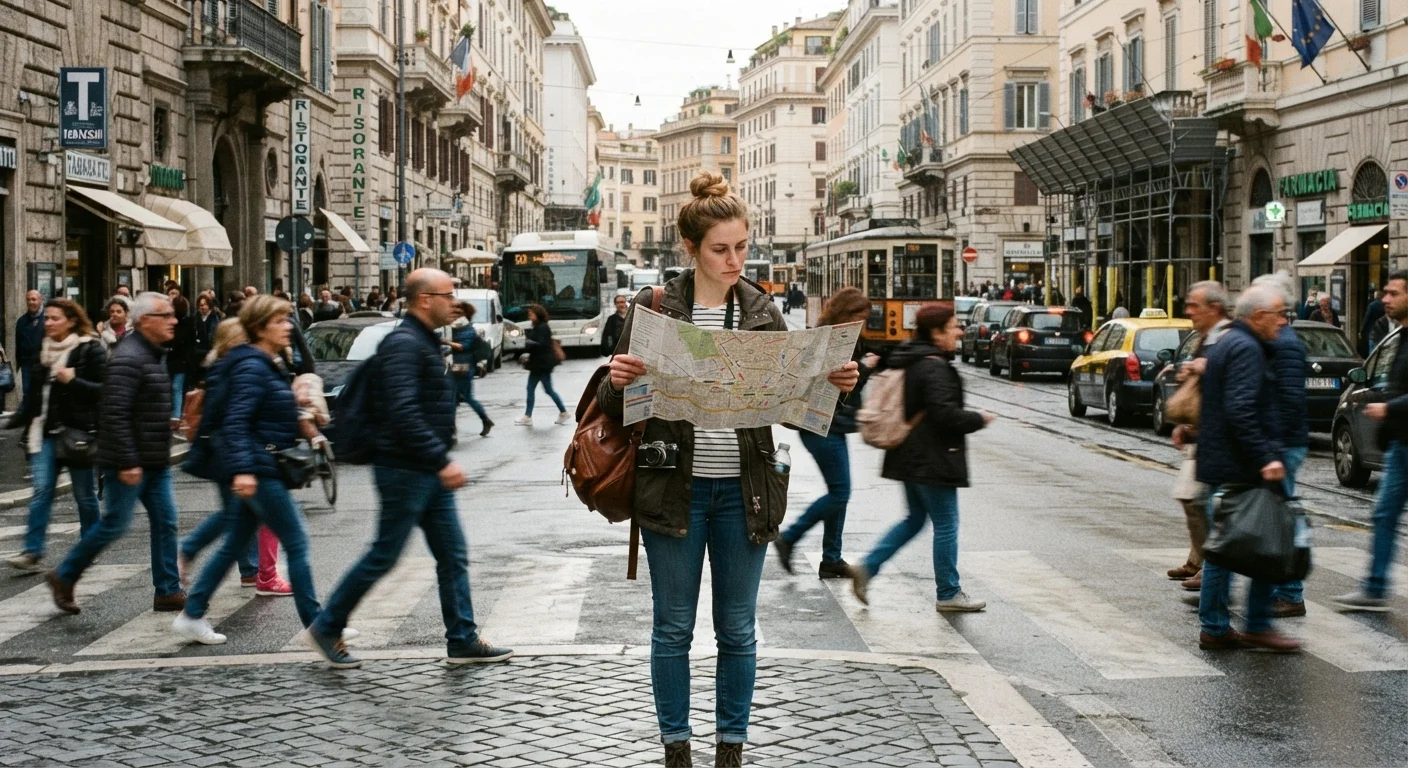
Security awareness trainers and travel safety organizations widely cite distraction — phones, maps, earphones — as the primary enabler in most opportunistic theft situations involving tourists.
Top 3
Risk moments: arrival, transit hubs, crowded markets
Travel safety researchers consistently identify these three scenarios as the highest-risk contexts for pickpocketing and scams targeting travelers in unfamiliar cities.
Managing Your Digital Footprint as Part of Your Safety Routine
Physical awareness alone isn't sufficient in modern travel. Your devices, and what they reveal about you, are part of the risk picture. Checking your phone for directions while stopped on a busy sidewalk, or using public Wi-Fi to access financial accounts, are behaviors that create exposure.
Practical steps include downloading offline maps before you go (so you're not staring at a phone while searching for signal), keeping your device in an inside pocket rather than a back pocket or open bag, and being cautious about what you share publicly about your real-time location on social media.
For a full breakdown of how to protect your data while traveling, see our guide on digital safety while traveling.
Build a Simple Pre-Departure Safety Checklist
Before every trip, spend 15 minutes confirming: local emergency numbers saved, itinerary shared with a home contact, offline maps downloaded, and first-night route planned. This single routine addresses the most common gaps travelers discover only after they've arrived. Consistency matters more than perfection — even a partial checklist is better than none.