

Key Takeaways
Our Verdict
No single type of fat tells the whole dietary story, but the evidence consistently points in one direction: replacing artificial trans fats and limiting saturated fat while increasing unsaturated fat intake is broadly supported by major health organizations. Context — the overall diet pattern and food source — matters as much as any single nutrient.
| Best for | Recommended |
|---|---|
| Everyday cooking oil and dressings | Unsaturated fats (e.g., olive oil, avocado oil) |
| Those managing cardiovascular risk factors | Prioritizing mono- and polyunsaturated fat sources |
| Occasional use in baking or flavor | Saturated fat in moderation within an overall healthy diet |
| Fats to actively minimize or avoid | Artificial trans fats (partially hydrogenated oils) |
Why Fat Type Matters More Than Fat Amount
For decades, dietary fat was treated as a single villain. Low-fat products crowded grocery shelves while public health messaging urged people to cut fat across the board. The science has since grown considerably more nuanced. Today, major health bodies including the American Heart Association and the World Health Organization recognize that the type of fat consumed is more clinically meaningful than total fat quantity in most contexts.
Fat serves genuinely vital functions: it supports cell membrane integrity, enables absorption of fat-soluble vitamins (A, D, E, and K), cushions organs, and provides a sustained energy source. Eliminating it entirely — or replacing it indiscriminately with refined carbohydrates — is not a neutral swap. Understanding the three major categories of dietary fat gives you a practical framework for making food choices grounded in evidence rather than fear.
When scanning packaged food, the nutrition facts panel is your starting point. Our guide to reading nutrition labels explains exactly where fat information appears and how to interpret the numbers.
Saturated, Unsaturated, and Trans Fats: A Side-by-Side Look
Each fat category has a distinct chemical structure that influences how it behaves in the body. Here is how they compare across the criteria that matter most for everyday decisions.
| Saturated Fat | Monounsaturated Fat | Polyunsaturated Fat | Artificial Trans Fat | |
|---|---|---|---|---|
| State at room temperature | Solid | Liquid | Liquid | Solid or semi-solid |
| Primary food sources | Meat, dairy, coconut oil | Olive oil, avocados, nuts | Fatty fish, walnuts, seeds | Partially hydrogenated oils |
| Effect on LDL cholesterol | Raises LDL (generally) | Neutral to slightly reduces | Reduces LDL | Raises LDL significantly |
| Effect on HDL cholesterol | Neutral to slightly raises | Neutral to slightly raises | Varies by subtype | Lowers HDL |
| US regulatory status | Unrestricted; moderation advised | Unrestricted; broadly encouraged | Unrestricted; broadly encouraged | Largely banned (PHOs) |
| Recommended dietary approach | Limit; replace with unsaturated | Include regularly | Include regularly | Avoid where possible |
The table above offers a useful snapshot, but real-world foods rarely contain just one fat type. Olive oil, for example, is predominantly monounsaturated but also contains small amounts of saturated fat. Whole-food context matters alongside individual nutrient content.
Unsaturated Fats: The Broadly Supported Choice
Unsaturated fats divide into two families: monounsaturated (one double carbon bond) and polyunsaturated (multiple double bonds). Both are liquid at room temperature and are found predominantly in plant foods and fatty fish.
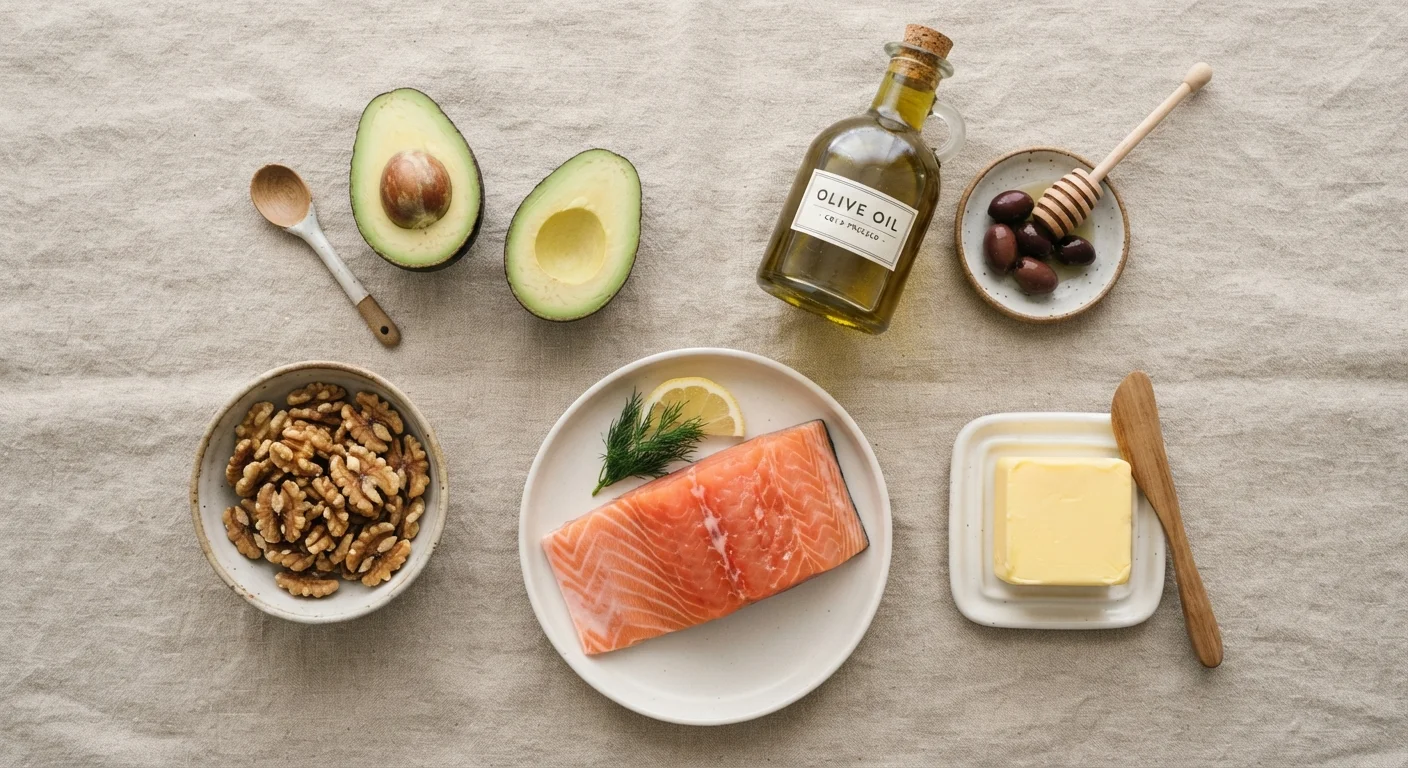
- Monounsaturated fat sources: Olive oil, avocados, almonds, cashews, peanuts
- Polyunsaturated fat sources: Walnuts, flaxseeds, sunflower seeds, fatty fish (salmon, mackerel, sardines), soybean oil
Polyunsaturated fats include the omega-3 and omega-6 fatty acids — both considered essential because the human body cannot synthesize them. Omega-3s in particular, especially the forms found in fatty fish (EPA and DHA), have a substantial body of research linking them to reduced inflammation and cardiovascular benefit. Research consistently associates higher unsaturated fat intake — particularly when it replaces saturated fat — with improved LDL cholesterol profiles.
A Simple Swap Worth Making
One of the most evidence-backed dietary shifts is replacing saturated fat sources with unsaturated alternatives where practical — for example, using olive oil instead of butter for sautéing, or choosing walnuts over processed snack foods. Small, consistent substitutions in cooking habits can meaningfully shift your fat intake profile over time. If you're also tracking hidden added sugars, this kind of ingredient-level awareness compounds the benefit.
Saturated Fat: Moderation, Not Elimination
Saturated fats are solid at room temperature and found primarily in animal-derived foods. Common sources include:
- Red meat (beef, lamb, pork)
- Full-fat dairy (butter, cheese, whole milk, cream)
- Coconut oil and palm oil (plant-based exceptions)
- Processed meats (bacon, sausage)
Long-standing dietary guidance has associated high saturated fat intake with raised LDL (low-density lipoprotein) cholesterol levels, which is a recognized cardiovascular risk factor. The American Heart Association recommends limiting saturated fat to roughly 5–6% of total daily calories for those managing cholesterol, though guidelines vary by organization.
It is worth noting that nutritional research continues to revisit this area. Some studies suggest the relationship between saturated fat and cardiovascular disease is modified by what replaces it in the diet — swapping saturated fat for refined carbohydrates, for instance, does not appear to confer benefit. The overall dietary pattern, not a single nutrient in isolation, is what the evidence most consistently supports.
5–6%
Saturated fat limit for those managing cholesterol
The American Heart Association recommends limiting saturated fat to approximately 5–6% of total daily calories for adults with high LDL cholesterol.
~17%
CVD risk reduction linked to replacing saturated with unsaturated fat
A review published in BMJ found that replacing saturated fat with polyunsaturated fat was associated with a meaningful reduction in cardiovascular disease risk.
Trans Fats: The Category to Avoid
Trans fats come in two forms. Small amounts occur naturally in some animal products (like dairy and beef), and these appear to have a different — and less harmful — physiological profile. The more concerning form is artificial trans fat, produced by partially hydrogenating liquid vegetable oils to make them solid and shelf-stable.
Artificial trans fats appear in older formulations of stick margarine, commercially fried foods, and certain packaged baked goods. Their effect on blood lipids is considered the most unfavorable of any fat type: they raise LDL cholesterol while simultaneously lowering HDL (high-density lipoprotein, the "good" cholesterol). The FDA moved to ban partially hydrogenated oils — the primary source of artificial trans fats — from the US food supply, a process that was substantially completed by 2020.
Even so, US labeling rules allow a product containing less than 0.5 grams of trans fat per serving to be labeled "0g trans fat." If you see partially hydrogenated oil anywhere in an ingredient list, that product contains some artificial trans fat. This is another reason why learning to read beyond the headline numbers on a label pays off — see our explainer on processed vs. whole foods for broader context.
"Zero Trans Fat" Doesn't Always Mean Zero
US FDA labeling rules permit a product to display "0g trans fat" per serving if it contains less than 0.5 grams. If serving sizes are small or you eat multiple servings, intake can add up. Always check the ingredient list for the words "partially hydrogenated oil" as a reliable indicator that artificial trans fat is present, regardless of the front-of-pack claim.
This article is for general informational and educational purposes only and is not a substitute for professional medical or dietary advice. Consult a qualified healthcare provider or registered dietitian for guidance specific to your health circumstances.