

Key Takeaways
Pet Food Label
A pet food label is the regulated set of information printed on every commercial pet food package — including the ingredient list, guaranteed analysis panel, nutritional adequacy statement, and feeding guidelines. In the United States, these labels are governed by standards set by the Association of American Feed Control Officials (AAFCO) and enforced at the state level. Each section tells you something specific about the food's composition and intended use.
AAFCO does not directly approve individual pet food products but publishes model regulations that most U.S. states adopt. Manufacturers must meet AAFCO nutrient profiles or conduct feeding trials to use the term "complete and balanced."
Why Pet Food Labels Are Harder to Read Than They Look
Walk down any pet food aisle and you'll encounter claims like "ancestral diet," "superfood blend," and "vet-recommended formula." These phrases are designed to attract attention, not to inform. The genuinely useful information — the kind regulated by law — is elsewhere on the package, often in small print. Knowing where to look, and what each section actually means, helps you cut through the noise.
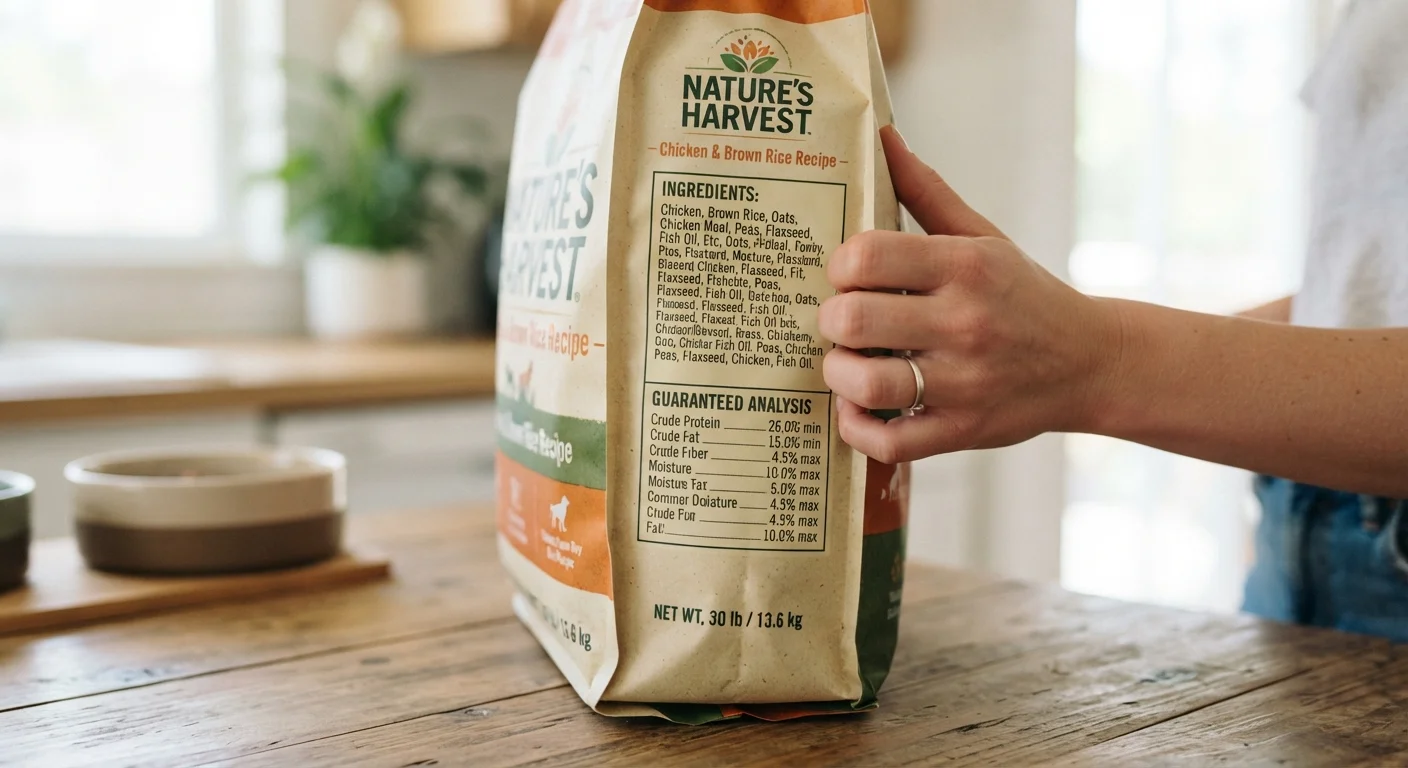
In the U.S., commercial pet food labeling is governed by AAFCO model regulations and state feed laws. This framework requires specific elements on every label: the product name, net weight, ingredient list, guaranteed analysis, nutritional adequacy statement, feeding directions, and manufacturer contact information. Each of these has a defined meaning. The marketing copy does not.
For a broader look at how different diet formats — kibble, raw, wet food, and more — compare overall, see our guide to the pet food landscape.
The Ingredient List: What Order Really Means
Ingredients must be listed in descending order by pre-cooking weight. This means a fresh chicken ingredient listed first may weigh more going in than it does after processing removes moisture. A dry ingredient like chicken meal — which is already dehydrated — may contribute more concentrated protein by the time it reaches the bowl, even if it appears second or third on the list.
This is sometimes called ingredient "splitting" when manufacturers divide a single ingredient type (such as different forms of grain) to push it further down the list. It's worth knowing, though it doesn't automatically signal a low-quality food.
95%
Chicken required if it's the product name
AAFCO naming rules require the named ingredient to make up at least 95% of total content (excluding water) when it appears as the sole product name.
25%
Minimum ingredient for 'dinner' or 'formula' labels
Products named 'Chicken Dinner' or 'Salmon Formula' only require the named ingredient to comprise 25% of the total formulation under AAFCO guidelines.
3%
Minimum for 'with [ingredient]' claims
A pet food labeled 'with Chicken' or 'with Salmon' must contain just 3% of that ingredient by AAFCO rules — a common source of consumer confusion.
Terms like "meat by-products" are also regulated. AAFCO defines these as clean, non-rendered parts such as organ meat — not waste material, as is sometimes claimed. Organ meat is nutrient-dense and commonly used in nutritionally sound diets. Individual ingredient names matter, but no single component determines overall quality.
If you're weighing whether a grain-free label is a meaningful upgrade, our article on grain-free dog food and the science behind it examines what research actually shows.
The Guaranteed Analysis: Minimums, Maximums, and What's Missing
The guaranteed analysis panel lists crude protein (minimum), crude fat (minimum), crude fiber (maximum), and moisture (maximum). These figures are guarantees — legal floors or ceilings — not exact measurements of what's in the bag. Actual nutrient content can be higher for protein and fat, or lower for fiber.
Dry-Matter Basis: A Fairer Comparison
When comparing the protein content of a wet food (70–80% moisture) to a dry kibble (10% moisture), the raw percentages aren't directly comparable. Converting to dry-matter basis removes moisture from the equation. For example, a wet food showing 10% protein with 78% moisture yields about 45% protein on a dry-matter basis — potentially higher than many kibbles. This calculation helps you compare foods more accurately.
Comparing wet and dry foods directly using these percentages is misleading because moisture levels differ dramatically. To make a fair comparison, convert values to a "dry-matter basis" by dividing the nutrient percentage by the percentage of dry matter (100 minus moisture percentage). This levels the playing field.
For a plain-language walkthrough of what each figure in this panel means, see our dedicated guide on reading the guaranteed analysis panel.
The Nutritional Adequacy Statement: The Most Important Line You Might Be Skipping
The nutritional adequacy statement — sometimes called the AAFCO statement — is one of the most information-dense lines on the label, yet many owners never notice it. It does two things: it states which life stage the food is formulated for, and it tells you how that was established.
There are two ways a food can earn this statement. It can be formulated to meet AAFCO's published nutrient profiles, or it can have passed an actual AAFCO feeding trial. Feeding trials involve feeding the food to real animals over a defined period and monitoring health outcomes — a higher bar than calculation alone.
Match the Life Stage Statement to Your Pet
Before buying any new food, locate the AAFCO nutritional adequacy statement — usually near the guaranteed analysis panel — and confirm it lists your pet's life stage. Growth formulas and all-life-stages foods are not interchangeable with adult maintenance foods, particularly for puppies and kittens with higher nutrient demands. When in doubt, ask your veterinarian which life stage designation is appropriate for your individual pet.
Life stage designations include growth (puppies or kittens), adult maintenance, reproduction, or "all life stages." A food labeled for all life stages must meet the highest nutrient minimums in the AAFCO framework. Feeding an adult maintenance food to a rapidly growing puppy can create nutritional gaps. Always match the food's stated life stage to your pet's actual life stage, and confirm with your veterinarian if you're unsure.
You can also explore our broader resource on pet health and care for guidance across all stages of your pet's life.
Marketing Language: What the Front of the Pack Can and Can't Tell You
AAFCO does regulate some product naming conventions — for example, if a product is called "Chicken for Dogs," chicken must make up at least 95% of the total ingredients (excluding water). A "Chicken Dinner" or "Chicken Formula" only requires 25%. A food "with Chicken" needs just 3%. These rules are specific and enforceable.
Other front-of-pack terms have little or no regulatory bite. "Holistic," "premium," "artisan," and "human-grade" are not defined by AAFCO and impose no minimum quality standard. "Natural" has a limited AAFCO definition but allows exceptions for added vitamins and minerals, which are present in nearly all commercial foods.
The practical upshot: treat the front of the package as advertising and the back panel as information. Making decisions based on imagery or buzzwords is less reliable than reading the ingredient list, guaranteed analysis, and adequacy statement together — and then discussing the choice with your vet.
This article provides general educational information about pet food labeling. It is not a substitute for personalized advice from a licensed veterinarian who knows your pet's specific health needs and history.