

| Regulated by | AAFCO model regulations, enforced at the state level |
| Nutrients with minimums | Crude protein, crude fat |
| Nutrients with maximums | Crude fiber, moisture |
| Typical kibble moisture | 10–12% |
| Typical canned food moisture | 75–82% |
| Calories listed separately | Yes — in the "calorie content" statement, not the GA panel |
What the Guaranteed Analysis Panel Actually Is
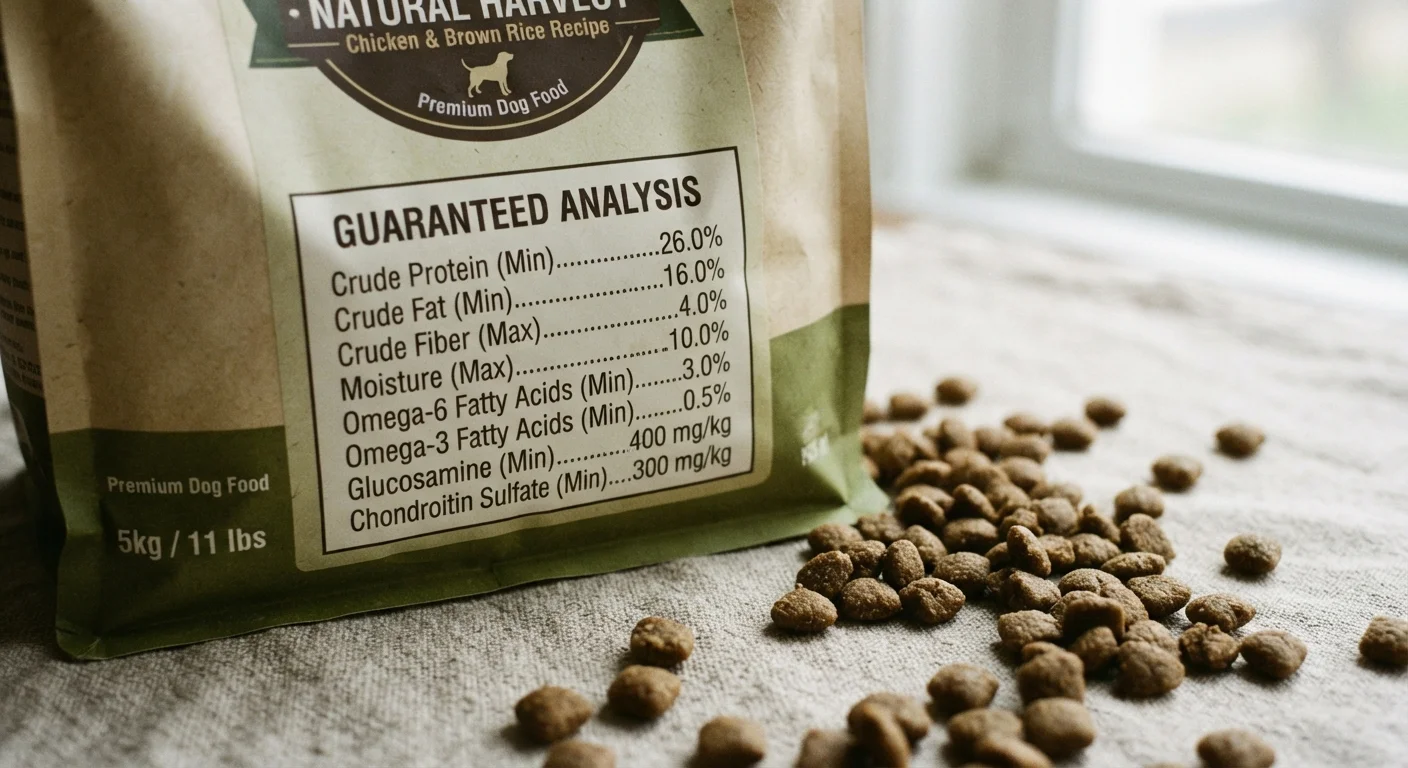
Every bag, can, or pouch of pet food sold in the United States must carry a guaranteed analysis (GA) panel — a standardized block of nutrient data regulated by the Association of American Feed Control Officials (AAFCO) and enforced at the state level. Think of it as a nutrient snapshot: it doesn't tell the full story of a diet's quality, but it gives you a consistent, legally required baseline for comparison.
The panel lists minimum or maximum percentages for key nutrients. Minimums appear for protein and fat (the manufacturer guarantees at least that much). Maximums appear for fiber and moisture (guaranteeing those figures won't be exceeded). This asymmetry trips up many readers — a food is not necessarily better because its crude protein percentage looks high, and it's not automatically poor because its fiber reads low.
For a broader look at how GA panels fit alongside ingredient lists and feeding claims, see how to read the full pet food label.
| Regulated by | AAFCO model regulations, enforced at the state level |
| Nutrients with minimums | Crude protein, crude fat |
| Nutrients with maximums | Crude fiber, moisture |
| Typical kibble moisture | 10–12% |
| Typical canned food moisture | 75–82% |
| Calories listed separately | Yes — in the "calorie content" statement, not the GA panel |
Breaking Down Each Line Item
Understanding what each nutrient term means — and what it doesn't — helps you use the panel as a practical tool rather than marketing noise.
Guaranteed Analysis (GA)
A mandatory panel on regulated pet food packaging that lists minimum or maximum percentages of key nutrients. It provides a legally required baseline but does not fully describe nutritional quality.
Crude Protein
A lab measurement estimating total protein content by detecting nitrogen in the food. "Crude" refers to the measurement method, not ingredient quality or digestibility.
Crude Fat
A lab measurement of total fat content extracted by a solvent process. It reflects calorie density and is listed as a minimum on the GA panel.
Crude Fiber
A measurement of indigestible plant material captured by a specific lab method. It underestimates total dietary fiber because soluble fiber is largely excluded.
As-Fed Basis
Nutrient percentages reported exactly as the food exists in the package, including its water content. As-fed figures make cross-format comparisons (kibble vs. canned) misleading without conversion.
Dry-Matter Basis (DMB)
A calculation that removes moisture from nutrient percentages, allowing accurate comparison of foods with different water contents. Essential when comparing canned and dry foods.
AAFCO
The Association of American Feed Control Officials — a non-governmental organization that develops model regulations for pet food, including the required contents of the guaranteed analysis panel.
Crude protein and crude fat are measured by chemical methods, not by directly counting amino acids or fatty acids. "Crude" signals a measurement technique, not a quality judgment. A food with 30% crude protein on a dry-matter basis isn't necessarily superior to one at 26%; the source, digestibility, and amino acid profile matter just as much as the number.
Crude fiber captures only a fraction of the total dietary fiber in a food because the lab method doesn't fully account for soluble fiber. This means the GA panel can understate how much total fiber a pet actually consumes — a relevant consideration for pets managed for digestive health.
Moisture is perhaps the most misunderstood line. Canned food typically runs 75–82% moisture; kibble usually sits at 10–12%. Because moisture dilutes every other nutrient percentage, comparing a canned food's crude protein directly to a kibble's crude protein is misleading. That's where dry-matter basis conversion becomes essential.
Why Moisture Makes Direct Comparisons Misleading
To compare nutrient levels across food types fairly, nutritionists convert figures to a dry-matter basis (DMB) — essentially removing water from the equation. The math is straightforward:
- Subtract the moisture percentage from 100 to get the dry-matter percentage (e.g., 78% moisture → 22% dry matter).
- Divide the nutrient percentage by the dry-matter percentage and multiply by 100.
Example: a canned food showing 9% crude protein and 78% moisture has a dry-matter protein of roughly 41% — far higher than the as-fed number suggests. Without this conversion, kibble almost always appears to be the higher-protein option simply because it contains less water.
Quick Dry-Matter Conversion Reminder
To convert any as-fed nutrient percentage to dry-matter basis: divide the nutrient % by (100 minus the moisture %) and multiply by 100. For example, 9 ÷ (100 − 78) × 100 = 40.9% dry-matter protein. This single step makes cross-format comparisons valid.
For a deeper dive into how food format affects nutrition, explore the main pet diet types and what research says about each.
What the Panel Cannot Tell You
The guaranteed analysis is a regulatory floor, not a complete nutritional portrait. Several important factors fall outside its scope:
- Digestibility: Two foods can share identical GA numbers yet deliver very different amounts of absorbable nutrients depending on ingredient quality and processing.
- Caloric density: The GA panel doesn't list calories. Check the "calorie content" statement — required separately — to understand energy per cup or can.
- Micronutrients: Vitamins, minerals, and trace elements are not routinely included in the GA, though some manufacturers voluntarily add them.
- Ingredient quality: A high crude-protein figure doesn't distinguish between highly digestible animal proteins and less bioavailable plant-based nitrogen sources.
Before your next vet visit, consider using a structured review of your pet's current diet. The annual pet nutrition audit checklist covers life stage, weight, ingredients, and recent health changes — making your appointment more productive.
~41%
Dry-matter protein in a typical 9% as-fed canned food
Illustrates how moisture dilutes as-fed figures; conversion to dry-matter basis is needed for accurate comparisons.
4 nutrients
Minimum guaranteed analysis requirements under AAFCO model regulations
Crude protein, crude fat, crude fiber, and moisture are the four nutrients every GA panel must include at minimum.
This article provides general educational information about pet food labeling and is not a substitute for personalized veterinary nutritional advice. Consult your veterinarian or a board-certified veterinary nutritionist for guidance specific to your pet's health and dietary needs.