

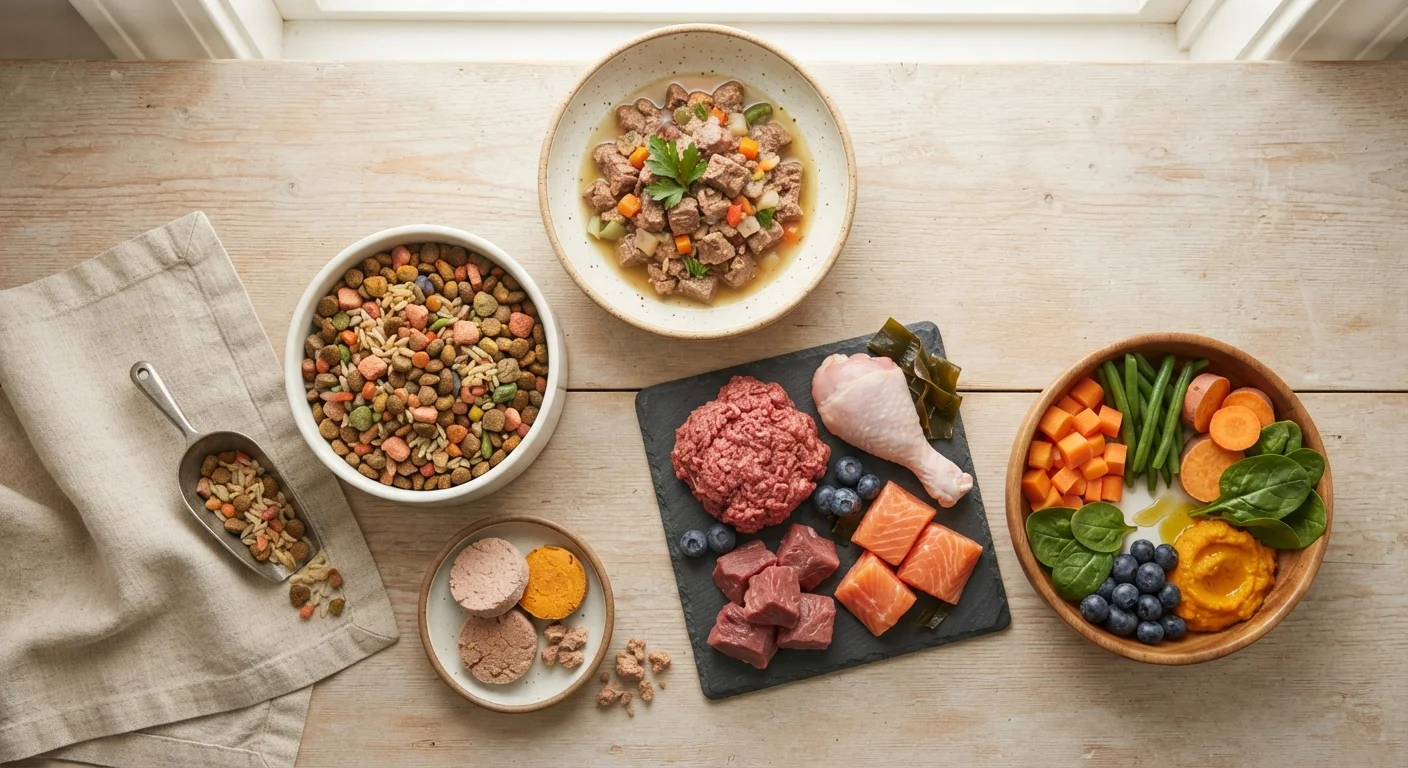
Key Takeaways
Why the Pet Food Debate Is So Noisy
Walk into any pet store and you'll encounter a wall of packaging making confident claims: grain-free, ancestral, biologically appropriate, human-grade. The language is designed to appeal to pet owners who care deeply — which is most of us. But marketing vocabulary and nutritional science are two very different things.
Pet food is a multi-billion-dollar industry in the United States, and it is regulated — but the regulations leave room for interpretation. The Association of American Feed Control Officials (AAFCO) establishes nutrient profiles that serve as the minimum standard for "complete and balanced" claims, but it does not pre-approve products before they reach shelves. This means the burden of evaluation falls, in large part, on the consumer.
This guide cuts through the noise. We map each major diet category — what it is, what the research supports, who it tends to suit, and where the real risks or gaps exist. For guidance on reading the fine print on packaging, see our ingredient list explainer.
70–80%
Moisture content in typical wet pet food
Compared to 6–10% in dry kibble, wet food closely approximates the water content found in whole prey animals.
$50B+
U.S. pet food market annual value
The American Pet Products Association estimates the U.S. pet food and treat market regularly exceeds $50 billion annually, reflecting intense commercial competition.
Most
Home raw recipes failing AAFCO standards
A study in the Journal of the American Veterinary Medical Association found the majority of surveyed home-prepared raw diets did not meet established nutrient profiles.
Dry Kibble: Convenience, Consistency, and Caveats
Dry extruded kibble remains the most widely fed pet food format in the US, and for good reason. It is shelf-stable, calorie-dense, easy to portion, and — when formulated to AAFCO standards — nutritionally complete. For most healthy adult dogs and cats, a quality dry food can meet all essential nutrient requirements.
The extrusion process (cooking ingredients under high heat and pressure) does reduce some heat-sensitive nutrients, which is why reputable formulas add vitamins and minerals back post-processing. This is normal and expected, not a red flag. What matters is the final guaranteed nutrient profile.
Check for the AAFCO Nutritional Adequacy Statement
Before evaluating any other aspect of a kibble label, locate the AAFCO statement. It should specify the life stage the food is formulated for (e.g., "growth," "adult maintenance," or "all life stages") and whether this was established through feeding trials or nutrient analysis. This single line tells you more than any front-of-bag claim. For a full walkthrough of what labels mean, see our pet nutrition labels guide.
The main legitimate criticism of some kibble formulas relates not to the format itself but to ingredient sourcing and the ratio of animal-to-plant protein. Cats are obligate carnivores and have a higher requirement for animal-derived nutrients like taurine and arachidonic acid. A kibble that meets feline AAFCO profiles addresses this, but it's worth verifying — our protein sources comparison explains how different ingredient types stack up.
One honest caveat: dry food's low moisture content (typically 6–10%) can be a concern for cats especially, who have a naturally low thirst drive and may not compensate with enough water intake.
Wet and Canned Food: Moisture as a Nutritional Tool
Wet food typically contains 70–80% moisture, closely approximating the water content of whole prey. For cats prone to lower urinary tract disease or chronic kidney disease, this higher moisture intake can be genuinely beneficial, supporting kidney function and diluting urine concentration. Veterinary nutritionists often recommend wet food as at least a partial strategy for cats with these conditions.
Wet food also tends to be higher in animal protein and lower in carbohydrates than many dry formulas, which aligns well with cats' metabolic needs. For dogs, it can be a useful palatability aid for picky eaters, seniors with dental discomfort, or animals recovering from illness.
The trade-offs: wet food is more expensive per calorie, has a short shelf life once opened, and does not provide the mild mechanical abrasion that some attribute (modestly) to dry food for dental health. Dental hygiene should never rely solely on food format — regular brushing or veterinarian-recommended dental care remains essential.
To understand what the numbers on the label actually mean, our guaranteed analysis panel guide offers plain-language explanations.
Raw Diets: What the Evidence Actually Shows
Raw feeding — typically raw meat, bones, and organs, sometimes with vegetables — has a vocal and passionate following. Proponents argue it mirrors ancestral diets and improves coat condition, energy, and digestion. The reality, as documented in peer-reviewed veterinary literature, is more complicated.
Raw Feeding Carries Documented Pathogen Risks
The American Veterinary Medical Association formally opposes raw protein diets for pets, citing documented risks of bacterial and parasitic contamination. This risk extends to human household members through contact with food, bowls, and pet feces. If you choose to feed raw despite these risks, strict hygiene protocols — including separate food prep surfaces, thorough handwashing, and regular bowl sanitation — are essential, not optional.
On the safety side, multiple studies have identified Salmonella, Listeria, E. coli, and other pathogens in commercially prepared raw pet foods. These bacteria pose risks not only to pets but to the humans handling the food and sharing the household — particularly children, the elderly, and anyone immunocompromised. The American Veterinary Medical Association (AVMA) has formally opposed raw feeding on public health grounds.
On the nutritional side, home-assembled raw diets are frequently imbalanced. A widely cited 2013 study published in the Journal of the American Veterinary Medical Association found that the majority of home-prepared raw recipes — even those from books and websites — did not meet AAFCO nutrient profiles. Calcium-to-phosphorus imbalances and deficiencies in key micronutrients are common without professional formulation.
If a pet owner is committed to raw feeding, working with a board-certified veterinary nutritionist to develop a complete and balanced recipe, and practicing rigorous food-handling hygiene, reduces (though does not eliminate) these risks.
If you're drawn to raw feeding, request that your veterinarian refer you to a board-certified veterinary nutritionist (DACVN) before starting. A professionally formulated recipe dramatically reduces — though does not eliminate — the risk of nutritional imbalance.
Studies consistently show that self-assembled raw diets, including those from published books, frequently miss key micronutrients or have imbalanced calcium-to-phosphorus ratios, which can cause serious long-term harm.
For cats especially, consider making at least a portion of the diet wet food regardless of what dry formula you use. The added moisture intake is one of the most practical and evidence-supported dietary adjustments available.
Cats evolved as desert animals with a low thirst drive and are prone to chronic kidney disease and lower urinary tract disorders — conditions where hydration status plays a meaningful role.
Freeze-Dried, Dehydrated, and Fresh-Cooked Options
Between conventional kibble and fully raw diets sits a growing middle ground of minimally processed formats. Understanding what each involves helps pet owners evaluate claims more critically.
Freeze-Dried
Freeze-drying removes moisture under vacuum at low temperatures, preserving most nutrients without high heat. Importantly, most freeze-drying processes do not reliably eliminate pathogens — so the food-safety considerations of raw feeding still apply. Some manufacturers use high-pressure processing (HPP) as an additional pathogen-reduction step; it's worth checking whether a specific product does.
Dehydrated
Dehydration uses gentle heat over time to remove moisture. Depending on temperature and duration, this may reduce some bacterial load more effectively than freeze-drying, but pathogen elimination is not guaranteed. Nutritionally, dehydrated foods can be excellent when formulated to AAFCO standards and rehydrated properly before feeding.
Fresh-Cooked (Refrigerated or Delivered)
A newer category of subscription-delivered, lightly cooked pet meals has grown significantly. When these are formulated by veterinary nutritionists and meet AAFCO standards, they represent a legitimate option. Cooking does address pathogen concerns that raw formats carry. For those interested in cooking for their pet at home, see our companion piece on homemade pet food nutritional requirements — balance is harder to achieve than it appears.
How to Choose the Right Format for Your Pet
No single diet format is objectively superior for all pets. The right choice depends on a combination of factors specific to your animal and your household.
Key Considerations
- Species and life stage: Cats and dogs have distinct nutritional requirements, and puppies, kittens, adults, and seniors need different nutrient profiles. Our life stage feeding guide outlines how needs shift with age.
- Existing health conditions: Kidney disease, urinary issues, food allergies, obesity, and gastrointestinal sensitivities all influence which format and formulation is most appropriate. Dietary changes for medical conditions should always involve a veterinarian.
- Household safety: If young children, elderly family members, or immunocompromised individuals share the home, raw diets introduce meaningful food-safety risk that should factor heavily into the decision.
- Compliance with AAFCO standards: Regardless of format, look for a statement confirming the food is "complete and balanced" for your pet's life stage. This is the minimum nutrition bar.
- Practical sustainability: A diet you can feed consistently, store safely, and afford over your pet's lifetime is more valuable than an ideal that's logistically unworkable.
When in doubt — or when your pet has specific health needs — a board-certified veterinary nutritionist (DACVN) can provide evidence-based dietary guidance tailored to your animal. Use our annual nutrition audit checklist to prepare for that conversation. And when you're ready to make a switch, our food transition guide helps keep the changeover smooth.
This article is for general informational and educational purposes only and does not constitute veterinary or medical advice. Always consult a licensed veterinarian before making significant changes to your pet's diet, particularly if your pet has an existing health condition.