

Key Takeaways
Uses significantly less water than overhead systems
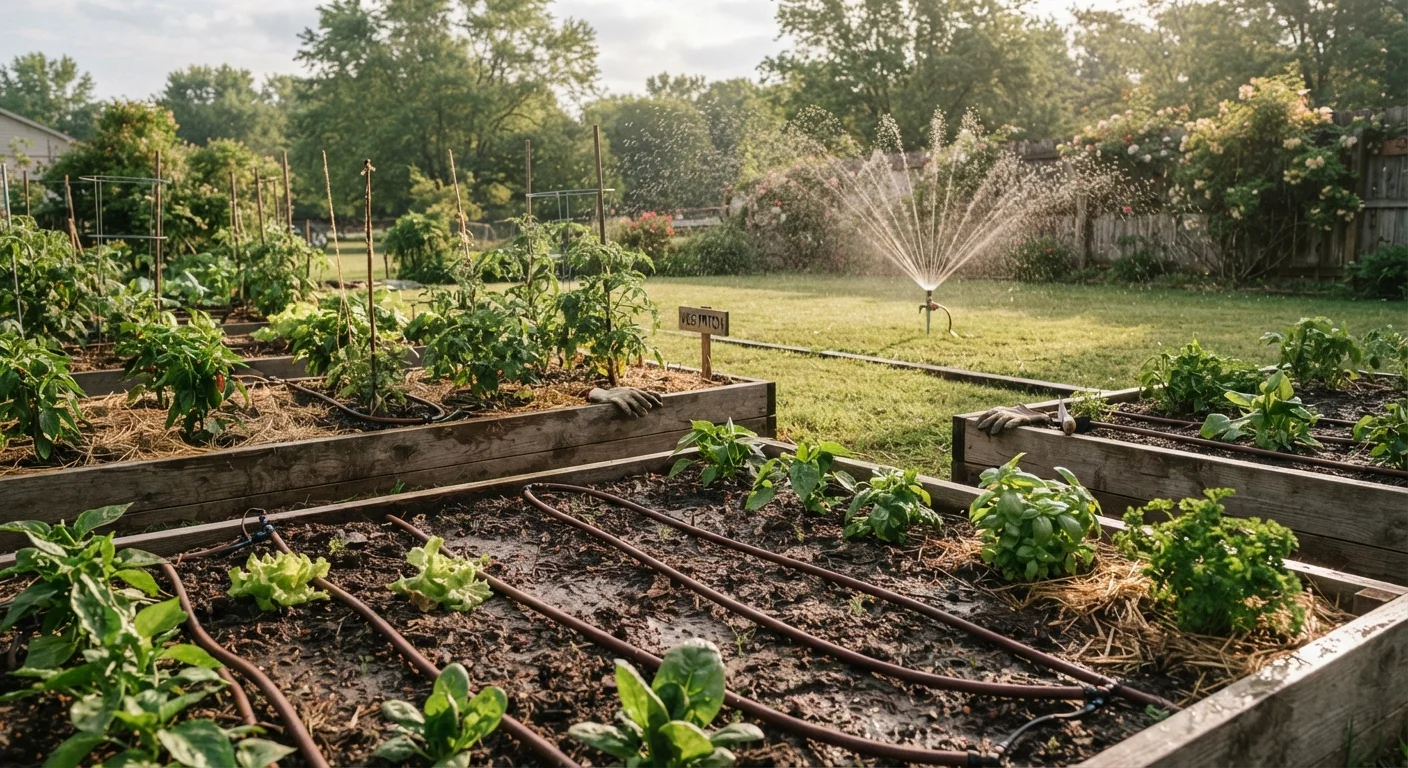
By delivering water at low flow rates directly to the root zone, drip systems minimize evaporation and runoff. Studies from university extension programs consistently find drip irrigation can reduce outdoor water use by 30–50% compared to overhead sprinklers in comparable conditions.
Keeps foliage dry, reducing fungal disease risk
Wet leaves create conditions where mildew and fungal pathogens thrive. Drip emitters bypass the canopy entirely, which is especially beneficial for tomatoes, squash, and other disease-prone vegetables.
Delivers water where plants need it most
Emitters can be placed precisely at each plant's root zone, meaning water isn't wasted on bare soil, paths, or gaps between plants. This precision is particularly useful in beds with irregular spacing.
Reduces weed germination between plants
Because only targeted areas receive moisture, weed seeds in the spaces between plants are less likely to germinate. This can reduce the frequency of weeding over a growing season.
Compatible with slopes and uneven terrain
Low-pressure drip emitters don't rely on even distribution across a spray arc, making them more reliable on hillsides or raised beds where sprinkler coverage tends to be uneven.
Higher upfront cost and more complex to install
Drip systems require emitters, tubing, pressure regulators, and filters — all sized and placed thoughtfully. For a first-time installer, the planning and assembly process takes considerably more time than setting up a basic sprinkler.
Emitters can clog without regular maintenance
Mineral deposits and debris from the water supply can block small emitter openings over time. Flushing lines and checking emitters at the start and end of each season is an ongoing maintenance requirement.
Not well suited for lawns or dense ground covers
Providing even coverage for turf using drip tubing would require an impractically dense grid of lines. Sprinklers remain the standard for lawn irrigation for this reason.
Tubing can be damaged by digging or pests
Surface or shallow-buried tubing is vulnerable to being cut by garden tools, chewed by rodents, or displaced during planting. Damage can be hard to detect if lines are buried.
Our Verdict
Drip irrigation is the stronger choice for water efficiency, targeted plant care, and vegetable or flower gardens where keeping foliage dry matters. Sprinkler systems remain practical for lawns and large, uniformly planted areas where broad coverage is the priority. Many homeowners ultimately use both — drip for beds and borders, overhead for turf.
Drip irrigation suits homeowners with defined garden beds, water-conscious goals, or drought-prone climates; sprinklers suit those maintaining lawns or large open plantings who value quick, low-maintenance setup.
How Each System Actually Works
Understanding the mechanics helps you match the system to your garden's real needs rather than guessing at which one sounds better.
Drip irrigation uses a network of flexible tubing and small emitters — sometimes called drippers or micro-sprayers — to deliver water slowly and directly to the base of individual plants. Flow rates are measured in gallons per hour rather than gallons per minute, which means water seeps into the soil gradually and is absorbed before it can run off or evaporate.
Sprinkler systems (also called overhead or spray irrigation) distribute water through rotating heads or fixed spray nozzles mounted at or above ground level. They cast water across a wide arc, wetting both soil and foliage. Depending on the system, coverage can range from a small pop-up head irrigating a few square feet to a rotor head covering a much larger radius.
Both systems can be connected to a timer or smart controller, but they perform very differently depending on what you're growing and where. See our garden watering myths guide for a closer look at common misunderstandings that affect both system types.
Pros and Cons of Drip Irrigation
Drip irrigation has earned a strong reputation among vegetable gardeners and water-conscious homeowners. Here's an honest look at both sides.
Uses significantly less water than overhead systems
By delivering water at low flow rates directly to the root zone, drip systems minimize evaporation and runoff. Studies from university extension programs consistently find drip irrigation can reduce outdoor water use by 30–50% compared to overhead sprinklers in comparable conditions.
Keeps foliage dry, reducing fungal disease risk
Wet leaves create conditions where mildew and fungal pathogens thrive. Drip emitters bypass the canopy entirely, which is especially beneficial for tomatoes, squash, and other disease-prone vegetables.
Delivers water where plants need it most
Emitters can be placed precisely at each plant's root zone, meaning water isn't wasted on bare soil, paths, or gaps between plants. This precision is particularly useful in beds with irregular spacing.
Reduces weed germination between plants
Because only targeted areas receive moisture, weed seeds in the spaces between plants are less likely to germinate. This can reduce the frequency of weeding over a growing season.
Compatible with slopes and uneven terrain
Low-pressure drip emitters don't rely on even distribution across a spray arc, making them more reliable on hillsides or raised beds where sprinkler coverage tends to be uneven.
On the downside, drip systems have real limitations worth considering before you invest.
Higher upfront cost and more complex to install
Drip systems require emitters, tubing, pressure regulators, and filters — all sized and placed thoughtfully. For a first-time installer, the planning and assembly process takes considerably more time than setting up a basic sprinkler.
Emitters can clog without regular maintenance
Mineral deposits and debris from the water supply can block small emitter openings over time. Flushing lines and checking emitters at the start and end of each season is an ongoing maintenance requirement.
Not well suited for lawns or dense ground covers
Providing even coverage for turf using drip tubing would require an impractically dense grid of lines. Sprinklers remain the standard for lawn irrigation for this reason.
Tubing can be damaged by digging or pests
Surface or shallow-buried tubing is vulnerable to being cut by garden tools, chewed by rodents, or displaced during planting. Damage can be hard to detect if lines are buried.
For mixed garden beds with a variety of plant spacings and sizes — like the kind discussed in our guide to raised beds vs. in-ground planting — drip emitters can be repositioned seasonally as your layout changes, which adds flexibility over time.
When Sprinklers Make More Sense
Overhead sprinklers aren't the water-wasting villain they're sometimes made out to be. In the right situation, they're genuinely the more practical tool.
30–50%
Potential water savings with drip vs. sprinkler
University cooperative extension research consistently finds drip irrigation uses substantially less water than overhead systems in comparable garden settings.
~50%
Of outdoor residential water used on landscapes
According to the U.S. Environmental Protection Agency (EPA), roughly half of residential outdoor water use goes toward landscape irrigation, much of which is applied inefficiently.
Sprinklers are well-suited to lawns, ground covers, and densely planted ornamental beds where individual emitter placement would be impractical. They're also easier to set up for a beginner — most systems require only basic assembly without specialty tubing or per-plant emitter sizing.
That said, overhead watering increases moisture on leaves and stems, which can promote fungal diseases in susceptible plants. Watering early in the morning — rather than in the evening — allows foliage to dry before temperatures drop, reducing this risk.
Timing Matters for Sprinkler Efficiency
Running sprinklers during the early morning — typically between 5 a.m. and 9 a.m. — reduces evaporation loss and gives foliage time to dry before nightfall. Evening watering leaves moisture on plants overnight, which can encourage fungal growth. Many irrigation timers allow you to program specific windows, making early-morning watering easy to automate without adjusting your schedule.
If your household includes a pollinator-friendly planting, it's worth noting that both drip and overhead systems can be compatible with that goal. Our pollinator garden guide covers plant choices that work alongside either irrigation approach.
Choosing Based on Your Garden's Needs
Neither system is universally superior. The right choice comes from mapping your garden's specific characteristics against each system's strengths.
- Vegetable gardens and raised beds: Drip irrigation is generally the better fit. Keeping leaves dry reduces disease risk, and targeted watering supports consistent yields.
- Lawns and ground covers: Sprinklers are typically more practical. Uniform coverage across turf is difficult to achieve with drip tubing, and the disease concern is less significant for grass.
- Mixed flower borders: Either can work, though drip with micro-spray heads gives you flexibility for different plant heights and spacings.
- Water-restricted areas: Drip irrigation's efficiency advantage becomes especially meaningful where water use is metered or subject to seasonal restrictions.
Budget matters too. Drip systems generally involve more components and more installation time, though ongoing water savings can offset that over time. Sprinkler systems, particularly basic oscillating or pop-up designs, tend to have a lower upfront cost and require less planning.
Busy homeowners who want their garden to run with minimal daily effort — drip or sprinkler — can pair either system with a timer. Our article on low-effort home maintenance habits covers how automation fits into a broader time-saving routine. Whatever you grow, pairing your irrigation choice with the right plants pays dividends — see our guide to annuals vs. perennials for help matching plant types to your watering setup.