

Key Takeaways
Gutter System
A gutter system is the network of channels, downspouts, and brackets attached to your roofline that collects rainwater and directs it safely away from your home's walls, foundation, and landscaping. When it works correctly, it's invisible. When it fails, the consequences can reach far beyond the roofline — into your basement, walls, and soil.
Gutters are typically sized to handle a specific flow rate (measured in inches of rainfall per hour per square foot of roof surface). Undersized or obstructed gutters exceed this capacity quickly, causing overflow even in moderate rain.
The Hidden Job Gutters Are Doing 24/7
Gutters don't announce themselves. They hang quietly at your roofline and most homeowners never give them a second thought — until something goes wrong. But a functional gutter system is quietly doing critical work every time it rains: channeling water off your roof, away from your siding, and well clear of your foundation.
Without that redirection, rainwater falls in sheets directly off the roof edge, saturates the soil around your home's perimeter, and begins working against your foundation. Over time, that cycle causes soil erosion, hydrostatic pressure against foundation walls, and eventual cracking or settling. These aren't rare worst-case scenarios — they're the predictable outcome of neglected gutters in virtually any US climate.
As part of a broader approach to exterior upkeep, gutters deserve the same seasonal attention you'd give your HVAC filter or smoke detector. See how they fit into the bigger picture in our guide to exterior maintenance tasks that protect far more than appearances.
~$10,000
Average cost of foundation crack repair
Foundation repair contractors commonly cite water intrusion from poor drainage — including gutter failure — as a leading cause of residential foundation damage.
2x/year
Minimum recommended gutter cleaning frequency
Most home maintenance guidelines recommend cleaning gutters at least twice annually, with additional cleanings for properties with significant tree coverage.
3–4 ft
Minimum downspout discharge distance from foundation
Building and drainage guidelines generally recommend downspouts extend water at least three to four feet from the foundation perimeter to prevent soil saturation.
What Happens When Gutters Get Ignored
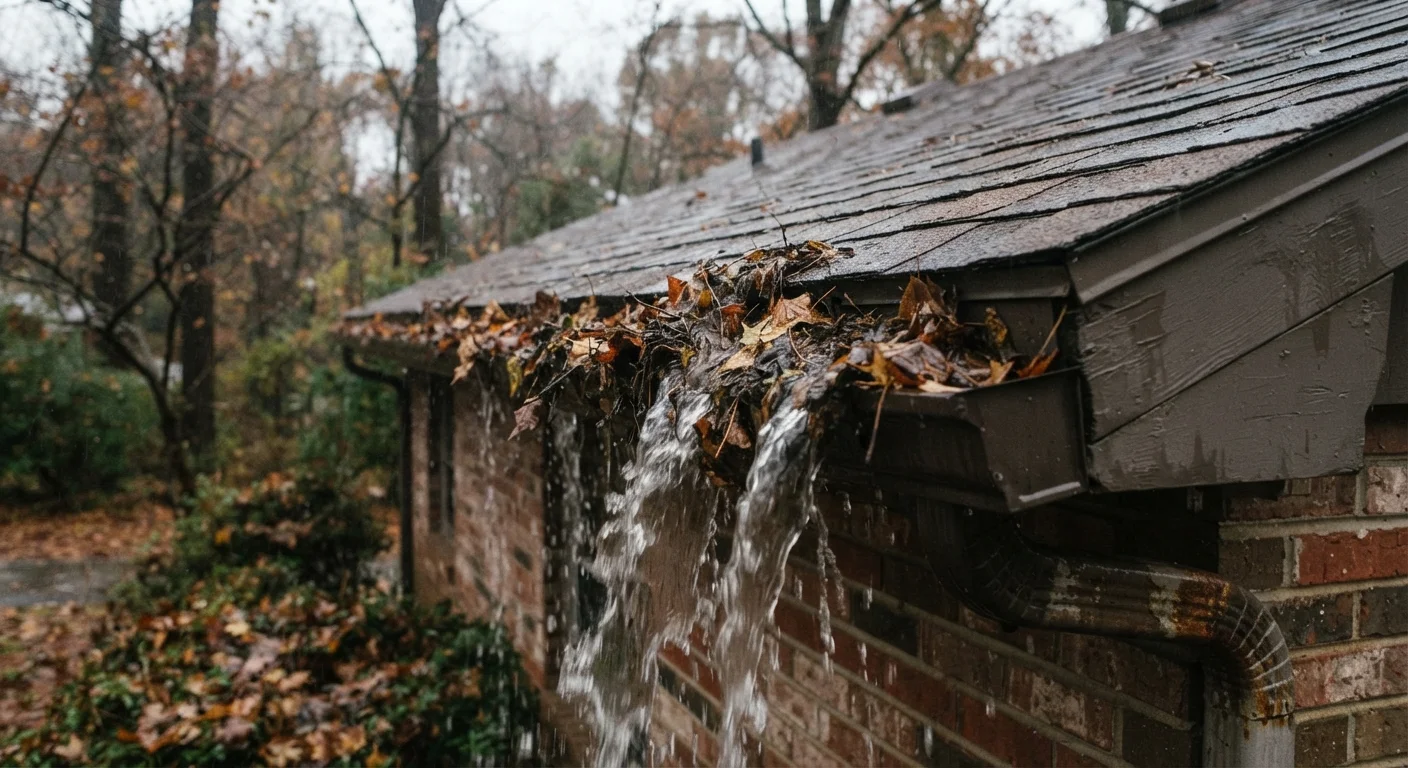
Debris accumulates in gutters faster than most homeowners expect. Leaves, seed pods, shingle grit, and even nesting materials from birds can block water flow within a single season. Once a clog forms, water has nowhere to go but over the edge — or backward under your roofing materials.
The downstream effects are wide-ranging:
- Foundation damage: Pooling water near the base of your home increases soil pressure against foundation walls, which can cause cracking, bowing, or basement water intrusion.
- Roof rot: Water trapped behind a clog can seep under shingles and into the decking, causing rot that spreads silently. This connects directly to broader roof vulnerabilities — see our article on roof maintenance myths that could cost you thousands.
- Fascia and soffit damage: The wooden boards your gutters attach to are vulnerable to prolonged moisture. Once rot sets in, the gutters themselves lose structural support.
- Mold and interior moisture: Water that finds its way into wall cavities or basements creates conditions for mold growth, which is both a health concern and a costly remediation project.
Small problems rarely stay small. The relationship between deferred maintenance and escalating damage is well-documented — our article on what happens when minor maintenance gets ignored explores this pattern in detail.
Check Downspouts After Every Major Storm
After heavy rain, take two minutes to walk around your home and watch where water is going. Gutters overflowing in the middle of a span (not just at the corners) typically signal a blockage, while overflow at the ends suggests a downspout clog. Catching this early costs nothing — ignoring it can cost thousands.
A Simple Gutter Maintenance Routine That Works
Keeping gutters functional doesn't require specialized tools or significant expense — mostly just consistency. Here's a practical seasonal approach:
- Clean twice a year at minimum. Late spring and late fall are the standard benchmarks. If your property has heavy tree coverage, add a midsummer check.
- Flush with a hose after clearing debris. This confirms water flows freely through downspouts and identifies any slow-draining sections that may indicate partial clogs lower in the system.
- Check downspout extensions. Water should discharge at least three to four feet from the foundation. Short or missing extensions are a common and easily corrected oversight.
- Inspect for physical damage. Walk the perimeter after heavy rain to look for overflow, sagging, or sections that have separated from the fascia.
- Look at what's happening inside too. Unexplained water stains in your basement or crawl space can sometimes be traced back to gutter failure. This overlaps with plumbing warning signs homeowners shouldn't ignore — not every moisture problem is a pipe problem.
When to Call a Professional
Cleaning single-story gutters yourself is reasonable for many homeowners. However, if your home is multi-story, the roofline is steep, or you notice structural issues like sagging sections or rotting fascia boards, a licensed contractor should assess the system. Gutter work at height carries real fall risk — don't let a maintenance task become an emergency.
If you're new to home ownership and building out your maintenance routine for the first time, gutters are an ideal starting point — low cost, high impact. Our broader guide for first-time homeowners covers the full scope of what to track and when.