

Key Takeaways
Companion Planting
Companion planting is the practice of growing two or more plant species near each other so that at least one benefits from the arrangement. The goal is usually to deter pests, attract beneficial insects, improve soil, or make better use of garden space. Some pairings have solid research support, while others are rooted in tradition and gardening lore.
In scientific literature, companion planting overlaps with concepts like intercropping, allelopathy (chemical inhibition between plants), and habitat manipulation for biological pest control — each with its own evidence base.
The Real Science Behind Plant Pairings
Companion planting isn't a single mechanism — it's a loose umbrella for several distinct plant interactions, each with a different level of scientific support.
Pest confusion is one of the better-documented effects. Interplanting strongly scented herbs like basil or dill among vegetable crops can make it harder for specialist pests to locate their host plants by smell. Research on intercropping systems consistently shows that visual and chemical diversity in a planting can reduce pest pressure compared to monoculture rows.
Biological pest control through habitat is also well-supported. Flowering plants like dill, fennel, and yarrow attract parasitic wasps and predatory insects that feed on common garden pests. This is closely related to broader pollinator attraction strategies — if you want to draw more beneficial insects into your garden, diverse plantings are one of the most reliable approaches.
Nitrogen fixation by legumes (beans, peas, clover) is perhaps the most straightforward and scientifically solid benefit. Legumes host bacteria in their root nodules that convert atmospheric nitrogen into a soil-available form, which neighboring plants can access — particularly after the legumes are cut and their roots decompose.
“The evidence for companion planting is real but uneven. Nitrogen fixation by legumes is rock solid. Pest deterrence through plant diversity is plausible and often supported. Claims about flavor enhancement or specific repellent effects of herbs are mostly anecdotal and shouldn't be taken at face value.”
— Extension Horticulture Specialists, University Cooperative Extension Programs (general consensus position)
What the Evidence Says About Popular Pairings
Not every popular companion planting claim holds up to scrutiny. Here's an honest breakdown:
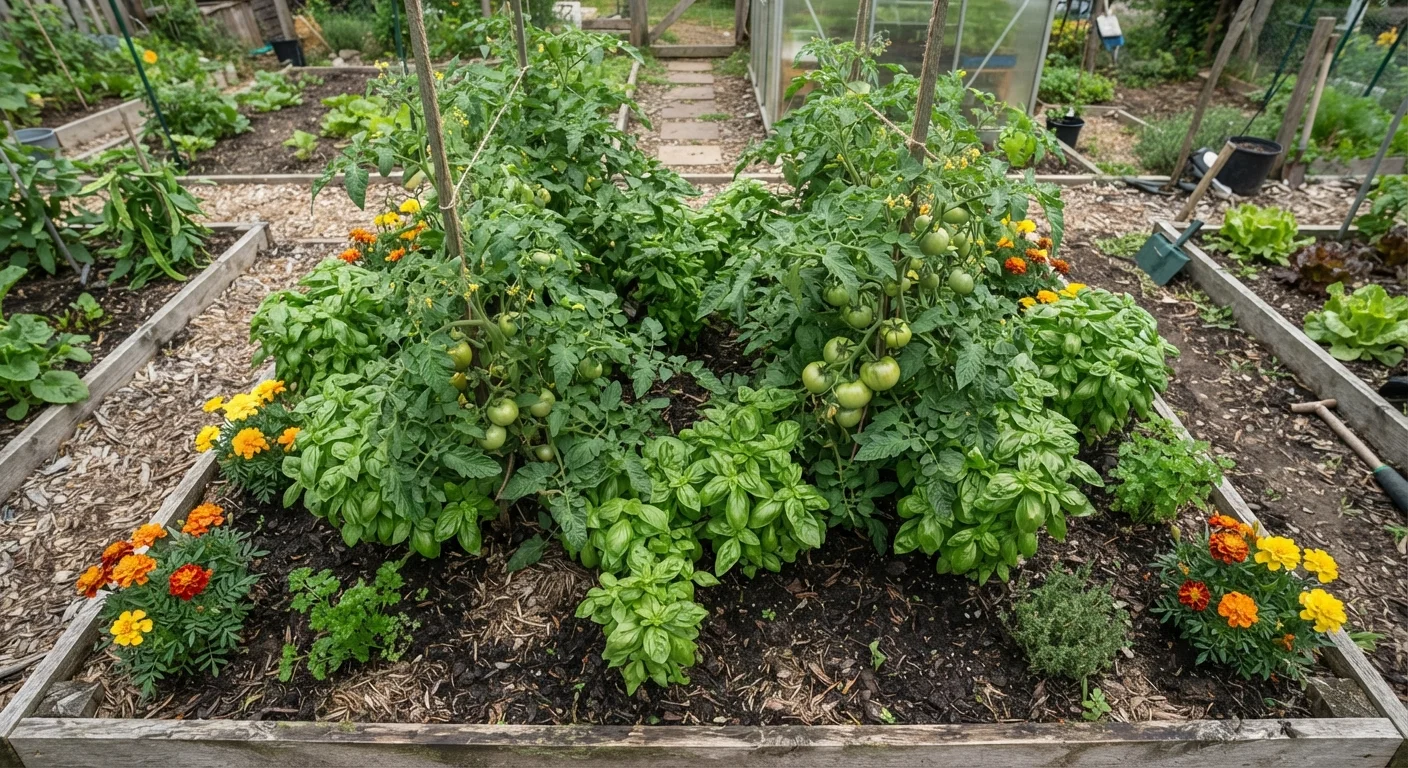
- Tomatoes and basil: Beloved in kitchen gardens everywhere, but the evidence that basil improves tomato flavor or meaningfully repels pests is thin. That said, basil does attract pollinators, and they make excellent neighbors from a space-use perspective.
- Marigolds and vegetables: French marigolds have documented nematode-suppressing properties when planted densely — but the effect requires a full season of mass planting, not just a few border flowers. The insect-repelling claims are more mixed.
- The Three Sisters (corn, beans, squash): This Indigenous agricultural system is among the most well-validated examples of companion planting. Each plant provides a measurable benefit to the system as a whole, and it has been studied by agronomists in controlled settings.
- Garlic near roses: Widely repeated, but controlled evidence is sparse. Anecdotal reports of reduced aphid pressure exist, though garlic's actual impact on pest behavior in garden settings is not well-quantified.
35%
Pest reduction in some intercropping studies
Research published in agricultural journals has found pest pressure can be reduced by roughly 35% in diversified intercropping systems compared to monoculture plots, though results vary widely by crop and pest type.
50–200 lbs
Nitrogen fixed per acre by legumes annually
University extension resources estimate that legume cover crops and edible legumes can fix 50 to 200 pounds of nitrogen per acre per year depending on species, soil conditions, and growing season length.
1 full season
Time needed for marigold nematode suppression
Research on French marigolds (Tagetes patula) indicates that meaningful nematode suppression typically requires dense planting maintained throughout an entire growing season, not just a few border plants.
For pairing decisions, university cooperative extension programs in your region are a more reliable reference than general gardening folklore.
Where Companion Planting Has Real Limits
Understanding where companion planting falls short helps you use it more strategically and avoid disappointment.
Scale matters enormously. Most published research on intercropping is conducted at agricultural scale, not in 4x8 raised beds. Effects that appear in a half-acre trial may not translate to a small home garden where pest populations, airflow, and microclimate are completely different.
Soil health is the foundation, not plant neighbors. If your soil pH is off, or your beds lack organic matter, no companion pairing will compensate. Plants struggling with nutrient deficiencies or compacted soil are more vulnerable to pest and disease pressure regardless of what grows beside them.
Allelopathy cuts both ways. The same chemical interactions that can suppress weeds can harm the plants you're trying to grow. Fennel, for example, is famously inhibitory to many vegetables and should generally be kept separate from the main food garden.
Keep a Simple Garden Journal
Because companion planting results vary so much by location and conditions, your own observations over two or three seasons are among the most useful data you can gather. Note which pairings seemed to reduce pest damage, which plants competed poorly, and what you'd repeat. A simple notebook or phone note works fine.
Finally, companion planting recommendations vary by climate, soil type, and the specific pest pressures in your area. A pairing that works in a Pacific Northwest garden may behave differently in a humid Southern climate or an arid Southwest yard. Treat general advice as a starting point, and observe your own garden over seasons to draw meaningful conclusions.
How to Use Companion Planting Practically
The most useful approach is to layer companion planting into a broader garden strategy rather than treat it as a silver bullet.
Start with pairings that have solid reasoning behind them: legumes for nitrogen, flowering herbs to attract beneficials, dense marigold plantings near susceptible crops. Think about your garden layout — whether you're working with raised beds or in-ground plots affects how much space you have to experiment with mixed plantings.
Combine companion planting with fundamentals that have stronger evidence bases: building soil with compost (see our guide to home composting), rotating crops annually, and choosing plant varieties suited to your region. Thinking about which annuals and perennials to combine can also open up space for plant diversity that supports a healthier overall ecosystem.
Companion planting is genuinely useful — just modestly so. Approached with realistic expectations, it's a low-cost, low-risk way to add ecological complexity to your garden, and in the best cases, it pays off in reduced pest pressure, better pollination, and more efficient use of space.